Death
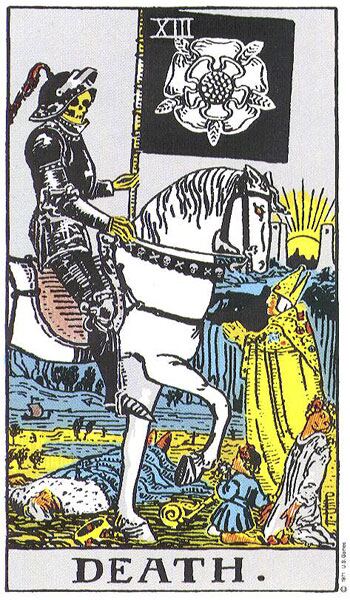
The Death tarot card meaning is about endings, transition, release, and the space created for change—not a literal prediction of physical death. This guide explains how Death can be read in love, work, personal growth, and different spread positions.
Core Symbolism & Themes
Death symbolizes ending, transformation, rebirth. It represents the inevitable closure and new beginning in life, reminding us that death is a natural part of life's cycle. Death is not literal physical death, but the end of a state, relationship, or phase, making room for new possibilities.
Core Themes:
- Inevitable ending and transformation
- Letting go and releasing
- Rebirth and renewal
- A natural cyclical process
The Image as a Sequence of Change
In the Rider–Waite–Smith image, the skeleton rider carries a black banner while figures of different ages respond to his approach. A fallen ruler, a kneeling child, a grieving figure, and a religious intermediary place the same event in different human frames. In the distance, the sun rises between two towers. The image therefore holds ending and continuation together: something has changed irreversibly, but the next form of life is not yet fully known.
This visual sequence is useful when reading Death in a practical question. Rather than asking only “What will end?”, ask what has already become unsustainable, what role or expectation is falling away, and what needs time before it can take shape. The card may describe an external transition, an internal decision, or the recognition that an old arrangement can no longer be maintained honestly.
Upright Meaning
Love
- Singles: May signal the complete end of an old romance, making room for a new relationship
- In a relationship: The relationship may face major transformation; need to release old patterns and welcome new ways of being together
- In marriage: The marriage enters a new phase; may need to release past expectations
Career
- Work environment: Work may undergo major changes such as reassignment, restructuring, or career transition
- Entrepreneurship/Projects: A project may end, but it creates space for new opportunities
- Job seeking: May need to completely change your job-seeking strategy or career direction
Personal Growth
- Psychological level: Need to release old thought patterns or belief systems
- Spiritual level: Undergoing profound transformation, gaining new perspectives and wisdom
- Life stage: Transitioning from one life stage to another
Health
- Physical health: May indicate the need to change unhealthy habits
- Mental health: Need to face and release past trauma or negative emotions
Reversed Meaning
Love
- Resisting change: Unwilling to accept the natural evolution of the relationship, attempting to maintain the status quo
- Unable to let go: Lingering on a finished relationship, blocking new beginnings
- Fear of intimacy: Afraid of the changes a deep relationship may bring
Career
- Resisting reform: Refusing to accept necessary changes in the work environment
- Stagnation: Staying in an unsatisfactory work situation out of fear of change
- Missed opportunities: Missing good career development opportunities due to resistance to change
Personal Growth
- Refusing growth: Unwilling to face necessary personal transformation
- Clinging to old patterns: Holding onto outdated modes of thought and behavior
- Fear of the unknown: Feeling fearful of future uncertainty
Health
- Ignoring problems: Unwilling to face health issues, delaying necessary treatment
- Resisting recovery: Psychologically resisting the recovery process
Common Question Scenarios
"Will I lose my job?"
When Death appears, it may indeed portend major changes in the work environment. But this is not necessarily bad — it may be an opportunity for career transition, guiding you toward a more suitable path.
"Will this relationship end?"
Death suggests the relationship needs profound transformation. This may mean a complete change in the relationship, not necessarily its end. The key is the willingness to release old patterns and welcome new ways of being together.
"How should I face major changes in life?"
Accept that change is natural, and trust that endings bring new beginnings. Focus on what you can control, rather than resisting inevitable transformation.
Death and Other Transformation Cards
Death is often confused with the Tower, the World, or Temperance because all four can describe change. Death focuses on completion, release, and the passage from one state to another. The Tower emphasizes a sudden rupture in a structure or assumption. The World emphasizes integration and the completion of a cycle. Temperance concerns gradual adjustment and the patient combination of elements. These distinctions are not rigid laws, but they help a reader ask a more precise question about the kind of change at hand.
A reversed Death may show resistance, delay, or a transition that is happening internally before it is visible. It does not mean that change is canceled. Look for the attachment that keeps an old pattern in place, and distinguish a necessary pause from an indefinite refusal to act.
Summary & Advice
Death teaches us that endings are an inevitable and necessary part of life. It reminds us to:
- Accept natural cycles — life is a continuous process of endings and beginnings
- Face transformation bravely — change is difficult but often brings growth
- Learn to let go — release what no longer serves us, making room for new possibilities
- Trust in rebirth — every ending contains the seed of renewal
When Death appears, it invites us to face life's transformations with an open heart. Remember, death is not the end but the threshold of transformation. True wisdom lies in understanding: sometimes, we must let certain things die so that new life can bloom.
Waite's 1910 Pictorial Key Entry
Historical source note: The following records A. E. Waite's card-specific divinatory vocabulary from the supplied 1910 edition. It belongs to one early-twentieth-century method, not a universal meaning system or a guarantee. Historical references to illness, marriage, loss, or other high-stakes outcomes are not diagnoses, professional advice, or certain predictions.
- Upright (Waite): End, mortality, destruction, corruption also, for a man, the loss of a benefactor for a woman, many contrarieties; for a maid, failure of marriage projects.
- Reversed (Waite): Inertia, sleep, lethargy, petrifaction, somnambulism; hope destroyed.
Source: A. E. Waite, The Pictorial Key to the Tarot (1910), Part III, § 3.