Eight of Cups
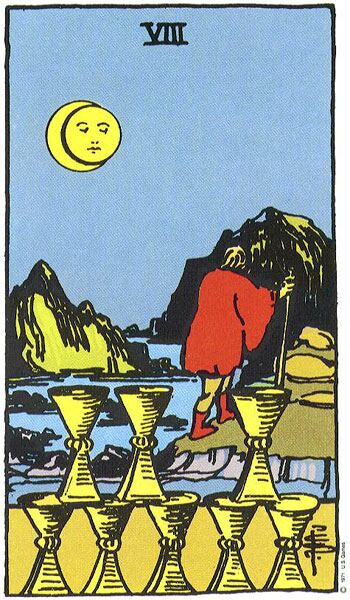
The Eight of Cups tarot card meaning centres on leaving an emotional pattern or situation that no longer offers enough depth. Upright, it can support a conscious departure; reversed, it asks whether you are staying from fear or leaving without direction.
1. Card Imagery (Visual & Symbolic)
In the Rider-Waite tarot system, the Eight of Cups typically presents the following classic image:
- Central figure: A solitary traveler in moonlight, leaving behind eight cups arranged in order.
- The act of leaving: The figure turns his back on the cups, holding a staff, walking toward distant mountains.
- Arrangement of cups: The eight cups are neatly arranged but one is missing, symbolizing imperfect emotional fulfillment.
- Background setting: A river and distant mountains under moonlight, symbolizing the depth of the emotional journey.
- Color symbolism: Blue represents emotional depth, yellow represents hope, gray represents transition.
This is the classic image of the Rider-Waite tarot system, retained consistently in most modern tarot decks.
2. Energy & Element and Archetypes
1. Energy & Element (Elemental & Thematic)
- Element: Water — symbolizing emotion, intuition, the inner journey.
- Number: 8 — symbolizing transformation, cycles, new beginnings.
- Energy type: Emotional awakening, inner exploration, courageous leaving, seeking deeper meaning.
2. Archetypes (Archetypal Origins)
- The Awakener archetype: Represents emotional awakening and the inner calling.
- The Explorer archetype: Associated with inner exploration and the spiritual journey.
- The Departing archetype: Symbolizes the courage to leave the comfort zone.
- The Seeker archetype: Represents the longing for deeper emotional fulfillment.
Points of uncertainty:
Is the leaving of the Eight of Cups always positive? Open to question — leaving itself is neutral, depending on motive and direction.
The clear distinction between the Eight of Cups and The Hermit? Open to question — both involve inner exploration, but with different emphases.
3. Detailed Upright Meaning
Core Meaning:
"The art of emotional awakening and courageous leaving — seeking deeper meaning through inner exploration."
Inner Interpretation:
- Emotional awakening: Recognizing the dissatisfaction of current emotional relationships, longing for deeper connection.
- Courageous leaving: Having the courage to leave the comfort zone, pursuing true inner longing.
- Inner exploration: Delving into the inner world, seeking deeper meaning in life.
- Emotional growth: Achieving emotional growth through leaving, moving toward a higher level.
- Self-discovery: Discovering the true self in a solitary journey.
- Spiritual calling: Responding to the inner spiritual call, following intuitive guidance.
- A new beginning: Ending old emotional patterns, opening a new emotional journey.
Upright in Common Questions:
| Scenario | Interpretation |
|---|---|
| Romantic relationships | Realizing the relationship needs deeper connection, or needing to step away temporarily to reflect. |
| Career | Dissatisfaction with current work, seeking a more meaningful career direction. |
| Personal growth | Inner awakening, beginning deep self-exploration and spiritual growth. |
| Health | Recognizing the need to change lifestyle, pursuing a healthier life. |
| Finance | Reflecting on material pursuits, seeking more meaningful values. |
4. Detailed Reversed Meaning
Core Meaning:
"Emotional awakening is blocked — either evading leaving, or leaving blindly."
Inner Interpretation:
- Evading leaving: Fleeing a necessary departure out of fear, remaining in an unsatisfactory state.
- Blind leaving: Impulsive leaving without careful thought, possibly heading in the wrong direction.
- Inner resistance: Resisting the call to awakening, choosing to maintain the status quo.
- Emotional confusion: Hesitating between leaving and staying, falling into emotional turmoil.
- Self-deception: Deceiving oneself that the current situation is good enough, refusing the opportunity for growth.
- External pressure: Forced to leave by external pressure, lacking inner preparation.
- Lost direction: Losing direction after leaving, lacking a clear goal.
Reversed in Common Questions:
| Scenario | Interpretation |
|---|---|
| Romantic relationships | Afraid to leave a comfortable relationship, or impulsive breakup without thought. |
| Career | Dissatisfied with work but afraid to change, or blindly job-hopping. |
| Personal growth | Resisting the call to inner growth, staying in the comfort zone. |
| Health | Knowing change is needed but lacking the will to act, or blindly trying extreme methods. |
| Finance | Dissatisfied with finances but afraid to change, or risky investment. |
5. Deeper Philosophical and Psychological Meaning
1. The Dialectic of Leaving and Returning
- The Eight of Cups explores the profound theme of leaving the comfort zone to find the true self.
- This resonates with the Daoist wisdom of "governing by non-action" — true action arises from inner calling.
- In modern psychology, this corresponds to the concepts of Self-Actualization and the Inner Journey.
2. The Psychological Process of Emotional Awakening
- The upright Eight of Cups shows healthy emotional awakening — a conscious choice to leave.
- When reversed, it indicates either evading a necessary departure (fear) or leaving blindly (impulse).
- True wisdom requires balancing the courage to leave with the wisdom to return.
Points of uncertainty:
Does the Eight of Cups always represent positive growth? Open to question — leaving may bring new problems.
The connection between the Eight of Cups and modern resignation trends? Open to question — traditional interpretation focuses more on the spiritual level.
6. Interaction with Other Cards (Tarot Combination Reference)
| Combination | Meaning |
|---|---|
| Upright Eight of Cups + Upright The Hermit | A perfect union of deep inner exploration and solitary wisdom. |
| Upright Eight of Cups + Upright The Star | Leaving old patterns to pursue hope and inspiration. |
| Reversed Eight of Cups + Upright The Devil | Remaining in a binding relationship out of fear. |
| Upright Eight of Cups + Upright The Fool | Courageously beginning a new emotional adventure. |
| Reversed Eight of Cups + Upright The Chariot | Inner conflict obstructing necessary action and leaving. |
7. Summary Comparison Table
| Dimension | Upright | Reversed |
|---|---|---|
| Core energy | Emotional awakening, courageous leaving | Evading leaving, blind leaving |
| Emotional tone | Awakening, courage, anticipation | Fear, confusion, hesitation |
| Suggested action | Follow the inner call, begin exploration | Reflect deeply, clarify motive |
| Interpersonal relationships | Seeking deeper connection, temporary leaving | Stagnant relationships, evading problems |
| Self-relationship | Self-discovery, inner growth | Self-deception, growth stagnation |
| Keywords | Awakening, leaving, exploration, growth | Evasion, blindness, confusion, stagnation |
8. Points of Uncertainty Explicitly Noted
The purity of the Eight of Cups' motive for leaving:
→ Open to question. Is leaving always motivated by growth? Evasion may be involved.The connection between the Eight of Cups and modern psychotherapy:
→ Open to question. Traditional interpretation emphasizes intuition, but modern therapy focuses more on rational analysis.The positive role of the Eight of Cups in relationships:
→ Open to question. Is leaving always good for a relationship? It may cause harm.Positive interpretation of the reversed Eight of Cups:
→ Open to question. In some contexts, staying may be the wiser choice.
Conclusion
The Eight of Cups teaches us that true growth comes from conscious leaving and courageous exploration. Upright, it is a guide to emotional awakening and inner exploration; reversed, it is an important signal reminding us to examine our motives and direction for leaving.
In any context, the Eight of Cups says:
"True courage is not leaving blindly, but choosing consciously; true growth is not escaping the present, but pursuing deeper meaning."
This is the most profound revelation of the Eight of Cups: leaving in life is not an end, but the beginning of a new journey.
Waite's 1910 Pictorial Key Entry
Historical source note: The following records A. E. Waite's card-specific divinatory vocabulary from the supplied 1910 edition. It belongs to one early-twentieth-century method, not a universal meaning system or a guarantee. Historical references to illness, marriage, loss, or other high-stakes outcomes are not diagnoses, professional advice, or certain predictions.
- Upright (Waite): The card speaks for itself on the surface, but other readings are entirely antithetical—giving joy, mildness, timidity, honour, modesty. In practice, it is usually found that the card shews the decline of a matter, or that a matter which has been thought to be important is really of slight consequence—either for good or evil.
- Reversed (Waite): Great joy, happiness, feasting.
Source: A. E. Waite, The Pictorial Key to the Tarot (1910), Part III, § 2.