Eight of Swords — Upright and Reversed in Detail
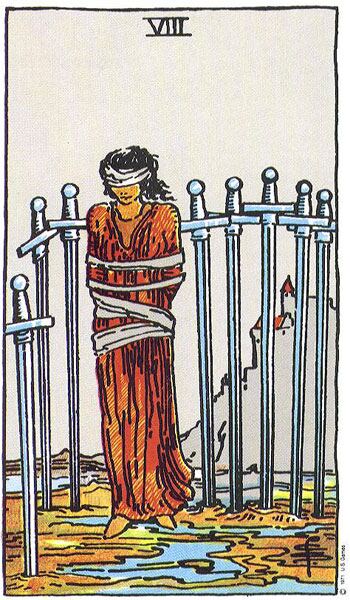
The Eight of Swords tarot card meaning centres on perceived restriction, fear, incomplete information, and the stories that make a choice feel impossible. It can invite a careful search for options and support, not a claim that the person is simply choosing to suffer.
I. Card Imagery (Visual and Symbolic)
The Eight of Swords in the Rider-Waite system typically presents the following classic image:
- Central figure: A blindfolded woman is surrounded by eight swords.
- Bound state: The figure's hands are bound behind her back, symbolizing mental bondage.
- Sword arrangement: Eight swords stand vertically in the ground, forming a cage-like enclosure.
- Environmental background: A gray sky and muddy ground, symbolizing hardship and restriction.
- Distant castle: A castle in the distance symbolizes possible liberation and freedom.
- Color symbolism: Gray represents restriction, blue represents calm, and yellow represents hope.
This is the classic image of the Rider-Waite system, consistent across most modern tarot decks.
II. Energy & Element and Archetypes
1. Energy & Element (Elemental & Thematic)
- Element: Air — symbolizes thought, reason, communication, and judgment.
- Number: 8 — symbolizes restriction, bondage, hardship, and trial.
- Energy type: Mental bondage, self-limitation, awareness of hardship, potential liberation.
2. Archetypes (Archetypal Origins)
- The Prisoner archetype: Represents mental bondage and self-limitation.
- The Victim archetype: Associated with a sense of hardship and powerlessness.
- The Awakener archetype: Symbolizes recognizing bondage and seeking liberation.
- The Tester archetype: Represents the trial of gaining wisdom through hardship.
Points of uncertainty:
Is the bondage of the Eight of Swords always self-limitation? Uncertain—external factors may be at play.
What is the clear distinction between the Eight of Swords and The Devil? Uncertain—both involve bondage, but of different natures.
III. Upright Meaning in Detail
Core Meaning:
"The art of mental bondage and self-limitation, finding a path to liberation through awakened awareness."
Inner Interpretation:
- Mental bondage: Being limited by negative thought patterns, unable to see the truth.
- Self-limitation: Self-imposed limits obstructing growth, fearing to face reality.
- Awareness of hardship: Recognizing the current predicament, but temporarily unable to free oneself.
- Potential liberation: The bondage is not permanent; the possibility of liberation exists.
- Need for help: External help may be needed to break the mental cage.
- Calm thinking: Calm analysis is required of the current situation and limiting factors.
- Inner strength: One possesses inner strength to overcome the current predicament.
Upright in Common Questions:
| Scenario | Interpretation |
|---|---|
| Love & Relationships | Feeling bound by the relationship, yet afraid to change or leave. |
| Career & Wealth | Work is mired in difficulty, feeling restricted and unable to advance. |
| Personal Growth | Limited by negative thought patterns, unable to fulfill potential. |
| Health | Mental stress causing physical discomfort; psychological support is needed. |
| Finance | Financial hardship that feels impossible to break through; fresh thinking is needed. |
IV. Reversed Meaning in Detail
Core Meaning:
"A breakthrough of mental bondage—either liberation begins, or the bondage grows deeper."
Inner Interpretation:
- Liberation begins: Beginning to recognize the bondage and seeking a way to freedom.
- Seeking help: Willing to accept external help to break through limitations.
- Shift in thinking: Changing negative thought patterns, seeing new possibilities.
- Deeper bondage: May sink into deeper mental bondage, refusing to change.
- Evading reality: Choosing evasion over confrontation of the current predicament.
- External intervention: External intervention may be required to break the deadlock.
- Slow progress: Liberation proceeds slowly, requiring patience and persistence.
Reversed in Common Questions:
| Scenario | Interpretation |
|---|---|
| Love & Relationships | Beginning to recognize the relationship's problems, seeking change or counseling. |
| Career & Wealth | Willing to try new methods to break through work difficulties. |
| Personal Growth | Accepting psychological help, beginning to change thought patterns. |
| Health | Seeking professional help to address psychological stress. |
| Finance | Willing to accept financial advice and try new strategies. |
V. Deeper Philosophical and Psychological Significance
1. The Dialectic of Mental Bondage and Free Will
- The Eight of Swords explores the profound theme of how the mind becomes a cage.
- This resonates with the Buddhist wisdom that "the mind is the king of all dharmas"—the mind can create bondage and also create freedom.
- In modern psychology, this corresponds to the concepts of Cognitive Distortions and Self-Limiting Beliefs.
2. The Psychological Process of Bondage Awareness
- The upright Eight of Swords shows the state of being aware of bondage but not yet liberated.
- When reversed, it indicates either the beginning of liberation (awakening) or deeper bondage (evasion).
- True wisdom requires recognizing the mental cage and bravely breaking it.
Points of uncertainty:
Is the bondage of the Eight of Swords always psychological? Uncertain—real-world limitations may exist.
The relation of the Eight of Swords to modern information overload? Uncertain—traditional readings focus more on individual thought.
VI. Interaction with Other Cards (Tarot Combination Reference)
| Combination | Meaning |
|---|---|
| Upright Eight of Swords + Upright The Star | Seeing hope within hardship, beginning to seek liberation. |
| Upright Eight of Swords + Upright The Devil | The double predicament of mental and material bondage. |
| Reversed Eight of Swords + Upright The Sun | Liberation begins, moving toward light and freedom. |
| Upright Eight of Swords + Upright The Tower | External events may shatter the mental cage. |
| Reversed Eight of Swords + Upright The Hermit | Finding a path to liberation through inner reflection. |
VII. Summary Comparison Table
| Dimension | Upright | Reversed |
|---|---|---|
| Core energy | Mental bondage, self-limitation | Liberation begins, seeking help |
| Emotional tone | Powerlessness, confusion, restriction | Hope, attempt, slow progress |
| Suggested action | Analyze calmly, seek help | Act positively, accept help |
| Interpersonal relationships | Feeling bound by relationships | Beginning to communicate and seek change |
| Relationship with self | Self-imposed limits, negative thinking | Shift in thinking, self-awakening |
| Keywords | Bondage, restriction, hardship, powerlessness | Liberation, help, transformation, progress |
VIII. Uncertainties Explicitly Noted
The reality of the Eight of Swords' bondage:
→ Uncertain. Does the bondage truly exist, or is it a psychological projection?The relation of the Eight of Swords to the external environment:
→ Uncertain. Is the hardship entirely self-created? External factors may be at work.The inevitability of the Eight of Swords' liberation:
→ Uncertain. Does awareness of bondage necessarily lead to liberation? More effort may be required.How positive the reversed Eight of Swords is:
→ Uncertain. Is the reversed card always more positive than the upright? It depends on the specific context.
Conclusion
The Eight of Swords teaches us that true freedom comes from recognizing the mental cage and bravely breaking it. When upright, it is a reminder of mental bondage and awareness of hardship; when reversed, it is a signal of beginning liberation and seeking help.
In any context, the Eight of Swords says:
"The greatest cage is in our own mind, and the true key is also in our own mind. Awareness is the first step to liberation; courage is the power to break the cage."
This is the most profound revelation of the Eight of Swords: thought can become the sturdiest cage, but it can also become the freest pair of wings.
Waite's 1910 Pictorial Key Entry
Historical source note: The following records A. E. Waite's card-specific divinatory vocabulary from the supplied 1910 edition. It belongs to one early-twentieth-century method, not a universal meaning system or a guarantee. Historical references to illness, marriage, loss, or other high-stakes outcomes are not diagnoses, professional advice, or certain predictions.
- Upright (Waite): Bad news, violent chagrin, crisis, censure, power in trammels, conflict, calumny; also sickness.
- Reversed (Waite): Disquiet, difficulty, opposition, accident, treachery; what is unforeseen; fatality.
Source: A. E. Waite, The Pictorial Key to the Tarot (1910), Part III, § 2.