Five of Swords — Upright and Reversed in Detail
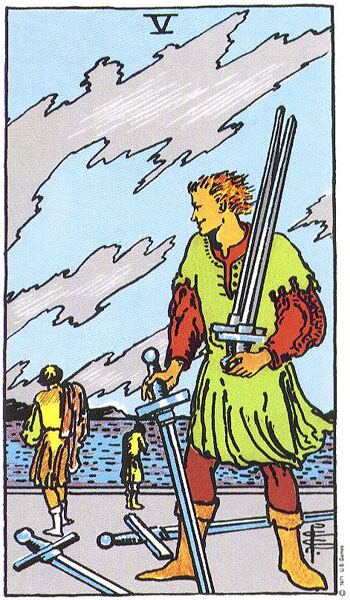
The Five of Swords tarot card meaning highlights conflict, winning at a cost, sharp words, and the question of what remains after an argument. This guide looks at boundaries, repair, and strategic withdrawal rather than treating the card as a fixed prediction.
Card Imagery
Core Keywords: Conflict, victory, cost, isolation, moral dilemma
Card Imagery: The Five of Swords depicts a battlefield scene. A victor holds three swords with a smug expression, while two others depart in dejection, two swords scattered on the ground. The background is a gray sky and barren terrain, symbolizing the emptiness that follows conflict.
Energy & Element: Air element (thought, communication, conflict)
Origins & Archetypes: The Five of Swords derives from the archetype of "the cost of victory," representing triumph gained through improper means or excessive competition, often accompanied by the breakdown of relationships and a moral price.
Upright Meaning in Detail
Basic Reading
- The cost of victory: Although an apparent victory has been won, something more important may have been lost.
- Conflict and confrontation: Tension and contradiction in interpersonal relationships.
- Moral dilemma: Whether victory is worth the price paid.
Specific Scenario Reading
- Work environment: Office politics; fierce competition that may lead to team division.
- Interpersonal relationships: Arguments, debates, and differences of opinion that strain relationships.
- Personal growth: The need to reflect on the true meaning and value of victory.
Deeper Philosophy
The Five of Swords reminds us to consider: what is true victory? Is it victory gained by suppressing others, or the fruits of cooperative win-win outcomes? This card challenges us to redefine the standard of success.
Reversed Meaning in Detail
Basic Reading
- Reconciliation and repair: Reconciliation after conflict; the possibility of repairing relationships.
- Abandoning the struggle: Choosing peace over continued confrontation.
- Moral awakening: Recognizing the cost of victory and choosing a more ethical path.
Specific Scenario Reading
- Work environment: Relinquishing unnecessary competition and seeking cooperative solutions.
- Interpersonal relationships: Apologies, reconciliation, and the rebuilding of trust.
- Personal growth: Learning humility, admitting mistakes, and seeking genuine harmony.
Deeper Philosophy
The reversed Five of Swords symbolizes learning and growing from conflict, recognizing that true strength comes from reconciliation rather than conquest.
Interaction with Other Cards
Combined Reading
- With Five of Wands: Double conflict; fierce competition that may lack substantive meaning.
- With Five of Cups: The combination of emotional loss and victorious conflict produces a strong inner emptiness.
- With Five of Pentacles: The double pressure of material hardship and relational conflict.
Comparative Analysis
Compared with the Two of Swords (evading conflict), the Five of Swords actively engages in conflict but may pay a moral price; compared with the Ten of Swords (total defeat), the Five of Swords achieves victory but may bring long-term harm.
Symbolism in Different Cultures
Western Culture
In Western culture, the Five of Swords resembles the "Pyrrhic victory"—a victory whose cost is so high that one may win the battle but lose the war.
Eastern Philosophy
The Eastern philosophical idea of "non-contention" stands in contrast to the Five of Swords, emphasizing the attainment of true victory through not fighting.
Modern Psychology
Modern psychology links the Five of Swords to "zero-sum thinking," the belief that one party's victory necessarily means the other's defeat.
Summary & Comparison
| Aspect | Upright Meaning | Reversed Meaning |
|---|---|---|
| Conflict handling | Pursuit of surface victory | Seeking genuine reconciliation |
| Interpersonal relationships | May lead to isolation | Repair and rebuilding |
| Moral consideration | May overlook moral cost | Valuing moral worth |
| Long-term impact | Short-term victory, long-term loss | Short-term compromise, long-term harmony |
Uncertainties and Divergent Views
Points of Contention
- The definition of victory: Different schools differ in their understanding of "victory."
- Moral judgment: What constitutes "improper" means is subjective.
- The necessity of conflict: Whether all conflicts are worth engaging in.
Different Schools of Reading
- Traditional Rider-Waite school: Emphasizes the moral cost of victory.
- Modern psychological school: Focuses on the psychological motives behind conflict and ways of resolution.
- Pragmatist school: Places greater weight on practical outcomes than on moral considerations.
Conclusion
The Five of Swords is a card of conflict, victory, and cost. It reminds us that true victory is not merely about defeating others, but more importantly about preserving inner integrity and the harmony of relationships. In the pursuit of our goals, we must weigh short-term benefits against long-term value, and choose a path of victory that meets ethical standards.
Core revelation: The value of victory lies not in conquering others, but in transcending the self and realizing a higher harmony and growth.
Waite's 1910 Pictorial Key Entry
Historical source note: The following records A. E. Waite's card-specific divinatory vocabulary from the supplied 1910 edition. It belongs to one early-twentieth-century method, not a universal meaning system or a guarantee. Historical references to illness, marriage, loss, or other high-stakes outcomes are not diagnoses, professional advice, or certain predictions.
- Upright (Waite): Degradation, destruction, revocation, infamy, dishonour, loss, with the variants and analogues of these.
- Reversed (Waite): The same; burial and obsequies.
Source: A. E. Waite, The Pictorial Key to the Tarot (1910), Part III, § 2.