Five of Wands
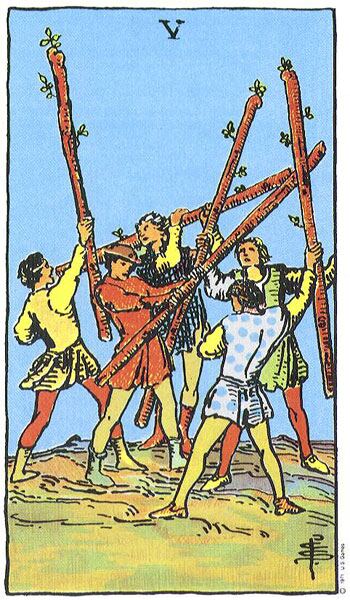
The Five of Wands tarot card meaning centres on friction, competition, creative testing, and the work of finding a useful form for conflicting energy. It can be productive disagreement, but it does not make every conflict worth continuing.
I. Card Features (Visual & Symbolic)
In the Rider-Waite tarot system, the Five of Wands typically presents the following classic image:
- Core Image: Five young people hold wands, engaged in what appears to be a chaotic combat or competition.
- Movement Characteristics: The figures' postures are dynamic and conflicting, wands crossing and waving, symbolizing competition and challenge.
- Setting: Usually in an open field or on a hillside, the sky is clear but the atmosphere tense.
- Clothing Symbolism: Participants wear garments of different colors, symbolizing differing viewpoints and positions.
- Crossed Wands: The wands cross and overlap, forming a complex pattern, symbolizing the complexity and interweaving of conflict.
- Color Symbolism: Red and orange represent passion and conflict, blue represents reason, and green represents growth opportunity.
This is the classic image of the Rider-Waite system and remains consistent across most modern tarot decks.
II. Energy, Element & Archetypes
1. Energy & Element
- Element: Fire — symbolizing passion, action, competition, and energy.
- Number: The 5th card (in the Minor Arcana sequence), symbolizing conflict, challenge, competition, and growth opportunity.
- Energy Type: Competition, conflict, challenge, diversity, vitality tested.
2. Archetypes (Archetypal Origins)
- The Competitor: Represents the competitor and challenger in life.
- The Conflict Mediator: Associated with sports, business competition, academic debate, and other competitive scenarios.
- The Tester of Diversity: Symbolizes the clash and testing of different viewpoints and positions.
- The Growth Catalyst: Represents the promotion of personal growth through challenge and competition.
Open Questions:
Does the Five of Wands always represent negative conflict? Disputed—competition itself is neutral, depending on intent and manner.
What is the clear distinction between the Five of Wands and the Five of Swords? Disputed—different traditions understand the conflict of Fire and Air differently.
III. Detailed Upright Meaning
Core Meaning:
"Healthy competition and challenge, testing strength and promoting growth through conflict."
Inner Interpretation:
- Competition and Challenge: Facing healthy competition and challenge, testing ability and strength.
- Clash of Diversity: The collision of different viewpoints and positions, generating creativity and vitality.
- Team Dynamics: Interaction and competition within a team or group, promoting collective growth.
- Energy Release: The release of pent-up energy, finding an outlet through competition.
- Skill Testing: Testing of ability and skill, revealing strengths and weaknesses.
- Expression of Passion: Expression of enthusiasm and drive, full of vitality and engagement.
- Growth Opportunity: Through challenge, gaining important learning and growth opportunities.
Common Question Scenarios (Upright):
| Scenario | Interpretation |
|---|---|
| Love & Relationships | Healthy competition and discussion in the relationship, promoting mutual understanding and growth. May involve disagreement but is beneficial. |
| Career Development | Workplace competition or project challenge, testing professional ability, promoting career growth. |
| Personal Growth | Facing personal challenges, discovering one's potential and shortcomings through competition. |
| Health | A test of physical vitality; may need more exercise or competitive activity. |
| Finance | Investment or business competition, requiring active participation in the market. |
IV. Detailed Reversed Meaning
Core Meaning:
"Conflict out of balance—either evading competition, or conflict escalating."
Inner Interpretation:
- Conflict Escalation: Competition turns into real conflict, out of control.
- Evading Challenge: Fear of competition or challenge, choosing evasion or retreat.
- Internal Friction: Internal consumption and wasted energy, meaningless struggle.
- Team Division: Strife and division within the team, affecting cooperation.
- Malicious Competition: Unhealthy competition, with malice or destructiveness.
- Chaos and Disorder: Complete chaos and disorder, lacking direction and purpose.
- Growth Obstructed: Conflict hinders rather than promotes personal or collective growth.
Common Question Scenarios (Reversed):
| Scenario | Interpretation |
|---|---|
| Love & Relationships | Real conflict and quarrels in the relationship; the root problem needs to be addressed. |
| Career Development | Office politics or malicious competition, affecting the work environment and efficiency. |
| Personal Growth | Afraid to face challenges, or caught up in meaningless internal friction. |
| Health | Health problems caused by excessive stress or conflict. |
| Finance | Investment risk too high, or business competition out of control. |
V. Deeper Philosophy & Psychological Significance
1. The Dialectic of Competition and Cooperation
- The Five of Wands explores the balance of competition and cooperation, conflict and harmony.
- This resonates deeply with the Daoist dialectic of "yin and yang give birth to and overcome each other."
- In modern psychology, this corresponds to Conflict Resolution and Group Dynamics.
2. Conflict as a Growth Catalyst
- Upright, the Five of Wands shows healthy conflict—one that sparks potential without destroying relationships.
- Reversed, it indicates either an absence of conflict (stagnation) or excessive conflict (destruction).
- True growth requires appropriate challenge and a healthy competitive environment.
Open Questions:
Does the Five of Wands represent necessary conflict? Disputed—some traditions hold that all conflict is avoidable.
The nature of conflict in the Five of Wands versus the Five of Swords? Disputed—Fire conflict is more passionate, Air conflict more rational.
VI. Interaction with Other Cards (Tarot Combination Reference)
| Combination | Meaning |
|---|---|
| Five of Wands (Upright) + The Chariot (Upright) | A powerful competitive will, able to overcome major challenges and win. |
| Five of Wands (Upright) + Justice (Upright) | Fair competition and conflict resolution; the outcome is just and reasonable. |
| Five of Wands (Reversed) + The Hermit (Upright) | Need to withdraw from conflict and seek inner peace and wisdom. |
| Five of Wands (Upright) + Six of Wands (Upright) | Victory and recognition after competition; effort is rewarded. |
| Five of Wands (Reversed) + The Devil (Upright) | Conflict escalating into addictive or destructive patterns. |
VII. Summary Comparison Table
| Dimension | Upright | Reversed |
|---|---|---|
| Core Energy | Healthy competition, growth challenge | Conflict escalation, evading challenge |
| Emotional Tone | Excitement, engagement, vitality | Anxiety, fear, chaos |
| Recommended Action | Participate actively, test your strength | Resolve conflict, seek harmony |
| Relationships | Healthy competition, mutual promotion | Real conflict, tense relationships |
| Self-Relation | Self-testing, discovering potential | Self-doubt, energy depletion |
| Keywords | Competition, challenge, vitality, growth | Conflict, evasion, depletion, chaos |
VIII. Clearly Stated Open Questions (Disputed)
The Inevitability of Conflict in the Five of Wands:
→ Disputed. Does all growth need to come through conflict? Different philosophical traditions hold different views.The Connection of the Five of Wands to Sports:
→ Disputed. Traditional readings emphasize athletic competition, but modern applications are broader.The Positive Role of the Five of Wands in Teams:
→ Disputed. Is team conflict always harmful? Some management theories hold that moderate conflict is beneficial.Positive Readings of the Reversed Five of Wands:
→ Disputed. In some situations, avoiding conflict may be wise rather than cowardly.
Conclusion
The Five of Wands teaches us that true growth comes from appropriate challenge and healthy competition. Upright, it is a guide to testing ability and sparking vitality; reversed, it is an important signal reminding us to balance competition with cooperation and conflict with harmony.
In any situation, the Five of Wands says:
"True strength is not avoiding all conflict, but knowing when to compete and when to cooperate; true growth is not the absence of challenge, but becoming stronger through challenge."
This is the most profound revelation of the Five of Wands: the conflicts and challenges in life are not obstacles to be avoided, but growth opportunities to be embraced.
Waite's 1910 Pictorial Key Entry
Historical source note: The following records A. E. Waite's card-specific divinatory vocabulary from the supplied 1910 edition. It belongs to one early-twentieth-century method, not a universal meaning system or a guarantee. Historical references to illness, marriage, loss, or other high-stakes outcomes are not diagnoses, professional advice, or certain predictions.
- Upright (Waite): Imitation, as, for example, sham fight, but also the strenuous competition and struggle of the search after riches and fortune. In this sense it connects with the battle of life. Hence some attributions say that it is a card of gold, gain, opulence.
- Reversed (Waite): Litigation, disputes, trickery, contradiction.
Source: A. E. Waite, The Pictorial Key to the Tarot (1910), Part III, § 2.