Four of Swords
The Four of Swords tarot card meaning points to rest, recovery, retreat, and the need to pause before acting again. This guide explains how to read stillness as an active choice without using the card to diagnose health.
Card Imagery
Card Imagery (based on the Rider-Waite-Smith system)
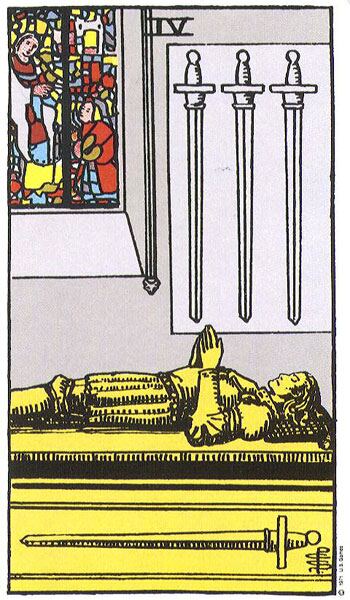
- Central image: A knight or warrior lies resting on a stone sarcophagus within a church or monastery.
- Action:
- The figure lies flat in rest, hands pressed together in prayer, with a serene expression.
- Three swords hang on the wall, and one lies horizontally beneath the sarcophagus (or beside the figure).
- A stained-glass window depicts a scene of one figure kneeling before another.
- Environment: The interior of a tranquil church, symbolizing a sacred sanctuary and a place of spiritual rest.
- Energy atmosphere: The image conveys a sense of rest, recovery, meditation, temporary withdrawal, and spiritual healing.
Key Symbolic Elements and Energy Reading
- The posture of lying at rest: Symbolizes withdrawal from battle and conflict; the body and mind require rest.
- Prayerful hands: Inner reflection, seeking spiritual guidance and peace of mind.
- The suspended swords: Temporarily set-aside conflicts, problems, and mental struggles.
- The sword lying flat: A latent threat or an issue not fully resolved.
- The church setting: A sacred sanctuary that provides a space of safety and healing.
- The stained-glass window: A symbol of spiritual guidance and inner dialogue.
- Overall energy: A pause of the Air element, mental rest, and recovery from mental struggle.
Upright Meaning in Detail
Core Themes
Necessary rest, spiritual recovery, temporary withdrawal, meditative reflection, a period of healing
Specific Reading
- State of body and mind: A state of exhaustion following stress, conflict, or mental struggle.
- Suggested action: Temporarily withdraw from the problem and give yourself time to rest and recover.
- Inner process: Sort out thoughts and restore energy through meditation and reflection.
- Healing significance: A necessary period of recuperation, preparing for the next phase of action.
- Positive aspect: Wisely recognizing one's own limits and actively choosing to rest.
Application in Life Scenarios
- Work pressure: Overwork; a vacation or a change of pace is needed.
- Interpersonal relationships: Temporarily withdrawing from conflict to calmly consider solutions.
- Health issues: Physical or psychological exhaustion requiring recuperation and recovery.
- Major decisions: Pausing and reflecting before making an important choice.
Reversed Meaning in Detail
Core Themes
Ending rest, returning to action, forced return, insufficient rest, evading reality
Specific Reading
- Returning to action: The rest period ends, and one is ready to re-engage with life and its challenges.
- Forced return: External pressure compels an early end to the rest period.
- Insufficient rest: Rushing back into action before fully recovering.
- Evasive tendency: Extending the rest period excessively, turning it into an evasion of reality.
- Inner preparation: After sufficient rest, the mind is clearer and stronger.
Application in Life Scenarios
- Returning to work: Resuming work after a vacation with renewed energy.
- Relationship repair: After a cooling-off period, ready to communicate again and resolve issues.
- Project restart: A paused project is relaunched with clearer thinking.
- Health recovery: The recuperation period ends, with improved physical and psychological state.
Deeper Philosophy and Psychology
Psychological Perspective
The Four of Swords reflects the modern phenomenon of "burnout." In environments of information overload and high pressure, the mind requires regular "digital detox" and deep rest.
Philosophical Insight
This card embodies the wisdom of "advancing by retreating." True strength lies not only in moving forward, but in knowing when to pause and recover. Rest is not weakness, but strategic self-care.
Interaction with Other Cards
Comparison with Related Cards
- Nine of Swords: The Four of Swords is active rest; the Nine of Swords is anxious insomnia.
- The Hermit: Both involve inner exploration, but the Hermit actively seeks wisdom while the Four of Swords is passive recovery.
- Death: The Four of Swords is temporary rest; Death is total ending and rebirth.
Combined Reading
- Four of Swords + Temperance: Balanced recovery and energy management.
- Four of Swords + The Star: Hope and inspiration after rest.
- Four of Swords + The Chariot: A renewed departure after sufficient rest.
Symbolism in Different Cultures
Eastern Philosophical Correspondence
In Chinese philosophy it corresponds to the wisdom of "meeting movement with stillness"—responding to dynamic change through stillness.
Western Psychology
It corresponds to the modern psychological theory of "restorative environments"—specific environments that promote psychological recovery.
Summary & Comparison Table
| Aspect | Four of Swords | Comparison with Related Cards |
|---|---|---|
| Nature of rest | Active, strategic rest | Nine of Swords: passive, anxious insomnia |
| Purpose of recovery | Restoration of mental energy | Four of Cups: recovery from emotional burnout |
| State of action | Temporary withdrawal | Four of Wands: active, celebratory action |
| Inner process | Meditative reflection | The Hermit: seeking wisdom |
Uncertainties and Divergent Views
Differences Across Schools
- Traditional reading: Emphasizes temporary withdrawal from battle.
- Modern reading: Focuses more on mental health and self-care.
Points of Contention
Does the horizontally placed sword represent an unresolved threat, or does it symbolize protective rest?
Conclusion
The Four of Swords is a card of wise rest and strategic withdrawal. It reminds us that in a life filled with challenges and pressure, true strength lies not only in perseverance but in knowing when to pause. Proper rest is not evasion, but preparation to set forth again in a stronger state.
Core revelation: Sometimes, the wisest action is to take no action for a time. True courage includes acknowledging one's limits and granting oneself the recovery one needs.
Waite's 1910 Pictorial Key Entry
Historical source note: The following records A. E. Waite's card-specific divinatory vocabulary from the supplied 1910 edition. It belongs to one early-twentieth-century method, not a universal meaning system or a guarantee. Historical references to illness, marriage, loss, or other high-stakes outcomes are not diagnoses, professional advice, or certain predictions.
- Upright (Waite): Vigilance, retreat, solitude, hermit's repose, exile, tomb and coffin. It is these last that have suggested the design.
- Reversed (Waite): Wise administration, circumspection, economy, avarice, precaution, testament.
Source: A. E. Waite, The Pictorial Key to the Tarot (1910), Part III, § 2.