Justice
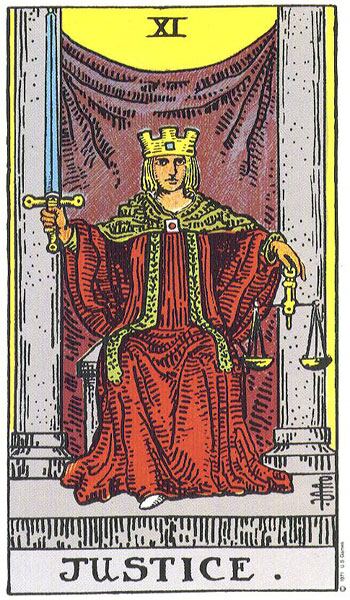
The Justice tarot card meaning centres on fairness, accountability, evidence, and the consequences of decisions. This guide explores upright and reversed readings without reducing every situation to a simple moral verdict.
Core Symbolism & Themes
Justice represents fairness, balance, truth, and karma. The card typically depicts a woman holding scales and a sword, symbolizing her ability to objectively weigh the facts and cut through falsehood with the sword of wisdom. This card reminds us that every choice carries corresponding consequences, and we must take responsibility for our actions.
Core Keywords: Fairness, balance, responsibility, karma, law, truth
Justice as a Decision Process
Justice is not merely a promise that fairness will prevail. In a reading, it can describe the work of making a situation legible: separating evidence from assumption, identifying who carries the cost, and asking whether the same standard is being applied consistently. This makes the card useful when a question involves contracts, boundaries, accountability, or a choice whose consequences affect more than one person.
The card's emphasis on evidence does not mean that every decision can be reduced to a calculation. Values still matter. A fair process may require acknowledging unequal power, repairing harm, or allowing more time before a conclusion is reached. Justice asks for both clarity and proportion: neither excusing a harmful pattern nor imposing a harsher verdict than the available facts support.
Upright Meaning
Love & Relationships
- Fairness and balance in the relationship
- Need to face relationship issues honestly
- May involve an important commitment or decision
- Seeking justice and equality in the relationship
Career & Wealth
- Fair treatment in the workplace
- Smooth progress in legal matters
- Need to make fair business decisions
- Signing of contracts or reaching of agreements
Personal Growth
- Taking responsibility for your choices
- Seeking inner balance and harmony
- Honestly facing your strengths and weaknesses
- Making decisions aligned with moral standards
Health
- Balanced state of the body's systems
- May need a medical diagnosis or examination
- Maintaining a healthy lifestyle
- Caring for mental health
Reversed Meaning
Love & Relationships
- Unfair dynamics in the relationship
- Evading responsibility or commitment
- Dishonest attitude in romance
- Legal disputes or a breakup
Career & Wealth
- Workplace unfairness or bias
- Troubled by legal issues
- An unfair competitive environment
- Contract disputes or breach
Personal Growth
- Evading responsibility and consequences
- A state of inner imbalance
- Moral dilemmas or a troubled conscience
- Unable to make fair judgments
Health
- Imbalance among the body's systems
- Unclear diagnosis or misdiagnosis
- Ignoring health warning signs
- Health issues caused by mental stress
Common Question Scenarios
Q: Should I continue this relationship?
Justice advises you to objectively assess the relationship's fairness, considering whether both partners receive due respect and care.
Q: Is this job opportunity right for me?
This card reminds you to weigh the pros and cons, ensuring the choice aligns with your values and brings fair returns.
Q: How should I resolve the current conflict?
Take a fair attitude, listen to all sides, and use wisdom and reason rather than emotion to solve the problem.
Q: Should I tell the truth?
Justice encourages honesty, but also consider timing and manner, ensuring the truth brings constructive results.
Justice in a Spread
Justice changes with its position. In a present or obstacle position, it may point to an imbalance that needs to be named. In an advice position, it asks for a fair process, clearer evidence, or a boundary that can be upheld. In an outcome position, it does not guarantee that a court, employer, partner, or institution will deliver the result the reader wants; it suggests that consequences will become more visible and that accurate records will matter.
When Justice appears beside emotionally intense cards, do not treat it as a command to suppress feeling. Emotion can identify what matters, while Justice helps test the story against observable facts. A useful journal prompt is: “What do I know, what am I inferring, and what would change my assessment?”
Summary & Advice
Justice teaches us that every decision in life produces corresponding consequences. It reminds us to:
- Maintain objectivity and fairness — exclude personal bias when making decisions
- Take responsibility — be accountable for your choices and actions
- Seek balance — maintain harmony in all aspects of life
- Respect truth — be honest with yourself and others
When Justice appears, it may signal that an important decision needs to be made. Trust your intuition, but verify it with reason. Remember, true justice is not only fairness to others, but also honesty toward yourself.
Waite's 1910 Pictorial Key Entry
Historical source note: The following records A. E. Waite's card-specific divinatory vocabulary from the supplied 1910 edition. It belongs to one early-twentieth-century method, not a universal meaning system or a guarantee. Historical references to illness, marriage, loss, or other high-stakes outcomes are not diagnoses, professional advice, or certain predictions.
- Upright (Waite): Equity, rightness, probity, executive; triumph of the deserving side in law.
- Reversed (Waite): Law in all its departments, legal complications, bigotry, bias, excessive severity.
Source: A. E. Waite, The Pictorial Key to the Tarot (1910), Part III, § 3.