King of Cups
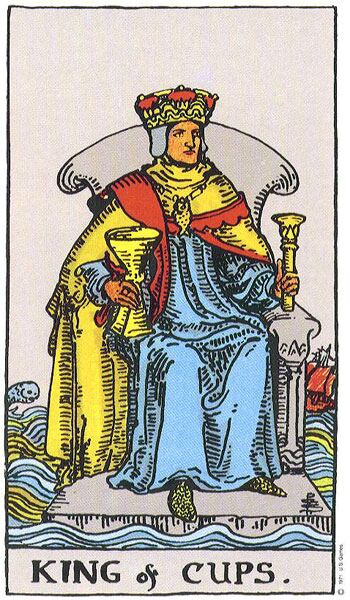
The King of Cups tarot card meaning centres on emotional maturity, steady compassion, and the ability to hold strong feelings without being ruled by them. Its guidance is about responsive care, not emotional suppression or guaranteed control.
1. Card Imagery (Visual & Symbolic)
In the Rider-Waite tarot system, the King of Cups typically presents the following classic image:
- Central figure: A mature, steady king sits on a throne in the sea, holding a cup.
- Ocean background: The throne floats on a turbulent sea, symbolizing the depth of the emotional world.
- The cup's symbolism: The king holds the cup steadily, his expression calm and wise.
- Sea creatures: Dolphins leaping and fish swimming in the sea, symbolizing the free flow of emotion.
- Crown and clothing: Wearing a golden crown and a blue robe, symbolizing emotional wisdom and authority.
- Color symbolism: Blue represents emotional depth, gold represents wisdom and authority, green represents life and vitality.
This is the classic image of the Rider-Waite tarot system, retained consistently in most modern tarot decks.
2. Energy & Element and Archetypes
1. Energy & Element (Elemental & Thematic)
- Element: Water — symbolizing emotion, intuition, compassion, and healing.
- Court card: King — symbolizing maturity, authority, wisdom, and leadership.
- Energy type: Emotional wisdom, compassionate leadership, intuitive authority, the power of healing.
2. Archetypes (Archetypal Origins)
- The Wise Elder archetype: A male figure representing emotional maturity and wisdom.
- The Healer archetype: Associated with emotional healing and spiritual guidance.
- The Compassionate Leader archetype: Symbolizes the ability to lead others with emotional wisdom.
- The Intuitive Guide archetype: Represents the wisdom of using intuition to guide life.
Points of uncertainty:
Does the King of Cups always represent positive emotion? Open to question — emotional authority is itself neutral, depending on how it is used.
The clear distinction between the King of Cups and the Queen of Cups? Open to question — different traditions hold different views on male and female emotional expression.
3. Detailed Upright Meaning
Core Meaning:
"The art of emotional wisdom and compassionate leadership — achieving spiritual healing through intuitive authority."
Inner Interpretation:
- Emotional maturity: Mature emotional wisdom, able to balance reason and feeling.
- Compassionate leadership: Leading others with compassion and empathy, attending to emotional needs.
- Intuitive authority: Using intuition to make wise decisions, trusting inner wisdom.
- Spiritual healing: The ability and willingness to heal the hearts of others.
- Emotional stability: Remaining steady amid emotional turbulence, becoming someone others can rely on.
- Artistic talent: The gift and ability for artistic and creative expression.
- Spiritual guidance: Providing spiritual guidance and support to others.
Upright in Common Questions:
| Scenario | Interpretation |
|---|---|
| Romantic relationships | Mature emotional expression, able to build deep emotional connection. |
| Career | Leading the team with emotional wisdom, creating a harmonious work environment. |
| Personal growth | Enhanced emotional maturity, able to handle complex emotional issues. |
| Health | Emotional health promotes overall health, with attention to spiritual healing. |
| Finance | Intuition guides financial decisions, with attention to investments of emotional value. |
4. Detailed Reversed Meaning
Core Meaning:
"Emotional authority out of balance — either emotion suppressed, or emotion overflows."
Inner Interpretation:
- Emotional suppression: Over-suppressing emotion, lacking emotional expression.
- Emotional overflow: Emotion out of control or over-sensitive, hard to think rationally.
- Abuse of authority: Abusing emotional authority, manipulating others' emotions.
- Lost intuition: Losing the connection to intuition, making wrong decisions.
- Healing failing: Healing ability fails or is used for negative purposes.
- Emotional evasion: Evading emotional responsibility, lacking accountability.
- Artistic drought: Creative depletion or blocked artistic expression.
Reversed in Common Questions:
| Scenario | Interpretation |
|---|---|
| Romantic relationships | Emotional expression barriers, or manipulative emotional behavior. |
| Career | Emotional leadership fails, tense emotional atmosphere within the team. |
| Personal growth | Insufficient emotional maturity, hard to handle emotional challenges. |
| Health | Emotional problems affect health, emotional healing is needed. |
| Finance | Emotion interferes with financial decisions, causing loss. |
5. Deeper Philosophical and Psychological Meaning
1. The Dialectic of Emotion and Reason
- The King of Cups explores the balance of emotion and reason, compassion and authority.
- This resonates deeply with the Confucian wisdom of "the benevolent one loves others."
- In modern psychology, this corresponds to the concepts of Emotional Intelligence and Empathetic Leadership.
2. The Psychological Process of Male Emotional Expression
- The upright King of Cups shows healthy emotional authority — mature without losing tenderness.
- When reversed, it indicates either over-suppression of emotion (coldness) or over-expression of emotion (overflow).
- True wisdom requires balancing emotional expression with rational control.
Points of uncertainty:
Does the King of Cups represent the ideal of male emotional expression? Open to question — different cultures have different expectations of male emotion.
The connection between the King of Cups and modern masculinity? Open to question — traditional interpretation may be shaped by particular cultures.
6. Interaction with Other Cards (Tarot Combination Reference)
| Combination | Meaning |
|---|---|
| Upright King of Cups + Upright The High Priestess | A perfect union of deep intuition and emotional wisdom. |
| Upright King of Cups + Upright The Star | The fusion of hope and emotion, a beautiful emotional vision. |
| Reversed King of Cups + Upright The Hermit | Need for solitude and reflection, reconnecting with emotional wisdom. |
| Upright King of Cups + Upright The Magician | Emotional wisdom turned into practical action, creating harmony. |
| Reversed King of Cups + Upright The Devil | Caught in emotional manipulation or dependent relationships. |
7. Summary Comparison Table
| Dimension | Upright | Reversed |
|---|---|---|
| Core energy | Emotional wisdom, compassionate leadership | Emotional suppression, abuse of authority |
| Emotional tone | Calm, wise, compassionate | Cold, sensitive, manipulative |
| Suggested action | Use emotional wisdom, continue healing | Emotional reflection, rebalance |
| Interpersonal relationships | Deep connection, emotional support | Tense relationships, emotional barriers |
| Self-relationship | Emotional maturity, self-acceptance | Emotional confusion, self-denial |
| Keywords | Wisdom, compassion, healing, intuition | Suppression, overflow, manipulation, lost |
8. Points of Uncertainty Explicitly Noted
The universality of King of Cups emotional expression:
→ Open to question. Should all men express emotion? Different cultures have different norms.The connection between the King of Cups and modern psychotherapy:
→ Open to question. Traditional interpretation emphasizes intuition, but modern application focuses more on scientific methods.The positive role of the King of Cups in leadership:
→ Open to question. Is emotional leadership always effective? Some situations call for rational decision-making.Positive interpretation of the reversed King of Cups:
→ Open to question. In some contexts, emotional control may be protection rather than suppression.
Conclusion
The King of Cups teaches us that true authority comes from the balance of emotional wisdom and compassion. Upright, it is a guide to emotional maturity and compassionate leadership; reversed, it is an important signal reminding us to balance emotional expression with rational control.
In any context, the King of Cups says:
"True wisdom is not suppressing emotion, but expressing it wisely; true leadership is not controlling others, but guiding with compassion."
This is the most profound revelation of the King of Cups: emotion in life is not a weakness to control, but a wisdom to express.
Waite's 1910 Pictorial Key Entry
Historical source note: The following records A. E. Waite's card-specific divinatory vocabulary from the supplied 1910 edition. It belongs to one early-twentieth-century method, not a universal meaning system or a guarantee. Historical references to illness, marriage, loss, or other high-stakes outcomes are not diagnoses, professional advice, or certain predictions.
- Upright (Waite): Fair man, man of business, law, or divinity; responsible, disposed to oblige the Querent; also equity, art and science, including those who profess science, law and art; creative intelligence.
- Reversed (Waite): Dishonest, double-dealing man; roguery, exaction, injustice, vice, scandal, pillage, considerable loss.
Source: A. E. Waite, The Pictorial Key to the Tarot (1910), Part III, § 2.