King of Swords — Upright and Reversed in Detail
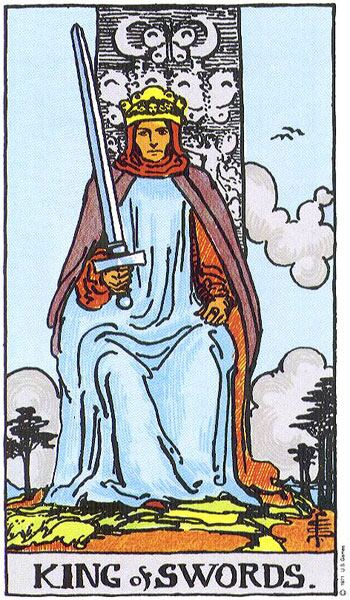
The King of Swords tarot card meaning centres on clear reasoning, ethical authority, and decisions grounded in evidence. It can support boundaries and precise language, while warning against using intelligence or rules to avoid humanity.
I. Card Imagery (Visual and Symbolic)
The King of Swords in the Rider-Waite system typically presents the following classic image:
- Central figure: A majestic and wise king sits on a throne atop a high mountain, holding a sword.
- Mountain background: The throne stands on a towering peak, symbolizing the height and clarity of thought.
- Sword symbolism: The king raises the sword aloft, his expression solemn and firm.
- Sky element: The sky is clear and cloudless, symbolizing clarity and transparency of thought.
- Crown and attire: He wears a silver crown and blue robes, symbolizing wisdom and authority.
- Animal symbolism: The throne bears an eagle carving, symbolizing insight and far-sightedness.
- Color symbolism: Silver represents wisdom, blue represents truth, and gray represents neutrality.
This is the classic image of the Rider-Waite system, consistent across most modern tarot decks.
II. Energy & Element and Archetypes
1. Energy & Element (Elemental & Thematic)
- Element: Air — symbolizes thought, truth, judgment, and communication.
- Court card: King — symbolizes maturity, authority, wisdom, and leadership.
- Energy type: Clarity of thought, judgment of truth, rational leadership, communicative authority.
2. Archetypes (Archetypal Origins)
- The Wise Elder archetype: Represents the masculine figure of clear thought and truthful wisdom.
- The Just Judge archetype: Associated with fair judgment and rational decision-making.
- The Guardian of Truth archetype: Symbolizes the capacity to guard truth and uphold principle.
- The Rational Mentor archetype: Represents the wisdom of using rational insight to guide life.
Points of uncertainty:
Does the King of Swords always represent positive rationality? Uncertain—reason itself is neutral and depends on how it is used.
What is the clear distinction between the King of Swords and the Queen of Swords? Uncertain—different traditions understand the masculine and feminine expression of reason differently.
III. Upright Meaning in Detail
Core Meaning:
"The art of clear thought and rational leadership, achieving just decisions through the judgment of truth."
Inner Interpretation:
- Clarity of thought: Clear thinking and logical analysis, able to see through to the essence.
- Rational leadership: Leading others with reason and justice, attending to the principles of truth.
- Judgment of truth: Using truth to make just judgments, upholding principle.
- Communicative authority: Effective communication and expression, able to persuade others.
- Mental stability: Remaining steady amid mental turbulence, becoming a pillar others can rely on.
- Analytical gift: A gift and capacity for analytical and critical thinking.
- Guardian of principle: Guarding truth and principle, undisturbed by emotion.
Upright in Common Questions:
| Scenario | Interpretation |
|---|---|
| Love & Relationships | Rational emotional expression, able to build clear relationships. |
| Career & Wealth | Leading teams with rational wisdom, creating a just work environment. |
| Personal Growth | Increased maturity of thought, able to handle complex intellectual problems. |
| Health | Clear thinking promotes health; emphasis on rational health management. |
| Finance | Reason guiding financial decisions, with attention to principle and fairness. |
IV. Reversed Meaning in Detail
Core Meaning:
"Rational authority out of balance—either excessive rationality, or a lack of it."
Inner Interpretation:
- Excessive rationality: Over-reason and coldness, lacking emotional warmth.
- Lack of rationality: Rational judgment is missing, leading to wrong decisions.
- Abuse of authority: Abusing rational authority, suppressing the thoughts of others.
- Truth lost: Losing the capacity to judge truth, falling into prejudice.
- Communication fails: Communication fails or is used for negative purposes.
- Evasion of responsibility: Evading intellectual responsibility, lacking accountability.
- Analysis exhausted: Analytical capacity depleted, or thinking becomes rigid.
Reversed in Common Questions:
| Scenario | Interpretation |
|---|---|
| Love & Relationships | Obstacles in rational expression, or controlling behavior through reason. |
| Career & Wealth | Rational leadership fails; the team's intellectual atmosphere is tense. |
| Personal Growth | Insufficient maturity of thought, struggling to handle intellectual challenges. |
| Health | Mental problems affect health; rational health management is needed. |
| Finance | Errors in rational judgment, leading to wrong decisions. |
V. Deeper Philosophical and Psychological Significance
1. The Dialectic of Reason and Emotion
- The King of Swords explores the balance between reason and emotion, truth and compassion.
- This resonates deeply with the Confucian ideal of "the wise are without confusion."
- In modern psychology, this corresponds to the concepts of Critical Thinking and Rational Decision Making.
2. The Psychological Process of Masculine Rational Expression
- The upright King of Swords displays healthy rational authority—clear without losing warmth.
- When reversed, it indicates either excessive rationality (coldness) or a lack of it (confusion).
- True wisdom requires balancing rational judgment with emotional warmth.
Points of uncertainty:
Does the King of Swords represent the ideal of masculine rational expression? Uncertain—different cultures hold different expectations of masculine reason.
The relation of the King of Swords to modern scientific rationality? Uncertain—traditional readings may be shaped by particular knowledge systems.
VI. Interaction with Other Cards (Tarot Combination Reference)
| Combination | Meaning |
|---|---|
| Upright King of Swords + Upright Justice | The perfect union of rational judgment and the principle of justice. |
| Upright King of Swords + Upright The Star | The fusion of the pursuit of truth and a vision of hope. |
| Reversed King of Swords + Upright The Hermit | Solitude and reflection are needed to reconnect with rational wisdom. |
| Upright King of Swords + Upright The Magician | Rational wisdom turned into practical action, creating justice. |
| Reversed King of Swords + Upright The Devil | Caught in rational control or mental suppression. |
VII. Summary Comparison Table
| Dimension | Upright | Reversed |
|---|---|---|
| Core energy | Clear thought, rational leadership | Excessive rationality, abuse of authority |
| Emotional tone | Serious, firm, just | Cold, confused, suppressive |
| Suggested action | Apply rational wisdom, keep thinking | Reflect rationally, restore balance |
| Interpersonal relationships | Clear communication, fair treatment | Strained relationships, mental control |
| Relationship with self | Mature thought, clear self-knowledge | Confused thought, self-denial |
| Keywords | Clarity, reason, truth, justice | Coldness, confusion, suppression, being lost |
VIII. Uncertainties Explicitly Noted
The universality of the King of Swords' view of reason:
→ Uncertain. Should all men pursue rationality? Different cultures hold different values.The link between the King of Swords and modern scientific rationality:
→ Uncertain. Traditional readings emphasize truth, but modern science emphasizes empirical evidence and skepticism.The positive role of the King of Swords in leadership:
→ Uncertain. Is rational leadership always effective? Some situations call for emotional leadership.Positive readings of the reversed King of Swords:
→ Uncertain. In some contexts, rational control may be protection rather than suppression.
Conclusion
The King of Swords teaches us that true authority comes from the balance of rational wisdom and emotional warmth. When upright, it is a guide to clear thought and rational leadership; when reversed, it is an important signal reminding us to balance rational judgment with emotional warmth.
In any context, the King of Swords says:
"True wisdom is not cold reason, but warm clarity; true leadership is not suppressing thought, but inspiring it."
This is the most profound revelation of the King of Swords: thought in life is not a tool to be controlled, but a wisdom to be expressed.
Waite's 1910 Pictorial Key Entry
Historical source note: The following records A. E. Waite's card-specific divinatory vocabulary from the supplied 1910 edition. It belongs to one early-twentieth-century method, not a universal meaning system or a guarantee. Historical references to illness, marriage, loss, or other high-stakes outcomes are not diagnoses, professional advice, or certain predictions.
- Upright (Waite): Whatsoever arises out of the idea of judgment and all its connexions—power, command, authority, militant intelligence, law, offices of the crown, and so forth.
- Reversed (Waite): Cruelty, perversity, barbarity, perfidy, evil intention.
Source: A. E. Waite, The Pictorial Key to the Tarot (1910), Part III, § 2.