Knight of Swords — Upright and Reversed in Detail
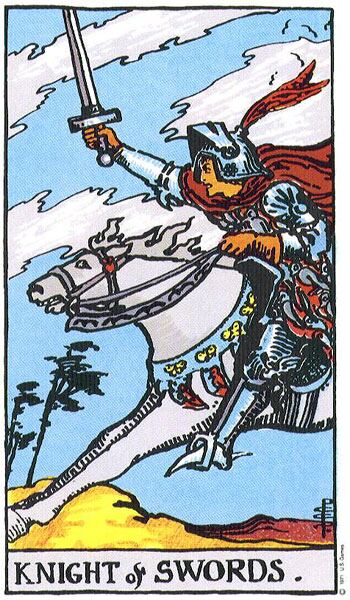
The Knight of Swords tarot card meaning brings speed, conviction, direct speech, and the risk of acting before the consequences are understood. This guide balances the card’s courage and clarity with its potential for haste.
I. Card Imagery (Visual and Symbolic)
The Knight of Swords—a card of sharp decisiveness and intellectual impact. This card is the expression of the Air element (thought, communication, logic, conflict) within the rank of the Knight among the court cards (carrying Fire qualities), with core themes of intellectual impact, decisive action, the challenge of conflict, and the pursuit of truth.
Core Keywords: Sharp decisiveness, intellectual impact, challenging conflict, pursuit of truth, swift action, intellectual courage
Card Imagery (based on the Rider-Waite system):
- The knight's image: A dashing young knight in armor, with a focused and resolute expression. He rides a strong white horse that rears up, full of dynamism.
- Posture and expression: The knight raises or brandishes a sharp sword, his gaze keen, his expression urgent or slightly angry, displaying a fearless charging posture.
- Sword and gesture: The sword the knight holds symbolizes thought, determination, and conflict. His gesture is typically raised high or pointing forward, representing intellectual impact and resolve in action.
- Background and environment: The background is usually a gray, cloudy sky with signs of strong wind. The environment may be rugged mountains or wasteland, creating a tense and unstable atmosphere.
- Clothing and decoration: The knight's armor and cloak are in cool colors, often silver, gray, or blue, emphasizing his Air-element character. Wind or cloud motifs are common, symbolizing the flow of thought and conflict.
Energy & Element:
- Air (dominant): The foundation of the Swords suit, representing thought, communication, logic, conflict, and decision-making.
- Fire (the Knight rank): The Knight's rank brings the energy of Fire, representing action, passion, pursuit, and expression. This card is the perfect combination of Air (thought) impacting and challenging through Fire (action).
Origins & Archetypes:
- "Fearless Warrior" archetype: The warrior who charges into battle, fighting for ideals and truth.
- "Impatient Reformer" archetype: Eager to change the status quo, acting swiftly and decisively.
- "Intellectual Challenger" archetype: Initiating challenges with sharp thought and logical argument.
- "Truth Seeker" archetype: Pursuing truth and justice, undaunted by authority or resistance.
II. Upright Meaning in Detail
Core Themes: Intellectual impact and decisiveness, the challenge and breakthrough of conflict, the pursuit and defense of truth
Positive / Strengths:
- Swift action: Acting on ideas immediately, with superlative execution and no procrastination.
- Clear sense of purpose: Clear thinking, defined goals, firm will, pressing forward with determination.
- Sharpness of thought: Agile thinking, clear logic, daring to pose sharp questions.
- Power to break through and transform: Able to swiftly break deadlocks and bring about major change.
- Decisive courage: Willing to take risks at critical moments and make difficult decisions.
Neutral / Aspects needing balance:
- May be too fierce: Action without thorough consideration, appearing rash and impulsive.
- Potential for conflict: Prone to provoking arguments, disputes, or even fierce conflict.
- Lack of patience: Pursuing speed, may overlook details and others' feelings.
- Idealism: May be too attached to ideas, unwilling to listen to different opinions.
Upright in Common Questions:
- Career/Work: Quickly throwing oneself into a new project; actively pursuing opportunities; driving major reform; intense debate with colleagues; suited to pioneering roles.
- Study/Research: High learning efficiency; outstanding performance in debate competitions; challenging authoritative views; the need to avoid impatience and a weak foundation.
- Personal Growth: Resolving to change habits; bravely facing inner conflict; actively learning new skills.
- Decision-making moments: Making decisions quickly; suited to situations that call for immediate resolution.
III. Reversed Meaning in Detail
Core Themes: Thought obstructed and distorted, action out of control and disastrous, conflict escalated and destructive
Negative / Problematic:
- Reckless disaster: Acting without regard for consequences, leading to serious errors and failure.
- Verbal violence: Speaking harshly and venomously; complete breakdown of communication.
- Stagnation and procrastination: Over-thinking with inability to act, or losing courage out of fear.
- Wrong direction: Furiously striving for the wrong goal, acting with no strategy.
- Abuse of energy: Mental or physical bullying; pure destructive force.
Warnings and potential turning points:
- Urgent need for reflection: Stop the current pattern; deeply reflect on motives and consequences.
- Learn patience: Recognize the limits of dash and speed; planning and cooperation are needed.
- Heal communication: Recognize the destructive power of words; learn peaceful and respectful communication.
- Realign direction: Review whether the goal is correct and the method appropriate.
Reversed in Common Questions:
- Career/Work: Failed impulsive decisions; offending important people; office politics and power struggles; workaholism leading to burnout.
- Study/Research: Exam failure; conflict with teachers or students; academic misconduct; evading due to excessive pressure.
- Interpersonal relationships: Fierce arguments; verbal or psychological harm; strong desire for control; rapid ending of relationships.
IV. Deeper Philosophical and Psychological Significance
The balance of thought and action: The Knight of Swords represents the power of thought driving action, but it requires the guidance of wisdom.
The dialectic of conflict and growth: Emphasizes the value of conflict as a catalyst for growth, and how to handle conflict constructively.
The unity of truth and method: The importance of pursuing truth, but the choice of method is equally crucial.
V. Interaction with Other Cards
Connection with the Swords suit: As the actor among the Sword court cards, he connects the exploratory spirit of the Page of Swords with the mature wisdom of the King of Swords.
Echoes with the Major Arcana: Has deep connections with Justice (the pursuit of truth), The Chariot (control of action), and The Tower (sudden upheaval).
Warnings when reversed: When appearing with The Devil or The Tower, it may hint at serious conflict or disastrous consequences.
VI. Symbolism in Different Cultures
Western culture: The brave warrior of medieval chivalry, fighting for honor and truth.
Eastern philosophy: The military idea that "in war, speed is precious," emphasizing swift and decisive action.
Modern psychology: The cognitive-behavioral theory of changing thought patterns and challenging irrational beliefs.
VII. Summary Comparison Table
| Aspect | Upright Meaning | Reversed Meaning |
|---|---|---|
| Mode of action | Swift and decisive execution | Reckless disaster or stagnation |
| Mental expression | Sharp and clear thinking | Distorted, confused, or violent |
| Conflict handling | Constructive challenge | Destructive confrontation |
| Goal pursuit | Defender of truth and justice | Fanaticism in the wrong direction |
| Communication style | Direct and candid expression | Harsh and venomous speech |
VIII. Uncertainties / Divergent Views to Note
- The symbolism of the "white horse": Traditionally the white horse symbolizes pure power, but in the Knight of Swords it emphasizes unmodulated raw energy.
- The knight's age: The knight's age varies across different decks, but the core is the image of a young, sharp-edged challenger.
- Speed of action: The Knight of Swords acts extremely swiftly, which is sometimes misread as "lacking depth" or "overly radical."
IX. Conclusion
The Knight of Swords teaches us that thought is a powerful weapon, and action is the outward expression of thought. It reminds us that on the path of pursuing truth and challenging the status quo, we must preserve sharpness and courage, but even more we must possess wisdom, strategy, and compassion. True strength lies not in manufacturing conflict, but in defending truth and promoting growth.
Remember: the sharpest sword is not meant to harm, but to cut through delusion and illuminate the path ahead.
Waite's 1910 Pictorial Key Entry
Historical source note: The following records A. E. Waite's card-specific divinatory vocabulary from the supplied 1910 edition. It belongs to one early-twentieth-century method, not a universal meaning system or a guarantee. Historical references to illness, marriage, loss, or other high-stakes outcomes are not diagnoses, professional advice, or certain predictions.
- Upright (Waite): Skill, bravery, capacity, defence, address, enmity, wrath, war, destruction, opposition, resistance, ruin. There is therefore a sense in which the card signifies death, but it carries this meaning only in its proximity to other cards of fatality.
- Reversed (Waite): Imprudence, incapacity, extravagance.
Source: A. E. Waite, The Pictorial Key to the Tarot (1910), Part III, § 2.