Knight of Wands
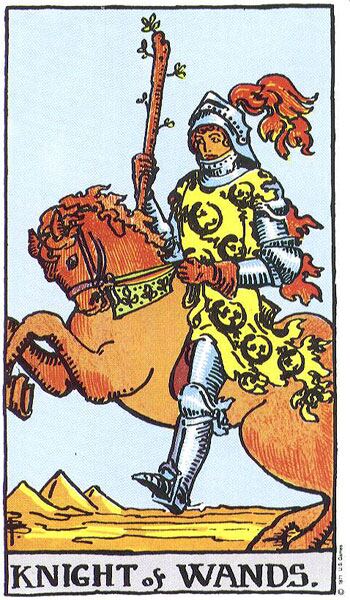
The Knight of Wands—passionate and free-spirited, the spirit of adventure. This card is the expression of the Fire element (passion, action, creation, adventure) at the Knight rank of the court cards (Fire element traits), with the core themes of passionate action, adventurous pursuit, the burst of creativity, and the vitality of life.
Core Keywords: Passionate Action, Spirit of Adventure, Burst of Creativity, Vitality of Life, Positive Enterprise, Free-Spirited
Card Imagery (based on the Rider-Waite tarot system):
- The Knight's Image: A vigorous young knight in light armor, usually in red or gold tones. He rides a galloping horse, the steed's posture high-spirited and full of dynamism.
- Posture and Expression: The knight typically holds a wand, his expression brimming with passion, his eyes full of resolve and expectation. He appears to be charging or exploring, displaying a fearless spirit of adventure.
- Wand and Gesture: The wand the knight holds symbolizes the capacity for action and creativity. His gesture is usually one of holding the wand aloft or pointing forward, representing the direction of advance and the passion of action.
- Background and Setting: The background is usually a desert, wilderness, or open terrain, symbolizing infinite possibility and the space for adventure. The sky is often clear, with perhaps rising dust, creating an atmosphere full of vitality.
- Clothing and Decoration: The knight's armor and cloak are vividly colored, often red, orange, or gold, emphasizing his Fire element traits. Patterns of flame or the sun are common, symbolizing passion and energy.
Energy & Element:
- Fire element (dominant): The foundation of the Wands suit, representing passion, action, creation, adventure, and vitality.
- Fire element (Knight rank): The Knight's rank brings the energy of the Fire element, representing action, passion, pursuit, and expression. This card is the embodiment of pure Fire element, a doubled Fire element energy.
Origins & Archetypes:
- The "Adventurer" Archetype: A fearless explorer, brave enough to challenge unknown territory.
- The "Passionate Pursuer" Archetype: A fervent chaser, giving his all for ideals and dreams.
- The "Creative Pioneer" Archetype: An innovative trailblazer, bringing new ideas and possibilities.
- The "Free Spirit" Archetype: An unbound individual, pursuing true freedom and expression.
II. Detailed Upright Meaning
Core Themes: Passionate action and pursuit, adventurous exploration and discovery, the burst and realization of creativity
Positive/Strengths:
- Passionate Action: Vigorous execution, swift and decisive capacity for action.
- Spirit of Adventure: Brave in trying new things, undaunted by challenges and risks.
- Burst of Creativity: Rich imagination and creativity, novel ideas and solutions.
- Positive Enterprise: An optimistic and upward attitude, confidence and expectation toward the future.
- Free-Spirited: Unbound by tradition, pursuing true self-expression.
Neutral/Aspects Needing Balance:
- May Be Too Impulsive: Acting without sufficient thought; needs appropriate composure.
- Distracted Attention: Broad interests but possibly lacking focus; needs clear goals.
- Insufficient Patience: Pursuing quick results; needs to cultivate endurance.
Common Question Scenario Interpretations:
- Career/Work: Rapid launch of new projects; implementation of innovative ideas; sales or promotional activities; entrepreneurship or venturesome work.
- Creativity/Art: A burst of inspiration for artistic creation; passion for performance or display; innovation in design or invention.
- Personal Growth: Learning a new skill; travel or exploration; a change of lifestyle.
- Love/Relationships: Passionate pursuit; romantic adventure; freshness in a relationship.
III. Detailed Reversed Meaning
Core Themes: Fading and obstruction of passion, failure and setback of adventure, exhaustion and chaos of creativity
Negative/Problematic Aspects:
- Impulsive Recklessness: Action without regard for consequences, leading to failure or loss.
- Fading Passion: Loss of drive and interest; abandoning projects midway.
- Failed Adventure: Negative outcomes from risk-taking; plans frustrated.
- Creative Chaos: Too many ideas but lacking focus; creativity difficult to realize.
- Excessive Freedom: Irresponsible behavior, causing trouble for others.
Warnings and Potential Turning Points:
- Need for Planning: Formulate a detailed plan before acting to avoid blind impulsiveness.
- Maintain Focus: Concentrate energy on completing important tasks and avoid distraction.
- Cultivate Patience: Understand that achievement takes time; learn to wait and persist.
- Take Responsibility: Consider others' feelings while pursuing freedom.
Common Question Scenario Interpretations:
- Career/Work: Project failure; consequences of impulsive decisions; confused career direction.
- Creativity/Art: Creative bottleneck; exhausted inspiration; decline in the quality of work.
- Personal Growth: Stalled growth; negative consequences of risk-taking behavior.
IV. Deeper Philosophy & Psychological Significance
The Balance of Passion and Reason: The Knight of Wands represents the need for rational guidance while maintaining passion.
The Unity of Freedom and Responsibility: Emphasizes the importance of individual freedom while also needing to bear corresponding responsibility.
The Combination of Action and Reflection: Teaches us the power of action, but also the need to pause for reflection at the right times.
V. Interaction with Other Cards
Connection with the Wands Suit: As the actor among the Wands court cards, it connects the Page of Wands' spirit of exploration with the King of Wands' mature leadership.
Resonance with the Major Arcana: Has deep connections with the passion control of the Strength card, the direction of action of the Chariot, and the vitality and brightness of the Sun card.
Warnings When Reversed: When appearing together with the Swords suit or the Devil card, it may suggest serious consequences of impulsive behavior.
VI. Symbolism in Different Cultures
Western Culture: The brave adventurer of medieval chivalric spirit, the discoverer of new worlds.
Eastern Philosophy: The Daoist idea of "free and unfettered wandering," pursuing freedom of the spirit and harmony with nature.
Modern Psychology: The growth need in self-actualization theory, pursuing the full realization of personal potential.
VII. Summary Comparison Table
| Aspect | Upright Meaning | Reversed Meaning |
|---|---|---|
| Mode of Action | Passionate and swift execution | Impulsive recklessness or procrastination |
| Spirit of Adventure | Brave exploration and attempt | Failed adventure or retreat |
| Creative Expression | Rich burst of inspiration | Creative exhaustion or chaos |
| Emotional State | Positive, optimistic, passionate | Fading passion or dejection |
| Pursuit of Freedom | Healthy self-expression | Excessive freedom or irresponsibility |
VIII. Open Questions and Differing Views to Note
- The Symbolism of the "Steed": Traditionally the steed symbolizes speed and strength, but in the Knight of Wands its vitality and dynamism are emphasized more.
- The Knight's Age: The knight's age varies across different card images, but the core is the image of a youthful and vigorous actor.
- Speed of Action: The Knight of Wands acts most swiftly, which is sometimes misread as "impatience" or "lack of depth."
IX. Conclusion
The Knight of Wands teaches us that the meaning of life lies in bravely pursuing and passionately acting. It reminds us that on the path of pursuing dreams and exploring the unknown, keeping the inner flame and the courage to act are most important. Whether it is innovation in career, creation in art, or personal growth, the Knight of Wands encourages us to embrace every possibility of life with full passion.
Remember: The most splendid life is not waiting for the scenery to appear, but bravely walking toward the unknown journey.
Waite's 1910 Pictorial Key Entry
Historical source note: The following records A. E. Waite's card-specific divinatory vocabulary from the supplied 1910 edition. It belongs to one early-twentieth-century method, not a universal meaning system or a guarantee. Historical references to illness, marriage, loss, or other high-stakes outcomes are not diagnoses, professional advice, or certain predictions.
- Upright (Waite): Departure, absence, flight, emigration. A dark young man, friendly. Change of residence.
- Reversed (Waite): Rupture, division, interruption, discord
Source: A. E. Waite, The Pictorial Key to the Tarot (1910), Part III, § 2.