Nine of Swords — Upright and Reversed in Detail
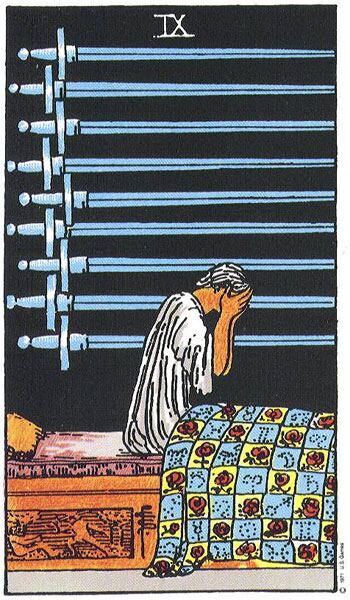
The Nine of Swords tarot card meaning centres on worry, rumination, shame, and the way night-time fear can enlarge a problem. It can invite honest support and practical grounding; it should never be used to diagnose a mental-health condition.
I. Card Imagery (Visual and Symbolic)
The Nine of Swords in the Rider-Waite system typically presents the following classic image:
- Central figure: A suffering person sits on a bed, hands covering the face.
- The nine swords: Nine swords hang on the wall, symbolizing mental burden.
- Dark background: A dark background symbolizes inner darkness and fear.
- Bed pattern: The bed is decorated with roses and astrological motifs, symbolizing hope and destiny.
- Body posture: The figure's body is curled up, showing extreme suffering.
- Environmental background: A bedroom or private space, symbolizing inner struggle.
- Color symbolism: Black represents fear, blue represents melancholy, and red represents pain.
This is the classic image of the Rider-Waite system, consistent across most modern tarot decks.
II. Energy & Element and Archetypes
1. Energy & Element (Elemental & Thematic)
- Element: Air — symbolizes thought, anxiety, fear, and worry.
- Number: 9 — symbolizes completion, extremity, crisis, and turning point.
- Energy type: Mental burden, anxious fear, inner struggle, psychological crisis.
2. Archetypes (Archetypal Origins)
- The Anxious archetype: Represents extreme anxiety and psychological pain.
- The Sleepless One: Associated with insomnia and night terrors.
- The Mental Prisoner: Symbolizes the state of being bound by negative thoughts.
- Psychological crisis: Represents a psychological extreme and turning point.
Points of uncertainty:
Does the Nine of Swords always represent a negative state? Uncertain—it may include a necessary psychological purification.
The relation of the Nine of Swords to creative anxiety? Uncertain—traditional readings focus more on negative emotion.
III. Upright Meaning in Detail
Core Meaning:
"A moment of extreme anxiety and mental burden, achieving a psychological breakthrough by facing fear."
Inner Interpretation:
- Extreme anxiety: Intense anxiety and worry, difficult to calm.
- Mental burden: Tormented by negative thoughts, unable to break free.
- Insomnia: Night terrors and sleeplessness, affecting health.
- Psychological crisis: Reaching a psychological limit, requiring a breakthrough.
- Inner struggle: Deep inner conflict, requiring resolution.
- Facing fear: Deep-seated fears must be faced, to attain liberation.
- Turning point: A turning point within the crisis, possibly bringing growth.
Upright in Common Questions:
| Scenario | Interpretation |
|---|---|
| Mental health | Extreme anxiety and insomnia; professional help is needed. |
| Mental burden | Cycles of negative thoughts; persistent worry that is hard to shake. |
| Interpersonal relationships | Anxiety affecting relationships; communication and understanding are needed. |
| Work pressure | Work pressure causing psychological crisis; adjustment is needed. |
| Personal Growth | Facing deep fears to achieve a psychological breakthrough. |
IV. Reversed Meaning in Detail
Core Meaning:
"Easing of anxiety—either liberation begins, or emotions are suppressed."
Inner Interpretation:
- Anxiety easing: Anxiety begins to lessen, offering a respite.
- Seeking help: Willing to seek external help, beginning recovery.
- Emotional suppression: Suppressing real emotion, appearing calm on the surface.
- Evading the problem: Choosing evasion over confrontation, providing temporary relief.
- Slow recovery: Psychological state slowly improves, requiring time.
- Accepting reality: Beginning to accept reality, reducing resistance.
- Inner strength: Discovering inner strength to meet challenges.
Reversed in Common Questions:
| Scenario | Interpretation |
|---|---|
| Mental health | Anxiety easing; recovery begins; sustained effort is needed. |
| Mental burden | Negative thoughts decreasing; gaining a new perspective. |
| Interpersonal relationships | Willing to communicate; relationships begin to improve. |
| Work pressure | Pressure lessening; finding ways to cope. |
| Personal Growth | Facing fears and gaining inner strength. |
V. Deeper Philosophical and Psychological Significance
1. The Dialectic of Anxiety and Liberation
- The Nine of Swords explores the profound themes of psychological pain and spiritual liberation.
- This resonates with the Buddhist "Four Noble Truths" and the Daoist idea that "when things reach an extreme, they turn around."
- In modern psychology, this corresponds to the concepts of Anxiety Disorders and Psychological Resilience.
2. The Transformation of Psychological Crisis
- The upright Nine of Swords shows extreme psychological pain that must be faced and broken through.
- When reversed, it indicates either the beginning of liberation (positive transformation) or the suppression of emotion (negative coping).
- True wisdom requires facing fear directly rather than evading it.
Points of uncertainty:
Does the Nine of Swords always represent a negative state? Uncertain—it may include a necessary process of psychological purification.
The relation of the Nine of Swords to creative thinking? Uncertain—some anxiety may stimulate creativity.
VI. Interaction with Other Cards (Tarot Combination Reference)
| Combination | Meaning |
|---|---|
| Upright Nine of Swords + Upright The Tower | The double blow of psychological crisis and sudden collapse. |
| Upright Nine of Swords + Upright Death | Extreme pain leading to necessary transformation and rebirth. |
| Reversed Nine of Swords + Upright The Star | Easing of anxiety brings hope and a new direction. |
| Upright Nine of Swords + Upright The Hermit | Inner pain requiring solitude and introspection. |
| Reversed Nine of Swords + Upright The Sun | Psychological recovery brings light and joy. |
VII. Summary Comparison Table
| Dimension | Upright | Reversed |
|---|---|---|
| Core energy | Extreme anxiety, mental burden | Anxiety easing, liberation begins |
| Emotional tone | Fear, pain, despair | Relief, hope, recovery |
| Suggested action | Face fear, seek help | Continue recovery, build resilience |
| Interpersonal relationships | Distancing due to anxiety; understanding needed | Willing to communicate; relationships improve |
| Relationship with self | Self-criticism, inner conflict | Self-acceptance, inner strength |
| Keywords | Anxiety, fear, insomnia, crisis | Relief, recovery, hope, strength |
VIII. Uncertainties Explicitly Noted
The necessity of the Nine of Swords' anxiety:
→ Uncertain. Is extreme anxiety always harmful? It may carry a necessary warning.The relation of the Nine of Swords to the creative process:
→ Uncertain. Does certain creative work require an anxious state? This is debated.The prevalence of the Nine of Swords in modern society:
→ Uncertain. Does modern anxiety differ from traditional readings?Negative readings of the reversed Nine of Swords:
→ Uncertain. In some contexts, suppression may be a necessary self-protection.
Conclusion
The Nine of Swords teaches us that true liberation comes from facing fear directly rather than evading pain. When upright, it is a warning of extreme anxiety and psychological crisis; when reversed, it is a signal of psychological recovery and growing inner strength.
In any context, the Nine of Swords says:
"The deepest darkness gives birth to the brightest light; the greatest pain brings the truest liberation."
This is the most profound revelation of the Nine of Swords: the value of psychological pain lies not in the pain itself, but in the growth and transformation it brings.
Waite's 1910 Pictorial Key Entry
Historical source note: The following records A. E. Waite's card-specific divinatory vocabulary from the supplied 1910 edition. It belongs to one early-twentieth-century method, not a universal meaning system or a guarantee. Historical references to illness, marriage, loss, or other high-stakes outcomes are not diagnoses, professional advice, or certain predictions.
- Upright (Waite): Death, failure, miscarriage, delay, deception, disappointment, despair.
- Reversed (Waite): Imprisonment, suspicion, doubt, reasonable fear, shame.
Source: A. E. Waite, The Pictorial Key to the Tarot (1910), Part III, § 2.