Nine of Wands
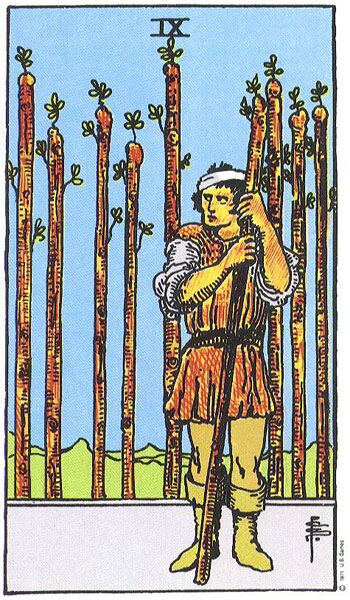
The Nine of Wands tarot card meaning centres on resilience, guardedness, and the knowledge gained through surviving earlier pressure. It can support a final boundary or sustained effort, while asking whether vigilance has become a prison.
I. Card Features (Visual & Symbolic)
In the Rider-Waite tarot system, the Nine of Wands typically presents the following classic image:
- Core Image: A wounded soldier leans against eight wands.
- The Ninth Wand: The soldier holds a ninth wand, remaining vigilant.
- Head Bandage: The soldier's head is wrapped in a bandage, symbolizing past battles.
- Defensive Posture: The soldier leans forward, showing defense and vigilance.
- Background Landscape: Distant hills and a castle, symbolizing goals and home.
- Wand Arrangement: Eight wands stand upright, forming a defensive barrier.
- Color Symbolism: Yellow represents vigilance, green persistence, brown resilience.
This is the classic image of the Rider-Waite system and remains consistent across most modern tarot decks.
II. Energy, Element & Archetypes
1. Energy & Element
- Element: Fire — symbolizing action, persistence, defense, and resilience.
- Number: 9 — symbolizing persistence, defense, vigilance, and the last line of defense.
- Energy Type: Persistent defense, the last line of defense, lessons of experience, inner strength.
2. Archetypes (Archetypal Origins)
- The Guardian: Represents defense, protection, and persistence.
- The Experienced Warrior: Associated with battle experience and lessons.
- The Last Line of Defense: Symbolizes final persistence and defense.
- Inner Resilience: Represents inner strength and resilience.
Open Questions:
Does the Nine of Wands always represent positive defense? Disputed—it may include over-defense.
The relationship of the Nine of Wands to passive defense? Disputed—traditional readings focus more on active persistence.
III. Detailed Upright Meaning
Core Meaning:
"The moment of persistent defense and the last line of defense, gaining inner strength through lessons of experience."
Inner Interpretation:
- Persistent Defense: Holding to position and principles, not giving up easily.
- Lessons of Experience: Learning from past experience, becoming wiser.
- Last Line of Defense: Guarding the final boundary, remaining vigilant.
- Inner Strength: Discovering inner resilience, overcoming difficulty.
- Cautious Action: Thinking carefully before acting, avoiding repeated mistakes.
- Self-Protection: Building necessary defenses, protecting oneself.
- Lasting Endurance: Possessing lasting endurance, persisting to the end.
Common Question Scenarios (Upright):
| Scenario | Interpretation |
|---|---|
| Career Development | Hold your ground, protect achievements, rich in experience. |
| Personal Challenges | Don't back down in the face of difficulty, persist to the end. |
| Relationships | Establish healthy boundaries, protect yourself. |
| Competitive Situations | Defensive strategy, wait for the right moment. |
| Personal Growth | Learn from experience, build resilience. |
IV. Detailed Reversed Meaning
Core Meaning:
"The dilemma of defense—either over-defending, or giving up persistence."
Inner Interpretation:
- Over-Defense: Over-protecting oneself, hard to approach.
- Giving Up Persistence: Giving up out of exhaustion, losing ground.
- Experience as Burden: Past experience becoming a burden, hard to move forward.
- Defense Collapsed: Defensive system collapsing, feeling fragile.
- Excessive Vigilance: Over-vigilance and suspicion, affecting judgment.
- Strength Depleted: Inner strength exhausted, needs recovery.
- Isolated and Unsupported: Isolated by defense, lacking support.
Common Question Scenarios (Reversed):
| Scenario | Interpretation |
|---|---|
| Career Development | Over-defense hindering cooperation, needs openness. |
| Personal Challenges | Giving up out of exhaustion, needs recharging. |
| Relationships | Over-strong defense causing isolation, needs trust. |
| Competitive Situations | Defensive strategy failing, needs adjustment. |
| Personal Growth | Experience becoming a burden, needs to be released. |
V. Deeper Philosophy & Psychological Significance
1. The Dialectic of Defense and Openness
- The Nine of Wands explores the profound theme of self-protection versus interpersonal connection.
- This resonates with the Confucian ideal of "the noble person seeks harmony but not uniformity" and the Daoist wisdom that "to preserve flexibility is called strength."
- In modern psychology, this corresponds to Psychological Boundaries and Psychological Resilience.
2. The Psychological Process of Persistent Defense
- Upright, the Nine of Wands shows a healthy defense mechanism—persistent and wise.
- Reversed, it indicates either over-defense (closing the self off) or giving up persistence (losing ground).
- True wisdom requires balancing self-protection with interpersonal openness.
Open Questions:
Does the Nine of Wands always represent positive defense? Disputed—it may include the isolation that defense brings.
The relationship of the Nine of Wands to modern safety needs? Disputed—traditional readings focus more on spiritual defense.
VI. Interaction with Other Cards (Tarot Combination Reference)
| Combination | Meaning |
|---|---|
| Nine of Wands (Upright) + Strength (Upright) | A perfect union of persistent defense and inner strength. |
| Nine of Wands (Upright) + The Chariot (Upright) | An ideal state of defensive persistence and forward momentum. |
| Nine of Wands (Reversed) + The Devil (Upright) | Over-defense may lead to self-binding. |
| Nine of Wands (Upright) + The Hermit (Upright) | Defensive persistence needs introspection and wisdom. |
| Nine of Wands (Reversed) + The Star (Upright) | Giving up defense brings new hope and openness. |
VII. Summary Comparison Table
| Dimension | Upright | Reversed |
|---|---|---|
| Core Energy | Persistent defense, wisdom of experience | Over-defense, giving up persistence |
| Emotional Tone | Vigilance, resilience, confidence | Exhaustion, doubt, fragility |
| Recommended Action | Stay vigilant, hold your ground | Open up moderately, recharge |
| Relationships | Healthy boundaries, self-protection | Over-defense, distant relationships |
| Self-Relation | Inner strength, wisdom of experience | Depleted strength, burden of experience |
| Keywords | Persistence, defense, resilience, vigilance | Excessive, give up, exhaustion, isolation |
VIII. Clearly Stated Open Questions (Disputed)
The Appropriateness of Defense in the Nine of Wands:
→ Disputed. Is defense always necessary? It may include unwarranted vigilance.The Relationship of the Nine of Wands to Teamwork:
→ Disputed. The balance between individual defense and team collaboration.The Applicability of the Nine of Wands in Modern Society:
→ Disputed. Do modern society's defense needs differ from tradition?Positive Readings of the Reversed Nine of Wands:
→ Disputed. In some situations, giving up defense may be a necessary opening.
Conclusion
The Nine of Wands teaches us that true strength comes from the balance of persistence and openness. Upright, it is the model of persistent defense and the wisdom of experience; reversed, it is an important signal reminding us to be wary of over-defense and to remain open.
In any situation, the Nine of Wands says:
"The strongest defense is not a high wall, but wisdom; not closure, but selective openness."
This is the most profound revelation of the Nine of Wands: the value of protection lies not in isolation, but in selective connection.
Waite's 1910 Pictorial Key Entry
Historical source note: The following records A. E. Waite's card-specific divinatory vocabulary from the supplied 1910 edition. It belongs to one early-twentieth-century method, not a universal meaning system or a guarantee. Historical references to illness, marriage, loss, or other high-stakes outcomes are not diagnoses, professional advice, or certain predictions.
- Upright (Waite): The card signifies strength in opposition. If attacked, the person will meet an onslaught boldly; and his build shews, that he may prove a formidable antagonist. With this main significance there are all its possible adjuncts—delay, suspension, adjournment.
- Reversed (Waite): Obstacles, adversity, calamity.
Source: A. E. Waite, The Pictorial Key to the Tarot (1910), Part III, § 2.