Seven of Swords — Upright and Reversed in Detail
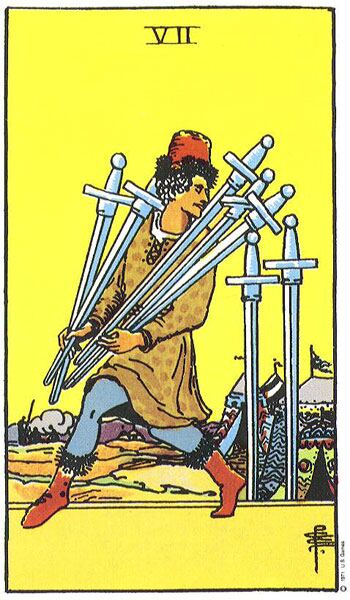
The Seven of Swords tarot card meaning centres on strategy, secrecy, selective disclosure, and the consequences of acting outside the group. It can describe clever independence, but it also asks what must be made explicit for trust and accountability.
I. Card Imagery (Visual and Symbolic)
The Seven of Swords in the Rider-Waite system typically presents the following classic image:
- Central figure: A figure sneaks away with five swords, leaving two in the camp.
- The theft scene: The figure tiptoes away from the camp, with a sly or tense expression.
- Sword distribution: Five swords are stolen, and two remain in place, symbolizing partial success.
- Camp background: In the distance are tents and banners, symbolizing a violated territory.
- Escape posture: The figure departs quickly, symbolizing evasion of responsibility or consequences.
- Color symbolism: Gray represents deception and ambiguity, blue represents cool calculation, and red represents danger and warning.
This is the classic image of the Rider-Waite system, consistent across most modern tarot decks.
II. Energy & Element and Archetypes
1. Energy & Element (Elemental & Thematic)
- Element: Air — symbolizes thought, strategy, deception, and evasion.
- Number: The 7th card (in the Minor Arcana sequence), symbolizing strategy, evasion, partial success, and risk-taking.
- Energy type: Strategy, deception, evasion, risk, partial success.
2. Archetypes (Archetypal Origins)
- The Strategist archetype: Represents the one who uses wit and strategy to achieve a goal.
- The Evader archetype: Associated with evading responsibility and consequences.
- The Risk-Taker archetype: Symbolizes the act of taking risks for gain.
- The Partial Success archetype: Represents the outcome of gaining part rather than complete success.
Points of uncertainty:
Does the Seven of Swords always represent negative deception? Uncertain—strategy itself is neutral and depends on its purpose.
What is the clear distinction between the Seven and Eight of Swords? Uncertain—different traditions understand evasive strategy differently.
III. Upright Meaning in Detail
Core Meaning:
"The art of strategy and risk, achieving partial success through clever evasion."
Inner Interpretation:
- Strategic intelligence: Using wit and strategy to solve problems or achieve goals.
- Risk avoidance: Cleverly sidestepping risk to protect one's own interests.
- Partial success: Gaining partial rather than complete success; further effort is required.
- Independent thinking: Thinking and acting independently, not relying on others.
- Flexible response: Responding flexibly to complex situations, finding a breakthrough point.
- Self-protection: Protecting one's interests and safety, avoiding direct conflict.
- Innovative methods: Using innovative approaches to solve traditional problems.
Upright in Common Questions:
| Scenario | Interpretation |
|---|---|
| Workplace competition | Using strategy to gain an edge in competition, but minding ethical boundaries. |
| Interpersonal relationships | Skillfully managing complex relationships, avoiding direct conflict. |
| Personal development | Thinking independently to solve problems, not blindly following others' opinions. |
| Finance | Using strategy to avoid financial risk and gain partial returns. |
| Health | Adopting innovative approaches to improve health, but sustained commitment is required. |
IV. Reversed Meaning in Detail
Core Meaning:
"Strategy out of balance—either excessive deception, or strategy fails."
Inner Interpretation:
- Strategy fails: A plan or strategy fails, is discovered, or is thwarted.
- Moral issues: Involving moral or legal issues, facing consequences.
- Evasion fails: Evading responsibility fails; reality must be faced.
- Trust broken: Trust is broken, losing the support of others.
- Risk out of control: Risk taken spirals out of control, causing losses.
- Isolation: Isolated by strategy, lacking a support system.
- Self-deception: Self-deception or evasion, unable to face real problems.
Reversed in Common Questions:
| Scenario | Interpretation |
|---|---|
| Workplace competition | Strategy is discovered or fails; a career crisis looms. |
| Interpersonal relationships | Deceptive behavior is discovered; the relationship breaks down. |
| Personal development | Attempts to evade problems fail; real challenges must be faced. |
| Finance | An investment strategy fails, bringing financial loss. |
| Health | Avoiding health issues leads to a worsening situation. |
V. Deeper Philosophical and Psychological Significance
1. The Dialectic of Strategy and Morality
- The Seven of Swords explores the balance between strategy and morality, risk and reward.
- This resonates deeply with the strategic wisdom of "in war, deception is permitted."
- In modern game theory, this corresponds to the concepts of Strategic Thinking and the Risk-Reward Tradeoff.
2. The Psychological Process of Evasion and Confrontation
- The upright Seven of Swords displays healthy strategic intelligence—flexibility without losing morality.
- When reversed, it indicates either excessive strategy (deception) or insufficient strategy (failure).
- True wisdom requires balancing the use of strategy with moral baselines.
Points of uncertainty:
Does the Seven of Swords represent a necessary strategic phase? Uncertain—some problems require direct confrontation.
The relation of the Seven of Swords to modern business strategy? Uncertain—traditional readings focus more on the personal level.
VI. Interaction with Other Cards (Tarot Combination Reference)
| Combination | Meaning |
|---|---|
| Upright Seven of Swords + Upright The Magician | Strategy and action perfectly combined, successfully achieving goals. |
| Upright Seven of Swords + Upright The Hermit | Profound reflection on strategy; wise choices and actions. |
| Reversed Seven of Swords + Upright Justice | Strategy fails and judgment arrives; responsibility must be taken. |
| Upright Seven of Swords + Upright The Star | Strategy brings hope and new possibilities. |
| Reversed Seven of Swords + Upright The Devil | Caught in a trap of deception, morality compromised. |
VII. Summary Comparison Table
| Dimension | Upright | Reversed |
|---|---|---|
| Core energy | Strategic intelligence, risk avoidance | Strategy fails, moral issues |
| Emotional tone | Wit, caution, confidence | Anxiety, fear, regret |
| Suggested action | Continue strategy, remain cautious | Face reality, take responsibility |
| Interpersonal relationships | Skillful handling, avoiding conflict | Trust broken, relationship crisis |
| Relationship with self | Independent thinking, self-protection | Self-deception, isolation |
| Keywords | Strategy, risk, partial success, wisdom | Failure, deception, evasion, consequences |
VIII. Uncertainties Explicitly Noted
The necessity of the Seven of Swords' strategy:
→ Uncertain. Do all complex problems require strategy? Some need direct communication.The link between the Seven of Swords and modern business ethics:
→ Uncertain. Traditional readings emphasize the personal level, but modern applications are broader.The positive role of the Seven of Swords in competition:
→ Uncertain. Does competition always require strategy? Some situations call for cooperation.Positive readings of the reversed Seven of Swords:
→ Uncertain. In some contexts, the failure of strategy may be an opportunity to return to the right path.
Conclusion
The Seven of Swords teaches us that true wisdom comes from balancing strategy with morality. When upright, it is a guide to flexible response and risk avoidance; when reversed, it is an important signal reminding us to balance the use of strategy with moral baselines.
In any context, the Seven of Swords says:
"True strategy is not about deceiving others, but about wisely meeting challenges; true success is not complete victory, but the continuous progress of partial achievement."
This is the most profound revelation of the Seven of Swords: strategy in life is not about defeating others, but about wisely navigating complex situations.
Waite's 1910 Pictorial Key Entry
Historical source note: The following records A. E. Waite's card-specific divinatory vocabulary from the supplied 1910 edition. It belongs to one early-twentieth-century method, not a universal meaning system or a guarantee. Historical references to illness, marriage, loss, or other high-stakes outcomes are not diagnoses, professional advice, or certain predictions.
- Upright (Waite): Design, attempt, wish, hope, confidence; also quarrelling, a plan that may fail, annoyance. The design is uncertain in its import, because the significations are widely at variance with each other.
- Reversed (Waite): Good advice, counsel, instruction, slander, babbling.
Source: A. E. Waite, The Pictorial Key to the Tarot (1910), Part III, § 2.