Seven of Wands
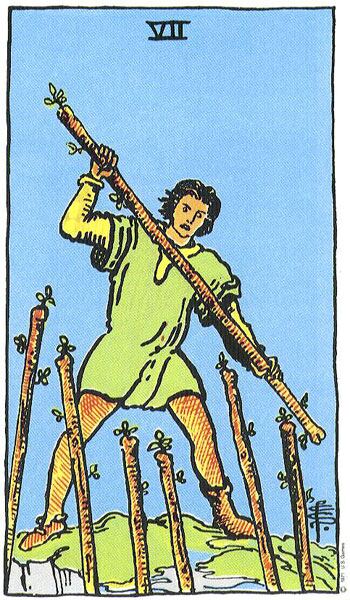
The Seven of Wands tarot card meaning centres on defending a position, protecting a hard-won boundary, and deciding which challenge deserves your energy. It can support courage under pressure, but not endless combat for its own sake.
I. Card Features (Visual & Symbolic)
In the Rider-Waite tarot system, the Seven of Wands typically presents the following classic image:
- Core Image: A figure stands on high ground, holding a wand to fend off the attack of six wands from below.
- Defensive Posture: The figure occupies advantageous terrain, expression firm and alert.
- Wand Distribution: One wand in hand as a weapon, six wands attacking from below.
- High-Ground Advantage: The figure stands on a hill or high ground, symbolizing strategic advantage and defensive position.
- Battle Scene: Symbolizes facing challenges and competition, the need to hold one's ground.
- Color Symbolism: Green represents vitality and persistence, brown stability and rootedness, red courage and battle.
This is the classic image of the Rider-Waite system and remains consistent across most modern tarot decks.
II. Energy, Element & Archetypes
1. Energy & Element
- Element: Fire — symbolizing action, courage, competition, and persistence.
- Number: The 7th card (in the Minor Arcana sequence), symbolizing defense, persistence, competition, and holding one's ground.
- Energy Type: Courage, persistence, defense, competition, holding one's ground.
2. Archetypes (Archetypal Origins)
- The Warrior: Represents one who bravely faces challenges and competition.
- The Defender: Associated with holding one's ground and protecting interests.
- The Competitor: Symbolizes the act of maintaining advantage in competition.
- The Persister: Represents the courage to hold to principle under pressure.
Open Questions:
Does the Seven of Wands always represent positive defense? Disputed—defense itself is neutral, depending on the rightness of one's position.
The clear distinction between the Seven of Wands and the Six of Wands? Disputed—different traditions understand the stages of competition differently.
III. Detailed Upright Meaning
Core Meaning:
"The art of persistence and courage, gaining competitive advantage by holding one's ground."
Inner Interpretation:
- Holding One's Ground: Holding to one's position and principles, not yielding easily.
- Brave Confrontation: Bravely facing challenges and competition, showing courage.
- Strategic Advantage: Occupying an advantageous position, defending against attack effectively.
- Self-Protection: Protecting one's interests and achievements, preventing encroachment.
- Competitive Awareness: Actively participating in competition, striving for due position.
- Holding to Conviction: Holding to one's beliefs and values, unswayed by the outside.
- Defensive Wisdom: Defending wisely rather than attacking blindly, maintaining reason.
Common Question Scenarios (Upright):
| Scenario | Interpretation |
|---|---|
| Workplace Competition | Holding your ground in competition, protecting career achievements and position. |
| Relationships | Maintaining personal boundaries, bravely expressing your needs and position. |
| Personal Development | Persisting in learning despite challenges, not giving up because of difficulty. |
| Finance | Protecting financial interests, preventing unnecessary loss. |
| Health | Maintaining a healthy lifestyle, resisting the temptation of bad habits. |
IV. Detailed Reversed Meaning
Core Meaning:
"Persistence out of balance—either over-defending, or wavering in position."
Inner Interpretation:
- Wavering Position: Unsteady in stance, easily influenced by the outside.
- Over-Defense: Excessive defensiveness or aggression, causing unnecessary conflict.
- Failed Competition: At a disadvantage in competition, hard to maintain position.
- Lack of Courage: Lacking courage to face challenges, choosing evasion.
- Isolated and Unsupported: Isolated because of persistence, lacking a support system.
- Compromised Principles: Compromising principles and values, losing the self.
- Strategic Error: Defensive strategy failing, causing loss.
Common Question Scenarios (Reversed):
| Scenario | Interpretation |
|---|---|
| Workplace Competition | At a disadvantage in competition, or over-defensiveness straining relationships. |
| Relationships | Wavering position leading to relationship confusion, or excessive persistence causing conflict. |
| Personal Development | Choosing evasion in the face of challenge, or persisting in the wrong direction. |
| Finance | Failed financial defense causing loss, or excessive conservatism missing opportunity. |
| Health | Insufficient persistence in health, or over-attention causing psychological pressure. |
V. Deeper Philosophy & Psychological Significance
1. The Dialectic of Persistence and Flexibility
- The Seven of Wands explores the balance of persistence and flexibility, defense and attack.
- This resonates deeply with the military strategist's wisdom of "defense as offense."
- In modern psychology, this corresponds to Self-Assertion and Boundary Setting.
2. The Psychological Process of Courage and Wisdom
- Upright, the Seven of Wands shows the wisdom of healthy persistence—brave without losing reason.
- Reversed, it indicates either excessive persistence (stubbornness) or insufficient persistence (wavering).
- True wisdom requires balancing firm position with flexible response.
Open Questions:
Does the Seven of Wands represent a necessary phase of competition? Disputed—some situations call for cooperation rather than competition.
The connection of the Seven of Wands to modern teamwork? Disputed—traditional readings focus more on the individual level.
VI. Interaction with Other Cards (Tarot Combination Reference)
| Combination | Meaning |
|---|---|
| Seven of Wands (Upright) + Strength (Upright) | A perfect union of courage and gentleness, holding one's ground wisely. |
| Seven of Wands (Upright) + The Chariot (Upright) | Resolute momentum, prevailing in competition. |
| Seven of Wands (Reversed) + The Hermit (Upright) | Need to reflect on the reasonableness of your persistence, adjust strategy. |
| Seven of Wands (Upright) + The Emperor (Upright) | Authoritative persistence, effectively maintaining order and rules. |
| Seven of Wands (Reversed) + The Devil (Upright) | Caught in stubborn or misguided persistence, needs clarity. |
VII. Summary Comparison Table
| Dimension | Upright | Reversed |
|---|---|---|
| Core Energy | Holding ground, brave defense | Wavering position, over-defense |
| Emotional Tone | Firm, confident, alert | Anxious, hesitant, stubborn |
| Recommended Action | Continue to hold, defend wisely | Reflect on your position, adjust strategy |
| Relationships | Maintaining boundaries, brave expression | Tense relationships, isolated and unsupported |
| Self-Relation | Self-assertion, holding to values | Self-doubt, compromised principles |
| Keywords | Persistence, courage, defense, competition | Wavering, evasion, stubbornness, failure |
VIII. Clearly Stated Open Questions (Disputed)
The Inevitability of Persistence in the Seven of Wands:
→ Disputed. Do all conflicts require persistence? Some need compromise and cooperation.The Connection of the Seven of Wands to Modern Conflict Resolution:
→ Disputed. Traditional readings emphasize individual competition, but modern applications focus more on cooperative resolution.The Positive Role of the Seven of Wands in Teams:
→ Disputed. Is individual persistence always needed in a team? Some situations call for collective decision-making.Positive Readings of the Reversed Seven of Wands:
→ Disputed. In some situations, relinquishing persistence may be wisdom rather than weakness.
Conclusion
The Seven of Wands teaches us that true courage comes from the balance of persistence and wisdom. Upright, it is a guide to holding ground and brave defense; reversed, it is an important signal reminding us to balance persistence with flexibility, defense with cooperation.
In any situation, the Seven of Wands says:
"True persistence is not stubbornness, but wisely defending the truth; true courage is not blind combat, but choosing the right battlefield."
This is the most profound revelation of the Seven of Wands: persistence in life is not about defeating others, but about guarding the truth within.
Waite's 1910 Pictorial Key Entry
Historical source note: The following records A. E. Waite's card-specific divinatory vocabulary from the supplied 1910 edition. It belongs to one early-twentieth-century method, not a universal meaning system or a guarantee. Historical references to illness, marriage, loss, or other high-stakes outcomes are not diagnoses, professional advice, or certain predictions.
- Upright (Waite): It is a card of valour, for, on the surface, six are attacking one, who has, however, the vantage position. On the intellectual plane, it signifies discussion, wordy strife; in business—negotiations, war of trade, barter, competition. It is further a card of success, for the combatant is on the top and his enemies may be unable to reach him.
- Reversed (Waite): Perplexity, embarrassments, anxiety. It is also a caution against indecision.
Source: A. E. Waite, The Pictorial Key to the Tarot (1910), Part III, § 2.