Six of Cups
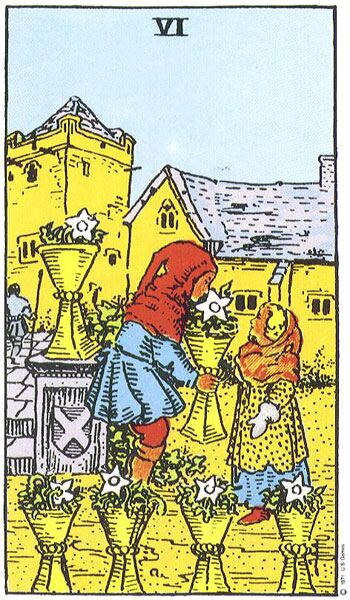
The Six of Cups tarot card meaning centres on memory, tenderness, familiarity, and the ways the past remains active in the present. It can suggest repair or generous connection, while asking whether nostalgia is clarifying the past or editing it.
1. Card Imagery (Visual & Symbolic)
In the Rider-Waite tarot system, the Six of Cups typically presents the following classic image:
- Central figures: A child offers a cup filled with flowers to another child.
- Childhood scene: The scene is set in a tranquil courtyard or garden, filled with a nostalgic atmosphere.
- Arrangement of cups: Of the six cups, five are filled with white flowers, symbolizing innocence and beautiful memories.
- Interaction between figures: An older child gives a cup to a younger child, symbolizing sharing and inheritance.
- Background setting: A castle or old house in the background, symbolizing a safe and familiar environment.
- Color symbolism: Soft tones represent nostalgia, white represents innocence, green represents growth.
This is the classic image of the Rider-Waite tarot system, retained consistently in most modern tarot decks.
2. Energy & Element and Archetypes
1. Energy & Element (Elemental & Thematic)
- Element: Water — symbolizing emotion, memory, nostalgia, and innocence.
- Number: 6 — symbolizing harmony, balance, giving and receiving.
- Energy type: Nostalgic emotion, innocent memory, emotional sharing, the influence of childhood.
2. Archetypes (Archetypal Origins)
- The Child archetype: Represents innocent childhood and beautiful memories.
- The Giver archetype: Associated with selfless sharing and emotional giving.
- The Nostalgic archetype: Symbolizes a tender attachment to the past and emotional connection.
- The Guardian of innocence: Represents the desire to protect innocence and beautiful feeling.
Points of uncertainty:
Does the Six of Cups always represent positive memories? Open to question — it may include selective memory.
The connection between the Six of Cups and modern psychotherapy? Open to question — traditional interpretations focus more on the emotional level.
3. Detailed Upright Meaning
Core Meaning:
"The art of nostalgic emotion and innocent sharing — connecting past and present through beautiful memories."
Inner Interpretation:
- Beautiful memories: Revisiting beautiful childhood memories, feeling pure emotion.
- Emotional sharing: Selflessly sharing emotion and care, building deep connection.
- Return to innocence: Reconnecting with inner innocence, rediscovering simple joys.
- Giving and receiving: Balancing giving and receiving, experiencing the flow of emotion.
- A safe environment: Creating a safe emotional space, fostering healing and growth.
- Inheriting wisdom: Passing beautiful traditions and values to the next generation.
- Emotional healing: Healing emotional wounds through nostalgia, repairing emotional injury.
Upright in Common Questions:
| Scenario | Interpretation |
|---|---|
| Romantic relationships | Revisiting beautiful memories, building innocent connection, sharing emotional care. |
| Family relationships | Family reunions, carrying on family traditions, creating beautiful memories. |
| Personal growth | Connecting with inner innocence, healing childhood wounds, rediscovering simple joys. |
| Career | Creating a warm atmosphere at work, building sincere cooperative relationships. |
| Health | Promoting physical and mental health through nostalgia and emotional connection. |
4. Detailed Reversed Meaning
Core Meaning:
"The imbalance of nostalgic emotion — either dwelling in the past, or refusing to remember."
Inner Interpretation:
- Dwelling on the past: Overindulging in memories, unable to live in the present.
- Refusing memory: Refusing to face the past, especially painful memories.
- Emotional imbalance: An imbalance between giving and receiving — either overgiving or refusing to receive.
- False innocence: Feigning innocence, hiding true feelings.
- Childhood influence: Overly influenced by childhood experience, unable to form mature relationships.
- Emotional dependence: Over-reliance on past emotional patterns, lacking independence.
- Distorted memory: Selective memory or distorted recollection, unable to view the past objectively.
Reversed in Common Questions:
| Scenario | Interpretation |
|---|---|
| Romantic relationships | Dwelling on past relationships, or refusing to face emotional issues. |
| Family relationships | Family conflicts rooted in unresolved past conflicts. |
| Personal growth | Bound by childhood wounds, unable to form a mature self. |
| Career | Nostalgia hindering career progress; real challenges must be faced. |
| Health | Emotional issues affecting physical health; psychological support is needed. |
5. Deeper Philosophical and Psychological Meaning
1. The Dialectic of Past and Present
- The Six of Cups explores the profound theme of how to connect past and present in a healthy way.
- This resonates with the Confucian wisdom of "reviewing the old to gain new insight."
- In modern psychology, this corresponds to the concepts of Attachment Theory and Childhood Influences.
2. The Psychological Process of Nostalgia
- The upright Six of Cups shows healthy nostalgia — connecting with the past without being bound by it.
- When reversed, it indicates either overindulgence (unable to move forward) or refusal to remember (unable to heal).
- True wisdom requires balancing memory and the present, innocence and maturity.
Points of uncertainty:
Does the Six of Cups always represent a positive childhood? Open to question — it may include idealized memory.
The connection between the Six of Cups and modern nostalgic culture? Open to question — traditional interpretations focus more on personal emotion.
6. Interaction with Other Cards (Tarot Combination Reference)
| Combination | Meaning |
|---|---|
| Upright Six of Cups + Upright The Sun | A perfect union of innocent joy and bright hope. |
| Upright Six of Cups + Upright The Hermit | Gaining inner wisdom and reflection through nostalgia. |
| Reversed Six of Cups + Upright The Devil | Bound by past emotional patterns, unable to break free. |
| Upright Six of Cups + Upright The World | Beautiful memories leading to fulfillment and a sense of completion. |
| Reversed Six of Cups + Upright The Tower | Need to break attachment to the past in order to move forward. |
7. Summary Comparison Table
| Dimension | Upright | Reversed |
|---|---|---|
| Core energy | Nostalgic emotion, innocent sharing | Dwelling on the past, refusing to remember |
| Emotional tone | Warm, nostalgic, grateful | Sentimental, evasive, imbalanced |
| Suggested action | Revisit beauty, share emotion | Live in the present, face reality |
| Interpersonal relationships | Sincere sharing, building connection | Emotional dependence, imbalanced relationships |
| Self-relationship | Connecting with innocence, emotional healing | Self-deception, growth stagnation |
| Keywords | Memory, sharing, innocence, healing | Indulgence, refusal, dependence, distortion |
8. Points of Uncertainty Explicitly Noted
The authenticity of Six of Cups memories:
→ Open to question. Do the beautiful memories truly exist, or are they idealized?The relationship between the Six of Cups and childhood trauma:
→ Open to question. Are all childhoods worth missing? Selective memory may be at play.The applicability of the Six of Cups in modern society:
→ Open to question. The difference between traditional notions of innocence and modern complex emotion.Positive interpretation of the reversed Six of Cups:
→ Open to question. In some contexts, letting go of the past may be necessary growth.
Conclusion
The Six of Cups teaches us that true innocence comes from consciously connecting past and present. Upright, it is a model of beautiful memory and emotional sharing; reversed, it is an important signal reminding us to balance nostalgia with reality.
In any context, the Six of Cups says:
"True nostalgia is not escaping reality, but drawing strength from the past; true innocence is not ignorance, but choosing to see beauty."
This is the most profound revelation of the Six of Cups: the beauty of the past is not a memory to drown in, but a wisdom to carry forward.
Waite's 1910 Pictorial Key Entry
Historical source note: The following records A. E. Waite's card-specific divinatory vocabulary from the supplied 1910 edition. It belongs to one early-twentieth-century method, not a universal meaning system or a guarantee. Historical references to illness, marriage, loss, or other high-stakes outcomes are not diagnoses, professional advice, or certain predictions.
- Upright (Waite): A card of the past and of memories, looking back, as—for example—on childhood; happiness, enjoyment, but coming rather from the past; things that have vanished. Another reading reverses this, giving new relations, new knowledge, new environment, and then the children are disporting in an unfamiliar precinct.
- Reversed (Waite): The future, renewal, that which will come to pass presently.
Source: A. E. Waite, The Pictorial Key to the Tarot (1910), Part III, § 2.