Six of Pentacles — Upright & Reversed in Detail
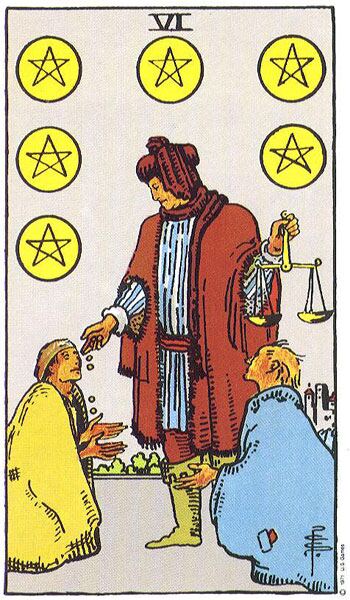
The Six of Pentacles tarot card meaning centres on exchange, generosity, resources, and the power differences that can shape giving and receiving. Its most useful question is not simply who has more, but whether the arrangement is fair, transparent, and sustainable.
I. Card Characteristics (Visual & Symbolic)
In the Rider-Waite Tarot system, the Six of Pentacles typically presents the following classic scene:
- Core image: A wealthy merchant is giving pentacles to two beggars in charity.
- The charity scene: The merchant holds a balance scale, symbolizing fairness and balanced giving.
- Distribution of the pentacles: The merchant gives a pentacle with the left hand and is about to give another with the right.
- Figure relationship: The rich man stands, the beggars kneel to receive, symbolizing a relationship of power and dependence.
- Environmental background: A marketplace or town square, symbolizing social and economic activity.
- Symbol of the scale: The hand-held scale represents fair distribution and the principle of justice.
- Color symbolism: Gold represents wealth, red represents power, and gray represents dependence.
This is the classic image of the Rider-Waite system and remains consistent across most modern Tarot decks.
II. Energy, Element & Archetypes
1. Energy & Element
- Element: Earth — symbolizing matter, wealth, fairness, and exchange.
- Number: 6 — symbolizing balance, fairness, giving, and receiving.
- Energy type: Wealth distribution, fair exchange, charitable giving, power dynamics.
2. Origins & Archetypes
- The Philanthropist archetype: Represents generous giving and the sharing of wealth.
- The Fair Distributor: Associated with the fair distribution of resources and the principle of justice.
- Power relations: Symbolizes the power dynamics between giver and receiver.
- Social exchange: Represents material exchange and dependency within society.
Points of ambiguity:
Does the Six of Pentacles always represent positive charity? Ambiguous—it may entail unequal power.
Its connection to modern welfare systems? Ambiguous—traditional readings focus more on personal charity.
III. Upright Meaning in Detail
Core Meaning:
"The art of financial fairness and charitable giving—building harmonious relationships through balanced distribution."
Internal Interpretation:
- Fair distribution: Distributing resources according to principles of fairness, ensuring justice.
- Charitable giving: Generously sharing wealth and resources, helping others.
- Balanced exchange: Maintaining balance between giving and receiving, building reciprocal relationships.
- Social responsibility: Bearing social responsibility, giving back to society.
- Wealth flow: Maintaining the healthy circulation of wealth, avoiding hoarding.
- Grateful acceptance: Knowing how to receive help with gratitude, remaining humble.
- Harmonious relationships: Building harmonious social relationships through fair exchange.
Common Scenarios (Upright):
| Scenario | Interpretation |
|---|---|
| Finance | Distributing wealth fairly, charitable donation, obtaining stable income. |
| Career development | Fair compensation, rational distribution of team resources, gaining recognition. |
| Interpersonal relationships | Reciprocal relationships, fair emotional exchange. |
| Social engagement | Participating in charity, bearing social responsibility. |
| Personal growth | Learning the balance of giving and receiving, cultivating generosity. |
IV. Reversed Meaning in Detail
Core Meaning:
"Imbalance in wealth distribution—either unfair giving or dependency."
Internal Interpretation:
- Unfair distribution: Unfair distribution of resources, favoritism or discrimination.
- Abuse of power: Using wealth to exert control, establishing dependency.
- False charity: Charity on the surface but control underneath, hidden true motives.
- Over-dependence: Over-relying on others' help, lacking self-reliance.
- Hoarding of wealth: Hoarding wealth excessively, refusing to share.
- Difficulty receiving: Difficulty accepting help, excessive pride.
- Imbalanced relationships: Imbalance in giving and receiving, breeding resentment.
Common Scenarios (Reversed):
| Scenario | Interpretation |
|---|---|
| Finance | Unfair compensation, financial dependence, impure charitable motives. |
| Career development | Workplace injustice, biased resource distribution, dependence on superiors. |
| Interpersonal relationships | Unequal relationships, emotional blackmail, over-dependence. |
| Social engagement | False charity, social injustice, abuse of power. |
| Personal growth | Self-esteem issues, difficulty accepting help, a dependent mindset. |
V. Deeper Philosophical & Psychological Significance
1. The Dialectic of Giving and Receiving
- The Six of Pentacles explores the profound themes of wealth distribution and social justice.
- This resonates with the Confucian wisdom of "the benevolent love others" and the Mohist ideal of "universal love."
- In modern psychology, it corresponds to the concepts of the Reciprocity Principle and Power Dynamics.
2. The Psychological Process of Wealth Ethics
- Upright, the Six of Pentacles shows a healthy distribution of wealth—fair and generous.
- Reversed, it is either unfair distribution (abuse of power) or dependency (lack of self-reliance).
- True wisdom requires balancing personal interest with social responsibility.
Points of ambiguity:
Does the Six of Pentacles always represent positive charity? Ambiguous—it may include the giver's sense of superiority.
Its connection to modern capitalism? Ambiguous—traditional readings focus more on the moral dimension.
VI. Interaction with Other Cards (Tarot Combinations)
| Combination | Meaning |
|---|---|
| Upright Six of Pentacles + Upright Justice | The perfect union of fair distribution and the principle of justice. |
| Upright Six of Pentacles + Upright Ten of Pentacles | The ideal state of abundant wealth and generous sharing. |
| Reversed Six of Pentacles + Upright The Devil | The double predicament of wealth control and material bondage. |
| Upright Six of Pentacles + Upright The Empress | The harmonious union of abundant giving and nurturing care. |
| Reversed Six of Pentacles + Upright The Tower | Unfair distribution may lead to systemic collapse. |
VII. Summary Comparison Table
| Dimension | Upright | Reversed |
|---|---|---|
| Core energy | Fair distribution, charitable giving | Unfairness, abuse of power |
| Emotional tone | Generosity, fairness, gratitude | Unfairness, control, dependence |
| Suggested action | Share fairly, bear responsibility | Reassess, establish self-reliance |
| Interpersonal relationships | Reciprocity, harmonious relationships | Inequality, dependent relationships |
| Self-relation | Generosity, social responsibility | Self-esteem issues, a dependent mindset |
| Keywords | Fairness, charity, balance, flow | Injustice, control, dependence, hoarding |
VIII. Points of Ambiguity to Note
The purity of the Six of Pentacles' charity:
→ Ambiguous. Is charity always selfless? It may include self-gratification.Its connection to the modern welfare state:
→ Ambiguous. The philosophical difference between personal charity and institutional welfare.The role of the Six of Pentacles in business ethics:
→ Ambiguous. The balance between commercial interest and social responsibility.Positive readings of the reversed Six of Pentacles:
→ Ambiguous. In some contexts, refusing dependence may be a necessary act of self-reliance.
Conclusion
The Six of Pentacles teaches us that true wealth arises from fair distribution and generous sharing. Upright, it is a model of financial fairness and charitable giving; reversed, it is an important signal warning us to be wary of power abuse and dependency.
In any context, the Six of Pentacles says:
"True generosity is not charity but respect; true fairness is not sameness but justice."
This is the profoundest revelation of the Six of Pentacles: the value of wealth lies not in how much one possesses, but in how it is shared.
Waite's 1910 Pictorial Key Entry
Historical source note: The following records A. E. Waite's card-specific divinatory vocabulary from the supplied 1910 edition. It belongs to one early-twentieth-century method, not a universal meaning system or a guarantee. Historical references to illness, marriage, loss, or other high-stakes outcomes are not diagnoses, professional advice, or certain predictions.
- Upright (Waite): Presents, gifts, gratification another account says attention, vigilance now is the accepted time, present prosperity, etc.
- Reversed (Waite): Desire, cupidity, envy, jealousy, illusion.
Source: A. E. Waite, The Pictorial Key to the Tarot (1910), Part III, § 2.