Six of Swords — Upright and Reversed in Detail
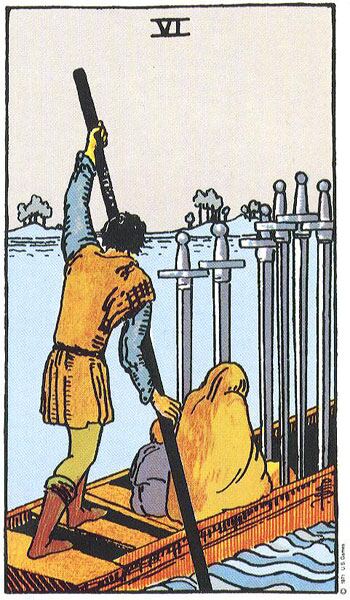
The Six of Swords tarot card meaning centres on transition, departure, and the gradual movement from turbulence toward a more workable shore. It does not erase grief; it asks what support, distance, and practical route make the crossing possible.
I. Card Imagery (Visual and Symbolic)
The Six of Swords in the Rider-Waite system typically presents the following classic image:
- Central figure: A small boat sails on calm water, carrying a boatman, a passenger, and six swords.
- Direction of travel: Sailing from the left side of the image (symbolizing the past hardship) toward the right (symbolizing the future and hope), the water gradually shifts from turbulent to calm.
- Figure characteristics: The passenger usually bows in thought or is wrapped in a cloak, while the boatman focuses on rowing; the two move forward in silence.
- Sword symbolism: Six swords stand upright in the boat, not touching the water, symbolizing mental burdens being safely transported but not yet resolved.
- Water changes: The water on the left has waves (symbolizing past turmoil), while the water on the right is calm (symbolizing future peace).
- Color symbolism: Blue represents calm and reason, gray represents transition, and yellow represents hope and new beginnings.
This is the classic image of the Rider-Waite system, consistent across most modern tarot decks.
II. Energy & Element and Archetypes
1. Energy & Element (Elemental & Thematic)
- Element: Air — symbolizes thought, communication, reason, and transition.
- Number: The 6th card of the suit, symbolizing harmony, balance, transition, and healing.
- Energy type: A transitional period, a journey of healing, rational forward movement, from hardship to peace.
2. Archetypes (Archetypal Origins)
- The Transition archetype: Represents the necessary transitional phase in life, the shift from a difficult period to a better state.
- The Ferryman archetype: The boatman symbolizes the guide and helper, who assists in crossing troubled waters.
- The Healing Journey: The gradual recovery from trauma or hardship, slow but steady progress.
- Rational Voyage: Meeting challenges through reason and planning rather than emotional reaction.
Points of uncertainty:
Does the Six of Swords refer to a specific historical or mythological transition? Uncertain—it is more broadly a symbol of universal human transition.
Who is the boatman specifically? Uncertain—he may represent a professional helper, inner wisdom, or fate itself.
III. Upright Meaning in Detail
Core Meaning:
"A rational transition from hardship to peace, a slow but steady journey of healing."
Inner Interpretation:
- A necessary transition: Currently in the process of moving from a difficult period toward a better state—slow, but in the right direction.
- Rational forward movement: Meeting challenges through calm thought and planning rather than emotional reaction.
- A healing journey: Gradually recovering and healing from trauma, loss, or hardship.
- Seeking help: Willing to accept the help and guidance of others in navigating hardship.
- Calm progress: Although carrying the burdens of the past, one is able to maintain peace and hope and move forward.
- Clear direction: Knowing where one is headed, with a clear goal, even if the road is long.
- Emotional stability: The ability to manage emotions, not allowing past pain to obstruct present progress.
Upright in Common Questions:
| Scenario | Interpretation |
|---|---|
| Love & Relationships | The relationship is transitioning from conflict toward harmony and may need time to heal old wounds. Singles are recovering from a past relationship. |
| Career & Wealth | The work environment or career direction is improving—slowly, but with promising prospects. Professional guidance may be needed. |
| Personal Growth | Gradually recovering from psychological trauma or difficult experiences, moving toward emotional stability and inner peace. |
| Health | Health is improving; recovery is slow but steady, requiring patience and consistent treatment. |
| Decision dilemma | The advice is to adopt a rational attitude, seek professional help, and trust in slow but steady progress. |
IV. Reversed Meaning in Detail
Core Meaning:
"Transition obstructed—either refusing to change, or problems arising within the transition."
Inner Interpretation:
- Refusal to transition: Stubbornly staying in hardship, refusing necessary change and forward movement.
- Transition difficulties: The process of change meets obstacles or delays and cannot move forward as intended.
- Emotional flooding: Past pain and emotion overwhelm reason, making effective progress impossible.
- Isolation without support: Refusing help, attempting to cope alone but unable to manage.
- Lost direction: Uncertain where to go, lacking clear goals and direction.
- Stagnation: Feeling stuck in the transition, unable to reach the other shore.
- Healing obstructed: Recovery meets setbacks; old wounds recur or new difficulties arise.
Reversed in Common Questions:
| Scenario | Interpretation |
|---|---|
| Love & Relationships | Improvement in the relationship is obstructed; one party may refuse to change. Old problems recur, and the healing process is difficult. |
| Career & Wealth | Career transition meets obstacles; there may be a lack of clear direction or external resistance. |
| Personal Growth | Psychological healing stagnates; one may be bound by past trauma and unable to look forward. |
| Health | Recovery meets setbacks; the treatment plan may need adjustment or new health challenges must be faced. |
| Decision dilemma | A warning against refusing necessary change; the transition plan may need to be re-evaluated. |
V. Deeper Philosophical and Psychological Significance
1. The Necessity of Transition
- The Six of Swords emphasizes the importance of necessary transitional phases in life, without which growth is impossible.
- This resonates deeply with the Daoist idea of "the transformation of yin and yang" and the Buddhist principle of "impermanence."
- In modern psychology, this corresponds to the concept of Post-Traumatic Growth.
2. The Balance of Reason and Emotion
- The upright Six of Swords shows how to guide emotion with reason, rather than suppressing it.
- When reversed, it indicates either excessive rationality (refusing to feel) or emotional loss of control.
- True healing requires the integration of rational understanding and emotional experience.
Points of uncertainty:
Does the Six of Swords always represent a positive transition? Uncertain—in some readings it may hint at evasion rather than genuine resolution.
Is the boatman always a benevolent helper? Uncertain—in some contexts he may represent forced change.
VI. Interaction with Other Cards (Tarot Combination Reference)
| Combination | Meaning |
|---|---|
| Upright Six of Swords + Upright The Star | Hope inevitably follows transition; light comes after darkness. |
| Upright Six of Swords + Reversed Nine of Swords | Gradually recovering from a nightmarish hardship. |
| Reversed Six of Swords + Upright Ten of Swords | Refusing transition may lead to greater pain and finality. |
| Upright Six of Swords + Upright Temperance | Successfully navigating the transition through balance and reconciliation. |
| Reversed Six of Swords + Upright Death | A greater change must be accepted before one can move forward. |
VII. Summary Comparison Table
| Dimension | Upright | Reversed |
|---|---|---|
| Core energy | Rational transition, healing forward movement | Transition obstructed, refusing change |
| Emotional tone | Calm, hope, patience | Anxiety, stubbornness, confusion |
| Suggested action | Accept help, move forward patiently | Re-evaluate, embrace change |
| Interpersonal relationships | Seek support, accept guidance | Isolation without help, refusing assistance |
| Relationship with self | Rational healing, emotional management | Emotional loss of control, self-binding |
| Keywords | Transition, healing, reason, hope | Stagnation, refusal, difficulty, being lost |
VIII. Uncertainties Explicitly Noted
The nature of the Six of Swords' transition:
→ Uncertain. Some readings consider the Six of Swords a positive healing transition, while others hold that it may hint at evading problems rather than truly resolving them.The identity and intent of the boatman:
→ Uncertain. The boatman is usually seen as a helper, but in some readings he may represent a forced change imposed by fate or external intervention.The relationship between the Six of Swords and "evasion":
→ Uncertain. The upright card is usually not seen as evasion, but reversed it may suggest using transition to avoid genuine problem-solving.The duration of the transition:
→ Uncertain. The Six of Swords does not specify how long the transition will take; it may vary by situation.
Conclusion
The Six of Swords teaches us that necessary transitions are part of growth. When upright, it is a guide to rational forward movement and gradual healing; when reversed, it reminds us not to refuse necessary change.
In any context, the Six of Swords says:
"True courage is not the absence of fear, but continuing forward in spite of it; true wisdom is not avoiding transition, but learning how to transition."
This is the most profound revelation of the Six of Swords: transition itself is not the goal, but the necessary path to a better state.
Waite's 1910 Pictorial Key Entry
Historical source note: The following records A. E. Waite's card-specific divinatory vocabulary from the supplied 1910 edition. It belongs to one early-twentieth-century method, not a universal meaning system or a guarantee. Historical references to illness, marriage, loss, or other high-stakes outcomes are not diagnoses, professional advice, or certain predictions.
- Upright (Waite): journey by water, route, way, envoy, commissionary, expedient.
- Reversed (Waite): Declaration, confession, publicity; one account says that it is a proposal of love.
Source: A. E. Waite, The Pictorial Key to the Tarot (1910), Part III, § 2.