Six of Wands
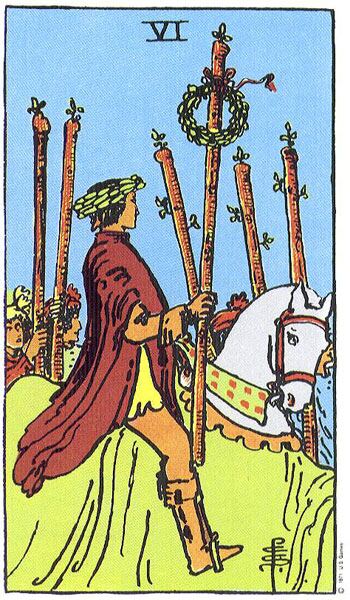
The Six of Wands tarot card meaning centres on recognition, visible progress, confidence, and the social dimension of achievement. It can celebrate a milestone, while asking whether praise is being used to strengthen the work rather than replace it.
I. Card Features (Visual & Symbolic)
In the Rider-Waite tarot system, the Six of Wands typically presents the following classic image:
- Core Image: A victorious knight rides a white horse, holding a wand.
- Victorious Posture: The knight raises the wand high, symbolizing victory and achievement.
- Crowd Cheering: The surrounding crowd cheers and celebrates, symbolizing public recognition.
- White Horse Symbolism: The white steed represents purity, strength, and triumph.
- Wand Decoration: The wand is decorated with a victory wreath, symbolizing honor.
- Setting: An open plain or battlefield, symbolizing conquest and expansion.
- Color Symbolism: Red represents passion, white purity, and green hope.
This is the classic image of the Rider-Waite system and remains consistent across most modern tarot decks.
II. Energy, Element & Archetypes
1. Energy & Element
- Element: Fire — symbolizing action, passion, victory, and achievement.
- Number: 6 — symbolizing harmony, balance, victory, and recognition.
- Energy Type: Victory celebration, public recognition, achievement and glory, leadership position.
2. Archetypes (Archetypal Origins)
- The Victor: Represents success, achievement, and victory.
- The Returning Hero: Associated with heroic triumph and public recognition.
- Leadership Authority: Symbolizes a leadership position and recognized authority.
- Social Recognition: Represents social standing and public praise.
Open Questions:
Does the Six of Wands always represent true success? Disputed—it may include hollow victory.
The relationship of the Six of Wands to inner fulfillment? Disputed—traditional readings focus more on external recognition.
III. Detailed Upright Meaning
Core Meaning:
"The glory of victory and the moment of public recognition; achieving due accomplishment and status through effort."
Inner Interpretation:
- Victorious Achievement: Gaining significant success and achievement, realizing goals.
- Public Recognition: Gaining the recognition and praise of others, building reputation.
- Leadership Position: Establishing a leadership position and authority, earning respect.
- Enhanced Confidence: Self-confidence notably increased, filled with a sense of power.
- Goal Achieved: Long-term goals realized, reaping the rewards.
- Team Recognition: Gaining recognition from team or organization, establishing prestige.
- Positive Influence: Success produces positive influence, inspiring others.
Common Question Scenarios (Upright):
| Scenario | Interpretation |
|---|---|
| Career Development | Earning a promotion, project success, recognition from leadership. |
| Personal Achievement | Completing an important goal, receiving awards and honors. |
| Relationships | Gaining the respect of others, building a good reputation. |
| Competitive Situations | Winning a competition, prevailing over opponents, gaining victory. |
| Personal Growth | Boosted self-confidence, enhanced sense of self-worth. |
IV. Detailed Reversed Meaning
Core Meaning:
"The shadow of victory—either delayed success, or hollow glory."
Inner Interpretation:
- Delayed Success: Success is postponed or obstructed, requiring patience.
- Hollow Victory: Surface victory lacking substance, driven by vanity.
- Excessive Arrogance: Success leads to pride and complacency, losing humility.
- Jealousy and Attack: Success provokes others' jealousy, meeting resistance.
- Lack of Recognition: Effort fails to receive due recognition, feeling lost.
- Leadership Crisis: Leadership position challenged, authority shaken.
- Pressure of Success: Success brings new pressure, hard to bear.
Common Question Scenarios (Reversed):
| Scenario | Interpretation |
|---|---|
| Career Development | Promotion obstructed, project delayed, recognition lacking. |
| Personal Achievement | Success questioned, honors disputed, feeling lost. |
| Relationships | Encountering jealousy, tense relationships, reduced support. |
| Competitive Situations | Losing a competition, strong opponents, confidence shaken. |
| Personal Growth | Pride and complacency, lack of humility, growth stalled. |
V. Deeper Philosophy & Psychological Significance
1. The Dialectic of Success and Humility
- The Six of Wands explores the profound theme of external success versus inner fulfillment.
- This resonates with the Confucian ideal of "being courteous despite wealth" and the Daoist wisdom of "retiring after success is achieved."
- In modern psychology, this corresponds to Achievement Motivation and Self-efficacy.
2. The Psychological Process of Triumphant Glory
- Upright, the Six of Wands shows a healthy experience of success—effort rewarded with recognition.
- Reversed, it indicates either delayed success (external obstruction) or hollow victory (inner emptiness).
- True wisdom requires balancing external recognition with inner fulfillment.
Open Questions:
Does the Six of Wands always represent positive success? Disputed—it may include the pressure that success brings.
The connection of the Six of Wands to modern success studies? Disputed—traditional readings focus more on the moral dimension of success.
VI. Interaction with Other Cards (Tarot Combination Reference)
| Combination | Meaning |
|---|---|
| Six of Wands (Upright) + The Sun (Upright) | A perfect union of glorious victory and a bright future. |
| Six of Wands (Upright) + The World (Upright) | Major achievement and ideal completion. |
| Six of Wands (Reversed) + The Tower (Upright) | Hollow victory may lead to sudden collapse. |
| Six of Wands (Upright) + The Chariot (Upright) | A harmonious unity of victorious advance and resolute will. |
| Six of Wands (Reversed) + The Hermit (Upright) | Delayed success may require introspection and patience. |
VII. Summary Comparison Table
| Dimension | Upright | Reversed |
|---|---|---|
| Core Energy | Glorious victory, public recognition | Delayed success, hollow victory |
| Emotional Tone | Pride, joy, confidence | Loss, doubt, pressure |
| Recommended Action | Celebrate success, maintain humility | Reassess, cultivate patience |
| Relationships | Earning respect, building reputation | Encountering jealousy, tense relationships |
| Self-Relation | Enhanced confidence, strong sense of worth | Pride and complacency, lack of humility |
| Keywords | Victory, recognition, achievement, glory | Delay, hollow, jealousy, pressure |
VIII. Clearly Stated Open Questions (Disputed)
The Durability of the Six of Wands' Victory:
→ Disputed. Will the victory last? It may be only a fleeting success.The Relationship of the Six of Wands to Inner Fulfillment:
→ Disputed. Does external success equal inner happiness? There may be a gap.The Role of the Six of Wands in Teamwork:
→ Disputed. The balance between individual victory and team success.Positive Readings of the Reversed Six of Wands:
→ Disputed. In some situations, delayed success may be a necessary process of growth.
Conclusion
The Six of Wands teaches us that true victory comes from the balance of effort and humility. Upright, it is the model of glorious success and public recognition; reversed, it is an important signal reminding us to be wary of hollow victory and to maintain patience.
In any situation, the Six of Wands says:
"True victory is not conquering others, but surpassing oneself; not gaining applause, but earning respect."
This is the most profound revelation of the Six of Wands: the value of success lies not in external glory, but in inner growth.
Waite's 1910 Pictorial Key Entry
Historical source note: The following records A. E. Waite's card-specific divinatory vocabulary from the supplied 1910 edition. It belongs to one early-twentieth-century method, not a universal meaning system or a guarantee. Historical references to illness, marriage, loss, or other high-stakes outcomes are not diagnoses, professional advice, or certain predictions.
- Upright (Waite): The card has been so designed that it can cover several significations; on the surface, it is a victor triumphing, but it is also great news, such as might be carried in state by the King's courier; it is expectation crowned with its own desire, the crown of hope, and so forth.
- Reversed (Waite): Apprehension, fear, as of a victorious enemy at the gate; treachery, disloyalty, as of gates being opened to the enemy; also indefinite delay.
Source: A. E. Waite, The Pictorial Key to the Tarot (1910), Part III, § 2.