Strength — Upright & Reversed in Detail
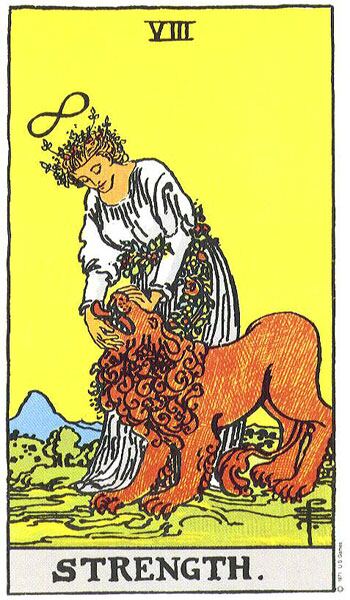
The Strength tarot card meaning centres on calm courage, self-mastery, and influence without force. Upright, it invites patient and compassionate action; reversed, it asks whether fear, over-control, or depletion is distorting your response.
I. Card Imagery (Visual & Symbolic)
In the Rider-Waite system, Strength typically presents the following classic scene:
- Central figure: An elegant woman (sometimes interpreted as a goddess or priestess) gently tames a lion's jaws with her bare hands.
- Posture: The woman is calm and serene, using no violence or force, but rather inner strength and gentle control to subdue the lion.
- Lion symbolism: The lion represents raw desire, instinct, fear, and wild force — powerful but untamed energy within the subconscious.
- Infinity symbol (∞): Above the woman's head usually appears an infinity symbol, signifying eternal spiritual power and infinite inner potential.
- Wreath and garments: The woman often wears a wreath (symbolizing connection to nature) and a white robe (symbolizing purity and spiritual power).
- Color symbolism: Yellow/gold for the sun and vitality, red for passion and courage, green for nature and growth, white for purity and spirit.
This is the classic imagery of the Rider-Waite system, consistent across most modern tarot decks.
II. Energy Elements & Archetypes
1. Energy Elements (Elemental & Thematic)
- Element: Fire — symbolizing will, courage, passion, and action.
- Number: 8 (in the Major Arcana sequence), forming a contrast with Justice (11), emphasizing that inner strength precedes outer balance.
- Energy type: Courage, patience, gentle power, self-mastery, inner harmony.
2. Archetypal Origins
- Christian Virtues: Strength is one of the seven cardinal virtues, alongside Temperance and Justice, representing moral courage and spiritual power.
- Greek mythology: Often associated with Hercules' taming of the Nemean Lion among his twelve labors, though the female figure in the card emphasizes gentle control rather than violent conquest.
- Egyptian mythology: May relate to the lioness goddess Sekhmet, though the card emphasizes control rather than destructive power.
- Archetypal imagery:
- The Gentle Controller: Mastering situations through love and understanding rather than violence
- The Inner Warrior: Courage and patience in the face of fear and challenge
- The Soul Tamer: Wisdom that tames the inner beast (desire, anger, fear)
Points of uncertainty:
Does Strength correspond directly to a specific Greek mythological story? Uncertain. Though often linked to Hercules, the card's spirit is closer to the Christian virtue tradition.
Does the female figure refer to a specific goddess? Uncertain. She may be a synthesis of feminine power symbols across multiple cultures.
III. Upright Meaning in Detail
Core Meaning:
"Harnessing inner strength through gentleness and patience; overcoming challenges with courage rather than violence."
Inner Interpretation:
- Gentle Power: True strength is shown not through suppression or violence but through understanding, patience, and compassion.
- Courage Before Fear: You have the ability to face inner fears, desires, and unease, handling them with calmness and confidence.
- Self-Mastery: Able to control your emotions, impulses, and instinctive reactions, demonstrating a high degree of self-discipline and inner balance.
- Patience & Perseverance: Maintaining patience in difficulty, trusting that sustained effort and the right approach will achieve the goal.
- Inner Harmony: The conflicting forces within (reason and feeling, courage and fear) reach a state of harmonious unity.
- Compassion & Understanding: Showing tolerance and understanding for others' weaknesses and mistakes, helping them in constructive ways.
- Spiritual Power: Power that transcends the material plane, demonstrating spiritual resilience and moral courage.
Common Question Scenarios (Upright):
| Scenario | Interpretation |
|---|---|
| Love & Relationships | Patience and understanding can resolve conflicts in the relationship without resorting to arguments or control. Singles show confidence and attraction. |
| Career Development | Remaining calm in the face of work challenges, solving problems through professional skill and interpersonal tact. Leadership takes the form of inspiration rather than command. |
| Personal Growth | Overcoming inner fears or unhealthy habits, achieving self-improvement through self-discipline and patience. |
| Health | Good physical and mental state; able to overcome health challenges through willpower. May need to engage in emotional management or stress control. |
| Decision Dilemmas | Advises handling problems with a gentle but firm attitude, avoiding extreme reactions. Trust your inner strength. |
IV. Reversed Meaning in Detail
Core Meaning:
"Strength out of control — either over-suppression or over-indulgence, inner balance lost."
Inner Interpretation:
- Abuse of Power: May manifest as over-control or autocracy, attempting to solve problems through force rather than understanding.
- Fear Dominates: Inner fears and unease gain the upper hand, leading to indecision, lack of confidence, or evading challenges.
- Emotional Loss of Control: Unable to manage emotions effectively, may manifest as irritability, anxiety, depression, or emotional outbursts.
- Self-Doubt: Doubting your abilities and worth, lacking the necessary courage and confidence to face life's challenges.
- Over-indulgence: Losing control over desires and instincts, possibly manifesting as addictive behavior, impulsive spending, or unhealthy dependence in relationships.
- Weakness and Powerlessness: Feeling overwhelmed by life, lacking the inner resources and resilience to cope with difficulty.
- Inner-Outer Conflict: The forces within clash without achieving harmony, leading to mental exhaustion and inner turmoil.
Common Question Scenarios (Reversed):
| Scenario | Interpretation |
|---|---|
| Love & Relationships | Over-control or over-dependence may appear. Communication lacks patience and is prone to emotional reactions. |
| Career Development | May feel inadequate at work, or take a hardline approach leading to team conflict. Lacking the ability to cope with pressure. |
| Personal Growth | Bound by inner fears or bad habits, lacking the courage to change and the perseverance to persist. |
| Health | Physical health may be affected by stress or emotional issues. Need to attend to mental health and emotional management. |
| Decision Dilemmas | A warning not to let fear or impulse drive decisions. Need to regain inner balance and confidence. |
V. Deeper Philosophy & Psychological Significance
1. Strength as "Gentle Control"
- The upright Strength subverts the conventional equation of "strength = violence," proposing that true strength comes from understanding and compassion.
- This resonates deeply with the Daoist idea that "the soft overcomes the hard," and the Buddhist ideal of "compassionate wisdom."
- In modern psychology, this corresponds to the concept of Emotional Intelligence (EQ) — achieving effective control through understanding and managing emotions.
2. The Dialectic of "Control" and "Release"
- Strength teaches us that control is not suppression, but conscious guidance.
- When reversed, it is either over-control (becoming autocratic) or total release (becoming indulgence).
- True balance lies in consciously choosing when to control and when to release.
Points of uncertainty:
Should Strength be placed before Justice? Uncertain. Different tarot traditions hold different views.
The Rider-Waite system places Strength as the 8th card, while the Marseille system places it as the 11th, reflecting differing philosophical understandings of the priority of "Strength" and "Justice."
VI. Interactions with Other Cards (Tarot Combinations Reference)
| Combination | Meaning |
|---|---|
| Upright Strength + Upright Chariot | Inner strength and outer action perfectly combined, able to overcome major challenges. |
| Upright Strength + Reversed Devil | Sufficient inner strength to break free of bondage and addiction. |
| Reversed Strength + Upright Moon | Fear and uncertainty overwhelm inner strength; need to face deep-seated fears. |
| Upright Strength + Upright Star | Maintaining hope through inner strength; light will surely follow darkness. |
| Reversed Strength + Upright Judgement | A major awakening is needed to regain inner strength. |
VII. Summary Comparison Table
| Dimension | Upright | Reversed |
|---|---|---|
| Core Energy | Gentle control, courage, patience | Strength out of control, fear, emotionality |
| Emotional Tone | Confident, calm, steadfast | Anxious, angry, powerless, doubtful |
| Suggested Action | Trust inner strength, be patient, gentle yet firm | Rebalance, face fears, seek support |
| Interpersonal | Understanding and tolerant, constructive communication | Control or dependence, ongoing conflict |
| Self-relationship | Self-disciplined and confident, inner harmony | Self-doubt, inner conflict |
| Keywords | Courage, patience, control, harmony | Fear, loss of control, suppression, conflict |
VIII. Points of Uncertainty Stated Explicitly
The numerical-order controversy of Strength:
→ Uncertain. The Rider-Waite system (8th) and the Marseille system (11th) place Strength differently, reflecting different philosophical understandings of the priority of "inner strength" versus "outer justice."The specific mythological origin of the female figure:
→ Uncertain. Though often linked to Hercules' lion-taming, the card's spirit is closer to the Christian virtue tradition; the female figure may be a composite symbol rather than a specific deity.The relationship between Strength and "desire":
→ Uncertain. Some readings view the lion purely as a symbol of "desire," but a more accurate reading is all untamed subconscious forces, including fear, anger, and instinct.Whether reversed Strength is always negative:
→ Uncertain. In some contexts, reversed Strength may signal a need to temporarily let go of control, allow vulnerability, and seek help, which may itself be a form of wisdom.
Conclusion
Strength teaches us that true power comes not from muscle or authority, but from inner courage, patience, and understanding. Upright, it is a wise guide for navigating life's challenges; reversed, it is an important signal reminding us to regain inner balance.
In any context, Strength declares:
"The truly strong are not those without fear, but those who move forward with fear; not those who suppress everything, but those who know when to control and when to release."
This is Strength's most profound revelation: the essence of power is love and understanding, not violence and control.
Summary & Advice
Strength teaches us that true power comes from inner courage and gentle control. He reminds us to navigate life's challenges through understanding and compassion rather than violence.
Key Advice:
- Cultivate inner courage and patience
- Learn to gently control emotions and desires
- Solve problems through understanding and compassion rather than force
- Find balance between strength and gentleness
The appearance of Strength is an important signal, encouraging us to face our fears and display true inner power. Whether upright or reversed, he reminds us to achieve true mastery through love and understanding, maintaining wisdom and balance in the exercise of power.
Waite's 1910 Pictorial Key Entry
Historical source note: The following records A. E. Waite's card-specific divinatory vocabulary from the supplied 1910 edition. It belongs to one early-twentieth-century method, not a universal meaning system or a guarantee. Historical references to illness, marriage, loss, or other high-stakes outcomes are not diagnoses, professional advice, or certain predictions. Waite labels this card Fortitude in the source text; this page uses the common RWS title Strength.
- Upright (Waite): Power, energy, action, courage, magnanimity; also complete success and honours.
- Reversed (Waite): Despotism, abuse of power, weakness, discord, sometimes even disgrace.
Source: A. E. Waite, The Pictorial Key to the Tarot (1910), Part III, § 3.