Temperance
The Temperance tarot card meaning points to balance, integration, pacing, and the patient work of combining different needs. This guide covers its symbolism, upright and reversed meanings, and practical uses in a reading.
I. Card Imagery & Energy Elements
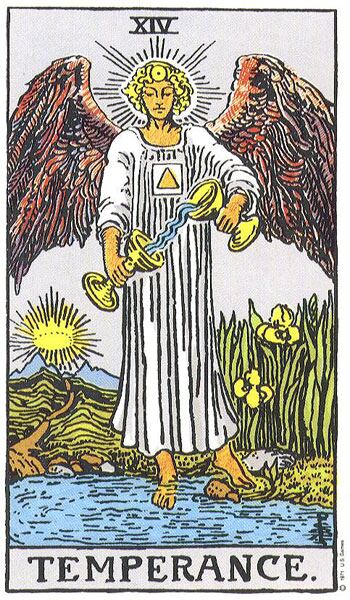
- Central figure (Rider-Waite system): At the center of the image is usually an angel (often identified as the Archangel Gabriel, symbolizing divine oracles and the transmission of messages, though Waite himself did not explicitly state this — this is a common association and remains uncertain). The angel has one foot on land (matter) and one foot in water (spirit/emotion), symbolizing the connection between heaven and earth, and the reconciliation of the material and spiritual worlds.
- Core action: The angel holds two cups, calmly and attentively pouring water (energy, life) from one cup into the other. This action is the card's core symbol: reconciliation, blending, the flow and transformation of energy. The motion is precise, steady, and fluid, embodying "moderation" and "control."
- Water: Represents emotion, the subconscious, fluidity, purification, and the source of life. The flow of water symbolizes the exchange and reconciliation of energy.
- Cups: Symbolize vessels, emotion, relationship, and spiritual nourishment. The two cups represent the opposites that need reconciling (such as reason and feeling, matter and spirit, giving and receiving).
- Path/Road: Behind the angel often lies a path leading to distant mountains (symbolizing spiritual goals, higher consciousness) or the sun (light, enlightenment), suggesting that harmony and balance are the way to reach higher realms.
- Iris/Lily (commonly seen): The iris symbolizes purity, hope, and sacred messages (often associated with Gabriel); the lily symbolizes purity, peace, and spiritual growth. Their presence in the image emphasizes spirituality and harmony.
- Crown/Halo: The halo or crown above the angel's head symbolizes divine wisdom, enlightenment, and spiritual power.
- Colors: Usually dominated by warm, calm tones (yellow/gold for the sun/wisdom; blue for water/spirit; green for nature/balance), creating a harmonious atmosphere.
- Energy Elements: Water (emotion, flow, reconciliation) is the dominant element, but it also fuses the inner spirit of Fire (will, transformation, alchemy) (the angel's action is an active and purposeful reconciliation and transformation). It also encompasses the rational control of Air (communication, thought) and the groundedness of Earth (material foundation, body) (foot on land).
II. Origins & Archetypes
- Virtue Origin: "Temperantia" is one of the seven cardinal virtues in Christian theology (the opposing sin is "Gluttony"). Its core meaning is self-restraint, moderation, avoiding excess — referring not only to diet but to the overall control of desires, emotions, and behavior.
- Alchemical Symbolism: Tarot has deep roots in alchemy. Temperance strongly echoes the alchemical stages of "Coagulation" or "Conjunction." The alchemist's goal was to reconcile and fuse opposing elements (such as sulfur = fire/active, mercury = water/passive) to create the "Philosopher's Stone." The angel pouring water is the perfect symbol of this unification of opposites, transformation and sublimation. "Blending liquid gold" is a key alchemical image often used to explain this card.
- Archetypal imagery:
- Mediator: Building bridges between conflicts or opposing forces, promoting understanding and cooperation.
- Alchemist: Mastering the art of transforming energy, fusing opposites, and creating higher value (spiritual/material).
- Wise Guide: Possessing inner balance and patience, able to guide others toward harmony.
- The Middle Path Holder: Practicing the Buddha's "Middle Way," avoiding extremes and seeking the just-right point of balance.
III. Upright Meaning in Detail
- Reconciliation & Balance: This is the most core meaning. It represents successfully coordinating and fusing the opposing forces in life (work and rest, reason and emotion, self and others, matter and spirit, giving and receiving), reaching a dynamic, healthy state of balance. The inner self feels calm and harmonious.
- Moderation & Self-Mastery: Understanding that "too much is as bad as too little." In diet, pleasure, work, and emotional expression, one can control oneself just right, avoiding both indulgence and suppression. Demonstrating patience, self-discipline, and wisdom.
- Integration & Transformation: Like alchemy, successfully fusing different elements, resources, ideas, and even relationships to create something of greater value than any single component (such as the merging of cultures, the combination of skills, finding common ground among contradictory views). Energy moves freely and is transformed.
- Patience & Timing: Understanding that things have their natural rhythm. Not rushing, willing to wait for the right moment, trusting that through sustained reconciliation and effort, the goal will be achieved. Emphasizes the importance of "process."
- Guiding Energy: Able to effectively direct your energy, emotions, and resources to the most suitable places, avoiding waste. Finding the "right proportion" and "best way" of doing things.
- Inner Harmony & Spiritual Growth: Inner conflict diminishes, self-awareness becomes clear. By reconciling inner contradictions (such as ideal vs. reality, fear vs. courage), promoting maturity and growth on the spiritual level. Connecting with higher goals or spiritual guidance.
- Health & Recovery (common extrapolation): Represents the process of physical or emotional recovery, emphasizing the importance of the body's systems working in harmony and the balance of body and mind for health. May suggest the need to adjust lifestyle to achieve optimal health.
- Successful Cooperation/Relationships (common extrapolation): In relationships, represents good communication, mutual understanding, compromise, and support. Both parties can respect differences, find a balance in getting along, and the relationship develops harmoniously.
Common Question Scenarios (Upright):
- Work/Career: Projects move forward steadily; you need to coordinate multiple parties' resources/people, and you are up to the task; work-life balance is well-managed; knowing how to balance work and rest, with high efficiency; able to find a compromise acceptable to both sides in negotiations; learning to integrate new skills or knowledge.
- Love/Relationships: The relationship is harmonious and stable, with smooth communication and mutual understanding and tolerance; singles are calm, not rushing, waiting or adjusting themselves; repairing rifts requires patience and mutual compromise; giving and receiving in the relationship are balanced.
- Personal Growth: Inner peace, able to integrate strengths and weaknesses; advancing steadily on the path of spiritual exploration or self-improvement; learning to balance different life roles (parent, child, employee, self); need to cultivate patience and long-term persistence.
- Health: Good physical condition, or in a recovery period, emphasizing a balanced lifestyle (diet, exercise, rest); paying attention to physical and mental health.
- Decisions/Dilemmas: Advises taking the middle path, avoiding extremes; need patience to wait for the right moment; consider how to reconcile contradictory needs or resources; seek a compromise solution.
IV. Reversed Meaning in Detail
When Temperance's energy cannot move freely or becomes distorted, reversal appears. It reveals the loss of balance and the failure of reconciliation:
- Imbalance & Extremes: Life tilts severely. Overwork or over-laziness, overspending or over-frugality, emotional flooding or extreme coldness. Going to extremes, unable to find the point of "moderation."
- Discord & Conflict: Inner contradictions are intense (such as wanting to move forward yet afraid, love and hate intertwined); out of sync with the outside (people, environment, tasks), poor communication, difficult cooperation; plans chaotic, resources misallocated.
- Impatience & Lack of Patience: Eager for quick success, pulling up shoots to help them grow; unable to endure the slowness of process; making mistakes or unwise decisions due to impatience; forcing progress when waiting is needed.
- Failed Integration/Waste: Unable to effectively combine different elements, leading to wasted resources, scattered energy, futile effort (such as half-heartedness, failed project integration, team infighting). Energy cannot transform effectively.
- Loss of Self-Control: Losing self-discipline, prone to indulging desires (binge eating, alcoholism, shopping addiction, gaming addiction, etc.), or being completely controlled by emotions (anger, anxiety, depression).
- Unclear Goals/Lost Direction: Inner turmoil leads to lack of clear goals; feeling that everything is in vain; losing connection with higher goals or spiritual guidance.
- Health Issues (common extrapolation): May suggest physical discomfort or lowered immunity due to imbalance (such as excessive stress, eating disorders, disrupted routines); the recovery process is hindered.
- Tense Relationships (common extrapolation): Arguments, cold wars, mutual misunderstanding in relationships; giving and receiving severely imbalanced; communication completely ineffective; unable to reconcile differences.
Common Question Scenarios (Reversed):
- Work/Career: Work-life severely imbalanced, exhausted or inefficient; team cooperation poor, full of friction; projects chaotic, resources wasted; decisions overly impulsive or indecisive; feeling busy without direction.
- Love/Relationships: Relationship full of arguments or coldness; communication difficult, talking past each other; one party giving too much, the other indifferent; emotional needs unmet or excessively demanded; may make relationship-damaging moves due to impatience (such as impulsive breakup/reconciliation).
- Personal Growth: Inner conflict and anxiety; self-doubt, unable to find direction; feeling stagnant or confused in spirituality or self-improvement; prone to indulging to evade problems; lacking self-discipline.
- Health: Body showing red flags due to stress, bad habits; slow or relapsing recovery; need to pay special attention to adjusting the imbalanced state of life (may be a warning from the body).
- Decisions/Dilemmas: Warns against extremes; avoid making decisions when impatient or emotional; currently need to resolve inner or outer conflicts first; reconciliation failed, may need to re-evaluate or seek outside help; indicates resource waste or energy misallocation.
Summary & Emphasis
- Core Essence: "Temperance" is the art of dynamic balance — active reconciliation and wise integration, rather than simple suppression or restraint. Upright is successful alchemy; reversed is a failed experiment.
- Energy Flow: Upright, energy moves freely like water, remaining controllable and nourishing; reversed, energy is blocked, floods, runs out of control, or dries up.
- Alchemical Metaphor: Always keep in mind the image of "blending liquid gold" — this is the key to understanding the card's deep meaning — transforming seemingly incompatible elements into a higher-value existence.
- Notes on Accuracy:
- Equating the angel specifically with Gabriel is a common interpretation, but not all tarot traditions or Waite's original design explicitly specify this; it is a common association/uncertain.
- The "health" extrapolation is generally accepted, but tarot cannot replace medical diagnosis.
- Specific meanings vary slightly across different tarot schools (such as Marseille, Thoth) and specific card designs; the above is based primarily on the Rider-Waite-Smith system and its mainstream derivative decks.
- Reversed meanings are not always "bad"; sometimes they merely remind one to notice potential imbalance, or to apply the principle of "reconciliation" in a different way (even an opposite way) (for example, reversed may indicate you have been too "temperate" and now need to loosen up a bit to break the deadlock, but this must be read in context and the spread).
Understanding Temperance means understanding how to find the "middle way" toward harmony, growth, and transformation in a world full of opposites and changes. It encourages us, like a master alchemist, to master the energy of reconciling self and world, ultimately achieving the golden balance of inner and outer.
Summary & Advice
Temperance teaches us the art of balance and reconciliation. It reminds us to:
- Seek the Middle Way — avoid extremes, finding the just-right point of balance in all aspects of life
- Reconcile Patiently — like an alchemist, patiently fusing different elements into something more valuable
- Master the Rhythm — understand the natural rhythm of how things develop, unhurriedly waiting for the right moment
- Maintain Flow — let energy, emotion, and resources move freely, avoiding blockage or waste
When Temperance appears, it invites us to examine the balance in our lives. Whether between work and rest, giving and receiving, or matter and spirit, we need — like the angel pouring water — to remain focused and steady. Remember, true wisdom lies not in suppression or indulgence, but in finding the point of balance where life's energy flows most effectively.
Waite's 1910 Pictorial Key Entry
Historical source note: The following records A. E. Waite's card-specific divinatory vocabulary from the supplied 1910 edition. It belongs to one early-twentieth-century method, not a universal meaning system or a guarantee. Historical references to illness, marriage, loss, or other high-stakes outcomes are not diagnoses, professional advice, or certain predictions.
- Upright (Waite): Economy, moderation, frugality, management, accommodation.
- Reversed (Waite): Things connected with churches, religions, sects, the priesthood, sometimes even the priest who will marry the Querent; also disunion, unfortunate combinations, competing interests.
Source: A. E. Waite, The Pictorial Key to the Tarot (1910), Part III, § 3.