The Emperor
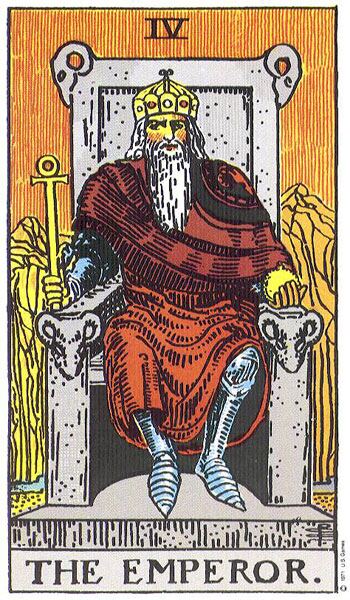
The Emperor tarot card meaning centres on structure, authority, responsibility, and the boundaries that make long-term growth possible.
The Emperor — Upright & Reversed in Detail
I. Card Imagery (Visual & Symbolic)
In the Rider-Waite system, The Emperor typically presents the following classic scene:
- Central figure: A majestic, mature man seated upon a stone throne, clad in a red robe and armor.
- Posture: The Emperor sits upright and authoritative, holding sceptre and orb, symbolizing dominion and order.
- Throne symbolism: The stone throne bears ram's-head carvings, symbolizing Aries and leadership.
- Background: Behind him lie rugged mountains and barren landscapes, symbolizing conquest and mastery.
- Sceptre and Orb: In his right hand the ankh sceptre, in his left the orb, symbolizing the union of spiritual and worldly power.
- Color symbolism: Red for power and authority, gold for dominion and the sacred, grey for stability and order.
This is the classic imagery of the Rider-Waite system, consistent across most modern tarot decks.
II. Energy Elements & Archetypes
1. Energy Elements (Elemental & Thematic)
- Element: Fire — symbolizing action, will, leadership, and creativity.
- Number: 4 (in the Major Arcana sequence), symbolizing stability, order, structure, and authority.
- Energy type: Authority, leadership, structure, order, paternal protection.
2. Archetypal Origins
- Paternal Authority archetype: Represents the establisher of order, rules, and structure.
- Ruler archetype: Associated with mythological rulers such as Zeus, Odin, and King Solomon.
- Builder archetype: Symbolizes the founder of civilization, law, and society.
- Protector archetype: Represents providing safety and protection through structure and order.
Points of uncertainty:
Does the Emperor always represent positive authority? Uncertain. Authority itself is neutral, depending on how it is wielded.
What is the precise division of labor between the Emperor and the Empress? Uncertain. Different traditions hold varying views on the balance of masculine and feminine energy.
III. Upright Meaning in Detail
Core Meaning:
"The establisher of order and authority; through structure and rules, stability and protection are achieved."
Inner Interpretation:
- Authority & Leadership: Demonstrating natural leadership and authority, able to set and enforce rules.
- Structure & Order: Establishing clear structure and order, allowing things to run in an orderly manner.
- Rational Thinking: Using logic, reason, and strategic thinking to solve problems.
- Stability & Security: Creating a stable and secure environment, providing protection and assurance.
- Responsibility & Commitment: Bearing leadership responsibilities and duties, providing guidance to others.
- Achievement & Recognition: Gaining social standing and recognition, with accomplishments affirmed.
- Paternal Care: Providing protection and guidance in a paternal manner.
Common Question Scenarios (Upright):
| Scenario | Interpretation |
|---|---|
| Love & Relationships | The relationship needs stability and commitment; may involve marriage or long-term commitment. Provides a sense of security and protection. |
| Career Development | Leadership position or managerial role; able to build effective work structures and processes. |
| Personal Growth | Self-discipline and sense of responsibility increase; able to set and execute personal goals. |
| Health | May invite attention to rest, routines, and sustainable care; it cannot diagnose illness or predict a medical outcome. |
| Finance | May invite careful planning and long-term risk awareness; it cannot establish financial security or predict investment returns. |
IV. Reversed Meaning in Detail
Core Meaning:
"Authority out of balance — either over-control or a lack of leadership."
Inner Interpretation:
- Over-control: Autocratic, rigid, and overly controlling, lacking flexibility.
- Abuse of authority: Misusing power or authority, becoming dictatorial and oppressive.
- Rigid structure: Overly rigid structures and rules, hindering innovation and growth.
- Evasion of responsibility: Shirking leadership responsibility, lacking commitment and decisiveness.
- Disorder: Lacking effective order and structure, leading to chaos and disarray.
- Patriarchal issues: Negative expression of paternal authority, such as control, suppression, or coldness.
- Excessive rationality: Over-rational and lacking emotion, neglecting human needs.
Common Question Scenarios (Reversed):
| Scenario | Interpretation |
|---|---|
| Love & Relationships | Control or coldness may arise; the relationship lacks emotional connection and flexibility. |
| Career Development | Leadership style issues — either over-control or ineffective management. |
| Personal Growth | Self-discipline issues — either overly strict or lacking self-discipline. |
| Health | May need to focus on stress management; avoid over-control or neglect of health. |
| Finance | Financial control issues — either overly conservative or lacking planning. |
V. Deeper Philosophy & Psychological Significance
1. The Dialectic of Authority and Freedom
- The Emperor explores the balance of authority and freedom, order and innovation.
- This resonates deeply with the Confucian social philosophy of "the ruler acts as ruler, the minister as minister, the father as father, the son as son."
- In modern psychology, this corresponds to the concepts of Self-Regulation and Responsibility.
2. The Healthy Expression of Paternal Power
- The upright Emperor displays healthy paternal power — protecting without controlling, guiding without suppressing.
- When reversed, paternal power is either deficient (weakness) or excessive (autocracy).
- True leadership requires respect for individual autonomy and creativity.
Points of uncertainty:
Does the Emperor represent traditional patriarchy? Uncertain. Modern interpretations emphasize healthy authority rather than gender roles.
What is the precise distinction between the Emperor and the Chariot? Uncertain. Different traditions hold varying views on the relationship between willpower and leadership.
VI. Interactions with Other Cards (Tarot Combinations Reference)
| Combination | Meaning |
|---|---|
| Upright Emperor + Upright Empress | Perfect balance of masculine and feminine energy, creating a stable and abundant life. |
| Upright Emperor + Upright Chariot | Powerful will and leadership combined, able to overcome major challenges. |
| Reversed Emperor + Upright Fool | Need to break rigid structures and embrace new possibilities and freedom. |
| Upright Emperor + Upright Justice | Fair leadership and management; the perfect embodiment of law and order. |
| Reversed Emperor + Upright Hanged Man | Need to relinquish control and accept different perspectives and sacrifice. |
VII. Summary Comparison Table
| Dimension | Upright | Reversed |
|---|---|---|
| Core Energy | Authoritative leadership, structural order | Over-control, lack of leadership |
| Emotional Tone | Confident, stable, responsible | Anxious, rigid, evasive |
| Suggested Action | Establish order, bear responsibility | Adjust flexibly, balance authority |
| Interpersonal | Protective guidance, stable and reliable | Controlling suppression, tense relationships |
| Self-relationship | Self-disciplined and responsible, clear goals | Self-doubt, lacking direction |
| Keywords | Authority, order, protection, stability | Control, rigidity, evasion, chaos |
VIII. Points of Uncertainty Stated Explicitly
The gender-role issue of the Emperor:
→ Uncertain. Traditional interpretations emphasize masculine authority, but modern readings focus on the essence of authority rather than gender.The link between the Emperor and autocratic rule:
→ Uncertain. The upright Emperor represents healthy authority, but is easily misread as autocratic rule.The applicability of the Emperor in modern society:
→ Uncertain. Traditional concepts of authority require reinterpretation in modern democratic societies.Positive readings of the reversed Emperor:
→ Uncertain. In some contexts, the reversal may signal a need to break rigid structures, which may itself be an opportunity for growth.
Conclusion
The Emperor teaches us that true authority comes from inner discipline and care for others' welfare. Upright, he is a guide to establishing order and providing stable protection; reversed, he is an important signal reminding us to balance control and freedom, authority and inclusiveness.
In any context, the Emperor declares:
"True leadership lies not in how much one controls, but in how much one can serve; true order lies not in how much one restricts, but in how much one can liberate."
This is the Emperor's most profound revelation: the true purpose of authority is to create space for safety and growth, not to suppress and restrict.
Waite's 1910 Pictorial Key Entry
Historical source note: The following records A. E. Waite's card-specific divinatory vocabulary from the supplied 1910 edition. It belongs to one early-twentieth-century method, not a universal meaning system or a guarantee. Historical references to illness, marriage, loss, or other high-stakes outcomes are not diagnoses, professional advice, or certain predictions.
- Upright (Waite): Stability, power, protection, realization; a great person; aid, reason, conviction; also authority and will.
- Reversed (Waite): Benevolence, compassion, credit; also confusion to enemies, obstruction, immaturity.
Source: A. E. Waite, The Pictorial Key to the Tarot (1910), Part III, § 3.