The Fool
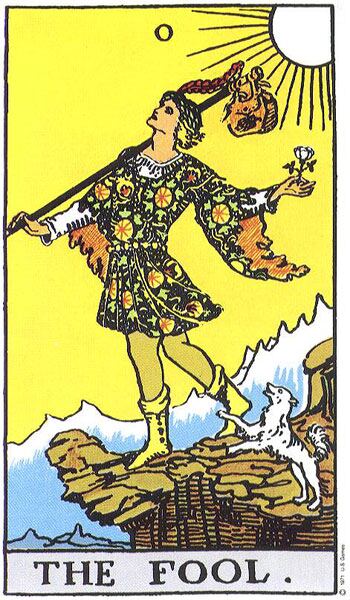
The Fool tarot card meaning centres on an open beginning: curiosity, possibility, movement, and the willingness to meet an unfamiliar situation without pretending to know its outcome. In a reading, The Fool can describe a first step, a fresh perspective, or a freedom that needs better boundaries. It is not a promise that every risk will work out.
Quick answer: Upright, The Fool suggests openness, experimentation, and a new chapter approached with curiosity. Reversed, it asks whether the leap is reckless, poorly prepared, or being avoided altogether.
The Fool Tarot Card Meaning: A Quick Answer
The Fool is commonly numbered 0 and placed at the threshold of the Major Arcana. That numbering is a useful modern convention, not a rule shared by every historical deck: in many Marseille-related traditions, the card is unnumbered and has a distinct status. Either way, its unusual position makes it a card of thresholds rather than a simple “beginner” label.
The most useful reading usually holds two ideas together:
- Openness: stay teachable, notice what the situation makes possible, and allow a new route to appear.
- Discernment: check the ground, the consequences, and the support available before turning courage into avoidable danger.
The Fool therefore does not mean “be careless.” It asks what kind of first step is available, what you have not yet considered, and how to preserve freedom while accepting responsibility.
The Fool in Different Tarot Traditions
In the Rider–Waite–Smith (RWS) image, a young traveller approaches the edge of a cliff with a small bundle, a white rose, and a dog. The bright sky and lifted face make the scene feel hopeful, while the cliff introduces a practical question: is the traveller aware of the terrain? This tension between possibility and consequence is more useful than treating every symbol as a fixed code.
The image is not identical across tarot history. Marseille-style decks often show a more marginal, wandering, or socially disruptive figure, and the card may be unnumbered. Thoth and modern independent decks may recast The Fool through different visual, elemental, or philosophical systems. When the deck changes, let its image and guidebook lead; do not assume that an RWS keyword list is universal.
Core Symbolism & Themes
- New beginnings: a door opens before the destination is clear.
- Possibility: several paths remain available, so certainty may be premature.
- Innocence and curiosity: experience starts with attention and a willingness to learn.
- Freedom: routine, inherited roles, or other people's expectations may no longer fit.
- Risk and vulnerability: a beginning exposes the reader to consequences as well as opportunity.
- The threshold: The Fool stands between what is familiar and what has not yet been tested.
These themes are prompts, not predictions. The surrounding cards, the spread position, the deck tradition, and the question should decide which theme deserves the most weight.
Upright Meaning of The Fool
1. New Beginnings & Possibility
- Starting a new phase with room to learn and adapt
- Releasing an old script so a different choice can be tested
- Meeting uncertainty with curiosity instead of demanding an immediate guarantee
- Taking a first step that is small enough to revise if new information appears
2. Innocence, Curiosity & Trust
- Asking a genuine question rather than performing certainty
- Staying open to people, ideas, and experiences outside the usual routine
- Trusting your ability to respond, while still checking practical facts
- Letting wonder return without handing over responsibility for your choices
3. Adventure & Spiritual Openness
- Exploring a place, practice, relationship, or idea that widens your perspective
- Following an inner call while remaining aware of consent, resources, and timing
- Allowing a meaningful experiment to teach you something before you name it a success
- Moving beyond inherited rules when those rules no longer serve the actual situation
4. Living in the Present
- Paying attention to the next useful step instead of rehearsing every future problem
- Letting a plan develop through contact with reality
- Enjoying the journey without confusing spontaneity with the absence of preparation
- Remaining flexible when the original destination changes
The Fool Upright in Common Questions
Love & Relationships
- Single: A new connection or a different way of meeting people may be possible. Keep the heart open, and let trust build through observable behaviour.
- In a relationship: The relationship may need playfulness, a new shared experience, or an honest reset of stale expectations.
- Commitment or marriage: A new stage can be welcomed, provided the practical conversation is not skipped.
- Reconciliation: A fresh start is possible only if the old pattern is understood and both people choose what changes.
Career, Work & Money
- Career: A new role, project, course, or direction may deserve a low-risk experiment before a full commitment.
- Money: Review assumptions, downside risk, and timing. The Fool can invite a new financial approach, but it is not a forecast of profit.
- Study: Curiosity is an asset; choose a manageable first lesson and let practice shape the next one.
- Entrepreneurship: Test the smallest credible version of the idea, document what you learn, and keep a runway for setbacks.
Personal Growth, Health & Travel
- Personal growth: Begin a practice that makes you more attentive to your own choices and less governed by inherited expectations.
- Health: Treat this as a prompt to build sustainable routines and seek qualified care when needed; a card cannot diagnose or predict a medical outcome.
- Travel: A journey can widen perspective, especially when the route includes sensible planning, documents, budget, and safety checks.
- Spirituality: Explore with humility. A meaningful experience does not remove the need for grounded judgment.
Reversed Meaning of The Fool
A reversed Fool does not have to mean “bad luck.” It can show the shadow of a beginning, a warning about timing, or fear that keeps a necessary first step permanently theoretical.
1. Recklessness & Missing Preparation
- Acting before checking the obvious risks or commitments
- Treating optimism as a substitute for evidence
- Overlooking how a decision affects other people
- Taking a dramatic leap when a reversible experiment would answer more
2. Naivety & Escapism
- Trusting a promise without looking for consistent behaviour
- Romanticising a situation to avoid its difficult facts
- Calling avoidance “freedom” when a responsibility still needs attention
- Starting repeatedly without staying long enough to learn
3. Fear of Change & Stagnation
- Waiting for perfect certainty before taking any step
- Letting an old identity or past mistake define every new option
- Rejecting useful novelty because it feels unfamiliar
- Missing an opportunity because the cost of trying has been exaggerated
4. Irresponsibility & Boundary Problems
- Leaving others to carry consequences that belong to you
- Ignoring consent, safety, money, or time constraints
- Confusing independence with isolation
- Using a spiritual or romantic story to excuse harm or broken commitments
The Fool Reversed in Common Questions
Love & Relationships
- Single: Be cautious of idealisation, intensity without reliability, or promises that cannot be tested.
- In a relationship: One person may be avoiding a needed conversation, or the relationship may be moving faster than its foundations can support.
- Commitment or marriage: Do not use a symbolic “fresh start” to cover unresolved practical issues.
- Reconciliation: Ask what has changed in behaviour, not only what is being hoped for.
Career, Work & Money
- Career: An impulsive exit or a poorly defined opportunity needs a pause, a written plan, and a fallback option.
- Money: Avoid decisions driven by urgency or promised certainty; check terms, exposure, and advice from a qualified professional.
- Study: A vague goal may be easier to abandon halfway. Define the next lesson and a realistic rhythm.
- Entrepreneurship: Separate a compelling idea from a tested business model and protect essential resources.
Personal Growth, Health & Travel
- Personal growth: Notice whether “I am not ready” is a truthful assessment or a story that protects you from change.
- Health: Do not ignore symptoms or replace professional support with a reading. Focus on practical follow-up and sustainable habits.
- Travel: Recheck logistics, timing, documents, and safety rather than relying on confidence alone.
- Spirituality: Ground unusual experiences in reflection, consent, community, and ordinary reality.
How to Read The Fool in a Spread
The Fool becomes clearer when its position is treated as a verb rather than a verdict. Ask what the position is requesting:
- As the situation: What is beginning, loosening, or asking to be seen without an old label?
- As a challenge: Where could enthusiasm be outrunning preparation, or fear be disguising itself as caution?
- As advice: What is the smallest honest experiment that creates information without creating unnecessary harm?
- As an outcome: What remains open, mobile, or not yet defined? What would make that uncertainty safer to inhabit?
Neighbouring cards refine the direction. The Hermit may make The Fool more private and deliberate; The Chariot may turn it into a question of steering; The Devil may highlight a risky attachment; Justice may ask for consequences and accountability. No combination removes the need to read the actual question and circumstances.
Summary & Reading Notes
- The Fool is a threshold card: it can describe a beginning, a release, or a return to curiosity.
- Upright, it supports openness, experimentation, and flexible movement with responsibility.
- Reversed, it can point to recklessness, avoidance, idealisation, or fear of change.
- The card is not a guarantee of success, a medical diagnosis, legal advice, or a financial prediction.
- Across traditions, the card's number, image, and social meaning vary. Name the deck before treating a detail as universal.
Reflection Prompts
When The Fool appears, consider:
- What is genuinely new here, and what am I merely repeating under a new name?
- What is the smallest reversible step that would give me better information?
- Which practical boundary would protect this beginning without suffocating it?
- Am I trusting my capacity to respond, or asking uncertainty to promise me safety?
- Who else is affected by this step, and what responsibility or consent needs to be made explicit?
Frequently Asked Questions
Is The Fool a yes-or-no card?
Often it leans toward yes to beginning or exploring, but not toward “yes, everything will work out.” Treat it as an invitation to test the next step and check the conditions around it.
What does The Fool mean in love?
It can suggest a new connection, renewed playfulness, or a fresh way of relating. It can also warn against idealising someone or skipping conversations about trust, boundaries, and commitment.
What does The Fool mean for a career or a new business?
It favours curiosity and early experimentation. Before making an irreversible move, define the smallest test, the resources required, the downside you can accept, and the evidence that would change your plan.
Is The Fool the first card of the Major Arcana?
In many modern decks it is numbered 0 and placed before The Magician. Historically, the card was often unnumbered and did not always sit inside a fixed sequence, so “first” is a convention rather than a universal historical fact.
The Fool is most useful when it keeps possibility and responsibility in the same frame: take the next honest step, remain willing to learn, and let reality—not wishful certainty—tell you what comes next.
Waite's 1910 Pictorial Key Entry
Historical source note: The following records A. E. Waite's card-specific divinatory vocabulary from the supplied 1910 edition. It belongs to one early-twentieth-century method, not a universal meaning system or a guarantee. Historical references to illness, marriage, loss, or other high-stakes outcomes are not diagnoses, professional advice, or certain predictions.
- Upright (Waite): Folly, mania, extravagance, intoxication, delirium, frenzy, bewrayment.
- Reversed (Waite): Negligence, absence, distribution, carelessness, apathy, nullity, vanity.
Source: A. E. Waite, The Pictorial Key to the Tarot (1910), Part III, § 3.