The Hanged Man — Upright & Reversed in Detail
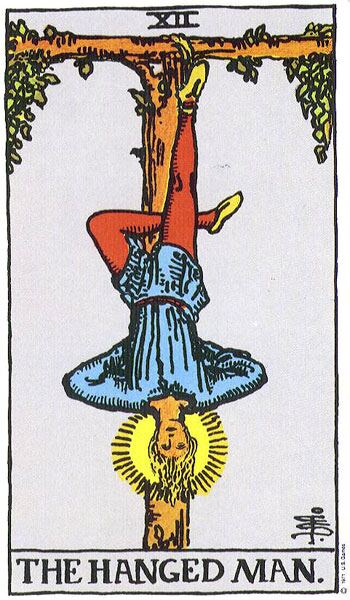
The Hanged Man tarot card meaning centres on pause, surrender, and a change in perspective rather than passive defeat. Upright, it can ask for patience or a voluntary release; reversed, it may show delay, resistance, or sacrifice without a clear purpose.
I. Card Imagery (Visual & Symbolic)
The Hanged Man is a highly symbolic card, its image typically as follows:
- A male (or androgynous figure) is hung upside down from a rope or beam, head downward, feet upward.
- He leans forward, arms outstretched, hands possibly holding some object (such as a scroll, sceptre, or symbolic tool), and sometimes appears in a contemplative or meditative posture.
- The background is often a wasteland, cliff, or natural setting with wind and clouds, symbolizing solitude, transition, and stillness.
- He usually shows no pain or anger, but rather a calm, accepting, even wise expression.
- Sometimes, beneath his feet lie red/grey clouds or a horizon, symbolizing being "suspended" between reality and transcendence.
This is a widely consistent iconographic tradition, stemming from the mainstream tarot systems of the 18th to early 20th centuries (such as Rider-Waite-Smith, RWS) and modern tarot scholarship.
II. Energy Elements & Archetypes
1. Energy Elements (Elemental & Thematic)
- Element: Air — symbolizing thought, spirituality, reflection, communication.
- Direction: Upward (in the suspended state, "upward" is counterintuitive) — representing an "inverted perspective."
- Energy type: Transition, pause, counterintuitive thinking, accepting reality, sacrifice, spiritual awakening.
2. Archetypal Origins
Archetypal source:
The Hanged Man traces back to medieval Christian mysticism and alchemical traditions, related to "crucifixion" or "sacrifice," but its core meaning is not "suffering" — rather, it is "being suspended to gain deeper insight."In ancient religion and philosophy, the Hanged Man symbolizes "inverted wisdom" or "gaining true knowledge through unconventional means" — for example:
- The wise man hung upside down to attain a higher level of understanding by "letting go of ego."
- The "anti-intellectual" or "unconventional" mode of thought in philosophy (like the one who leaves the cave in Plato's allegory).
- The Eastern traditions of "letting go," "emptiness," and "no-self."
Points of uncertainty:
Does the Hanged Man correspond directly to a specific deity or ritual in ancient Egyptian or Greek mythology? No clear documentary support exists; uncertain.
In the RWS system, the card is clearly categorized as a "sacrifice of wisdom," its archetype closer to "awakening through adversity" in medieval mysticism, rather than stemming directly from a particular deity.
III. Upright Meaning
Core Meaning:
"Through self-sacrifice and releasing attachments, gaining deeper insight and inner peace."
Inner Interpretation:
- Accepting the irreversibility of reality: You are facing a state you "must accept." You may think you have "failed," "been abandoned," or "gone the wrong way," but the Hanged Man reminds you: "This is not the end, but the starting point of transformation."
- Shifting perspective: From "I must win" to "Am I growing?" — the upright Hanged Man encourages you to view the problem from another angle, such as shifting from "being bound" to "being released."
- Sacrifice and dedication: Not for material gain or status, but for deeper spiritual growth or the maturing of a relationship.
- Silence and waiting: You may need to "pause action," entering contemplation or meditation to see the true direction clearly.
- The price of wisdom: True wisdom often comes with "loss of control" or "leaving the comfort zone."
Common Question Scenarios (Upright):
| Scenario | Interpretation |
|---|---|
| Love & Relationships | You may be in a relationship that seems "failing" or "neglected," but the Hanged Man suggests: this relationship may be helping you grow "in a silent way." You need to let go of possessiveness and accept the other's independence to truly understand each other. |
| Career Development | You may be placed in an "unpromising" position or project, but the upright Hanged Man encourages you: this may be the "necessary path" to acquiring new skills and understanding the industry's true face. |
| Personal Growth | You feel confused and self-doubting; the Hanged Man reminds you: true growth often occurs when you "no longer pursue outcomes" — when you let go of the obsession with "must succeed," you can see your true self. |
| Health | You may be physically "limited" (such as chronic illness, restricted movement); the Hanged Man suggests: this may be the body "reminding you to adjust your lifestyle" or "rebuilding your connection with nature." |
These interpretations are widely accepted in tarot teaching and practice, with ample case support.
IV. Reversed Meaning
Core Meaning:
"Refusing to accept reality, clinging to self-will, attempting to force change, and thereby obstructing true growth."
Inner Interpretation:
- Refusing to let go: Unwilling to admit that "the current state is unchangeable," attempting to force a "turnaround," which may backfire.
- Egocentrism: Reversed Hanged Man often represents "self-centered obsession" — you believe "I must succeed immediately," "I must win," "I must control everything."
- Evading reflection: Choosing to evade the problem, or substituting action for thought, leading to "busy on the surface, stagnant underneath."
- Resistance to reality: You may be dissatisfied with the status quo yet refuse to accept the necessity of "waiting" or "adjustment."
- Spiritual stagnation: When you refuse the "suspended" state, you cannot enter the "deeper wisdom" state.
Important reminder:
Reversed Hanged Man does not equal "failure" or "negativity", but rather "an incomplete transformation" — you are resisting a necessary process of letting go.
Common Question Scenarios (Reversed):
| Scenario | Interpretation |
|---|---|
| Love & Relationships | You are dissatisfied with a relationship yet refuse to let go, forcing it to continue, even attempting to "win back" the other — this will intensify conflict. Reversed Hanged Man reminds you: true maturity is allowing the relationship to flow naturally, not forcing control. |
| Career Development | You see a new opportunity but immediately want to "switch jobs at once" or "change immediately," overlooking the learning value of your current work. The result may be failure due to hasty decisions. |
| Personal Growth | You constantly pursue "quick success," neglecting inner peace and reflection, leading to intensified anxiety, exhaustion, and self-doubt. Reversed Hanged Man reminds you: growth is not a sprint but a settling. |
| Health | You refuse to heed the body's warnings (such as fatigue, pain), continuing high-intensity work or exercise, ultimately leading to physical breakdown. |
Reversed Hanged Man is "resistance in the growth process" — not a "bad card," but a "signal that needs to be noticed."
V. Deeper Philosophy & Psychological Significance
1. The Hanged Man as "Inversion of Wisdom"
- The upright Hanged Man is "gaining wisdom through unconventional means" — you must abandon the usual path to see the truth.
- This aligns closely with the Daoist idea of "wu wei" (non-action), the Buddhist idea of "letting go," and Socratic "knowledge of ignorance."
2. The Relationship to "Self-Sacrifice"
- The Hanged Man does not equal "being exploited" or "being harmed", but rather "actively choosing sacrifice" in exchange for deeper understanding.
- For example: a parent giving up a career for a child is not "failure," but "a wise choice made at the cost of love."
Points of uncertainty:
Does all "sacrifice" equate to the Hanged Man?
Some hold that sacrifice must be voluntary and conscious; otherwise it may merely be "passive suffering."
Therefore, if the sacrifice is forced or unconscious, the upright Hanged Man does not apply, and may even point to "reversed" or "another card."
→ Uncertain; needs to be judged in context.
VI. Interactions with Other Cards (Tarot Combinations Reference)
| Combination | Meaning |
|---|---|
| Upright Hanged Man + Upright Star | Through forced waiting, hope and inner peace will finally arrive. |
| Upright Hanged Man + opposing forces (e.g., Judgement) | The beginning of transformation; requires courage and sacrifice. |
| Reversed Hanged Man + Chariot | Wanting to control the situation, but falling into internal friction due to obsession. |
| Upright Hanged Man + Moon | Maintaining clarity amidst chaos; seeing the truth through contemplation. |
VII. Summary Comparison Table
| Dimension | Upright | Reversed |
|---|---|---|
| Core Energy | Letting go, reflection, acceptance, insight | Refusal, obsession, evasion, forcing change |
| Emotional Tone | Introspective, calm, wise, hopeful | Anxious, angry, struggling, powerless |
| Suggested Action | Pause, observe, accept reality, shift perspective | Recognize obsession, stop resisting, return to contemplation |
| Applicable Scenarios | Relationship stagnation, career transition, growth bottleneck | Emotional loss of control, impulsive decisions, failed relationship maintenance |
| Keywords | Wisdom, sacrifice, waiting, silence | Obsession, control, resistance, impatience |
VIII. Points of Uncertainty Stated Explicitly
Does the Hanged Man originate from a specific deity in ancient Egyptian or Greek mythology?
→ Uncertain. No direct documentary or iconographic evidence supports this. Its archetype is more likely from medieval Christian mysticism and alchemy.Does the Hanged Man represent "punishment" or "crucifixion"?
→ Uncertain. Although in some cultures "hanging" relates to the "cross," in tarot the Hanged Man emphasizes "wisdom" and "transformation," not "punishment." In mainstream interpretation, its symbolism is "sacrifice for wisdom", not "suffering."Does all "sacrifice" equate to the Hanged Man?
→ Uncertain. If the sacrifice is passive, unconscious, or motivated by fear, it more likely points to "reversed" or cards like "Judgement." The Hanged Man emphasizes "active choice" and "conscious release."
Conclusion
The Hanged Man is a card of transition, reflection, and sacrifice. It does not encourage "evading reality" but encourages you to understand reality in unconventional ways. Upright, it is a "pause of wisdom"; reversed, it is "loss of control through obsession."
In any question scenario, the Hanged Man reminds you:
"When you cannot move forward, perhaps you should pause — not because of failure, but because you have finally seen the direction."
This is one of tarot's most profound wisdoms: true growth often begins the moment you are "hung upside down."
Summary & Advice
The Hanged Man teaches us that sometimes we must let go of control and accept temporary stagnation to gain deeper wisdom. It reminds us to:
- Embrace different perspectives — viewing a problem from the opposite direction may reveal new solutions
- Learn to wait — not all action needs to be immediate; sometimes pausing brings better results
- Accept sacrifice — for a higher goal, you may need to temporarily set something aside
- Maintain patience — true transformation takes time; do not rush
When the Hanged Man appears, it may signal that it is time to re-examine your current situation. Trust the process, even if it feels uncomfortable or counterintuitive. Remember, sometimes taking a step back is for the sake of moving forward better.
Waite's 1910 Pictorial Key Entry
Historical source note: The following records A. E. Waite's card-specific divinatory vocabulary from the supplied 1910 edition. It belongs to one early-twentieth-century method, not a universal meaning system or a guarantee. Historical references to illness, marriage, loss, or other high-stakes outcomes are not diagnoses, professional advice, or certain predictions.
- Upright (Waite): Wisdom, circumspection, discernment, trials, sacrifice, intuition, divination, prophecy.
- Reversed (Waite): Selfishness, the crowd, body politic.
Source: A. E. Waite, The Pictorial Key to the Tarot (1910), Part III, § 3.