Three of Pentacles — Upright & Reversed in Detail
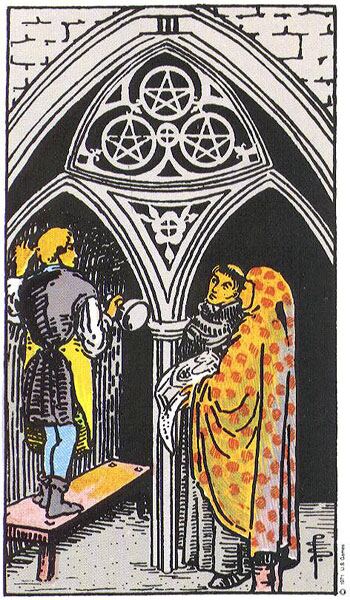
The Three of Pentacles tarot card meaning centres on collaboration, skilled contribution, and building something that benefits from more than one perspective. It can favour mentorship and shared standards, while asking how recognition and responsibility are distributed.
I. Card Characteristics (Visual & Symbolic)
In the Rider-Waite Tarot system, the Three of Pentacles typically presents the following classic scene:
- Core scene: Within a church or construction site, three figures are collaborating at work.
- Character roles:
- The craftsman / worker: Carving or building a pentacle ornament.
- The architect / designer: Holding design drawings and directing the work.
- The clergyman / patron: Supervising or appreciating the work.
- Position of the pentacles: Three pentacles are inset into the architectural structure, symbolizing the fruits of the work.
- Environmental details: Usually set within a Gothic interior, with arches and columns.
- Symbol of collaboration: The three figures divide the labor and cooperate, each performing their role, embodying team spirit.
- Symbol of tools: Carving tools, design drawings, and architectural structure symbolize professional skill.
This is the classic image of the Rider-Waite system and remains consistent across most modern Tarot decks.
II. Energy, Element & Archetypes
1. Energy & Element
- Element: Earth — symbolizing matter, reality, skill, and achievement.
- Number: The 3rd card, symbolizing collaboration, skill, building, and accomplishment.
- Energy type: Professional collaboration, application of skill, constructive work, demonstration of results.
2. Origins & Archetypes
- The Craftsman archetype: Possessing professional skill, attending to detail and quality.
- The Team Player archetype: Skilled at collaboration, respecting others' areas of expertise.
- The Builder archetype: Dedicated to creation and construction, focusing on long-term value.
- The Apprentice archetype: Growing through learning, accepting guidance and feedback.
Points of ambiguity:
The specific identities of the three figures? Ambiguous—different decks may offer different readings.
Does the Three of Pentacles only signify material construction? Ambiguous—it may also symbolize spiritual or relational construction.
III. Upright Meaning in Detail
Core Meaning:
"Professional collaboration and the application of skill—achieving constructive outcomes through teamwork and expertise."
Internal Interpretation:
- Teamwork: Effective team collaboration, with each member contributing their strengths.
- Professional skill: The application of expertise and skill, with attention to quality.
- The process of building: Constructive work underway, with a clear goal.
- Learning and growth: Growing through practice, accepting guidance.
- Demonstration of results: Work recognized, value affirmed.
- Execution of plans: Working according to plan, methodical and orderly.
- Long-term value: Focusing on long-term value and sustainability, not chasing short-term gain.
Common Scenarios (Upright):
| Scenario | Interpretation |
|---|---|
| Work projects | Team projects move forward well, with members collaborating effectively. |
| Skill learning | Learning a new skill, receiving professional guidance, making clear progress. |
| Partnerships | Business partnerships or alliances are stable and mutually beneficial. |
| Family building | Home renovation or construction, with family members participating together. |
| Personal growth | Through practice and learning, personal capability improves. |
IV. Reversed Meaning in Detail
Core Meaning:
"Obstacles to collaboration or insufficient skill—teamwork falters or professional expertise is lacking."
Internal Interpretation:
- Collaboration problems: Obstacles in teamwork, poor communication.
- Insufficient skill: Professional expertise is lacking, more learning is needed.
- Plan chaos: The work plan is in disarray, lacking clear direction.
- Decline in quality: Work quality declines, details are neglected.
- Lack of recognition: Work goes unrecognized, value is underestimated.
- Absence of guidance: Lacking professional guidance, learning progresses slowly.
- Short-termism: Overly pursuing short-term gain, neglecting long-term value.
Common Scenarios (Reversed):
| Scenario | Interpretation |
|---|---|
| Team conflict | Conflicts among team members make collaboration difficult. |
| Skill shortfall | Current skills are insufficient for the task; improvement is needed. |
| Project delays | Project progress is delayed; plan execution has problems. |
| Quality complaints | Work quality is problematic; clients or superiors are dissatisfied. |
| Absence of guidance | Lacking a mentor or professional guidance makes learning difficult. |
V. Deeper Philosophical & Psychological Significance
1. The Dialectic of Collaboration and Personal Growth
- The Three of Pentacles reveals that true achievement arises from collaboration rather than isolation.
- This resonates deeply with the Confucian idea of "harmony in difference" and the Daoist notion of "the harmony of yin and yang."
- In modern psychology, this corresponds to the concepts of Group Dynamics and Professional Skill Development.
2. The Hierarchical Relationship of Skill and Value
- Upright, the Three of Pentacles shows that professional skill is the foundation of value creation.
- Reversed, the issue is either collaboration or insufficient skill.
- True construction requires the perfect combination of skill, collaboration, and vision.
Points of ambiguity:
Is collaboration always superior to individual work? Ambiguous—some creative work may need to be done independently.
What is the standard of professional skill? Ambiguous—different fields have different requirements.
VI. Interaction with Other Cards (Tarot Combinations)
| Combination | Meaning |
|---|---|
| Upright Three of Pentacles + Upright The Emperor | A professional team completing an important project under authoritative guidance. |
| Upright Three of Pentacles + Reversed The Chariot | Good teamwork but lacking clear direction. |
| Reversed Three of Pentacles + Upright The Hermit | Need for independent reflection and professional guidance to solve a problem. |
| Upright Three of Pentacles + Upright The World | A team project brought to a successful, remarkable completion. |
| Reversed Three of Pentacles + Upright Temperance | Need to adjust the team's mode of collaboration and seek balance. |
VII. Summary Comparison Table
| Dimension | Upright | Reversed |
|---|---|---|
| Core energy | Professional collaboration, application of skill | Collaboration obstacles, insufficient skill |
| Emotional tone | Focus, cooperation, a sense of achievement | Chaos, frustration, dissatisfaction |
| Suggested action | Continue collaborating, focus on quality | Improve communication, enhance skills |
| Interpersonal relations | Team harmony, mutual benefit | Poor communication, difficult collaboration |
| Self-relation | Professional confidence, growth satisfaction | Self-doubt, feeling inadequate |
| Keywords | Collaboration, skill, construction, achievement | Obstacle, insufficiency, chaos, frustration |
VIII. Points of Ambiguity to Note
The boundaries of collaboration:
→ Ambiguous. When should one collaborate, and when should one work independently? This requires case-by-case analysis.The standard of professional skill:
→ Ambiguous. What level counts as professional? Different industries have different standards.Measuring results:
→ Ambiguous. How should work results be measured? Material outcomes or spiritual satisfaction?The necessity of guidance:
→ Ambiguous. Does all work require guidance? Some innovation requires free exploration.
IX. Practical Advice & Action Guide
Action advice when the Three of Pentacles is upright:
- Strengthen collaboration: Continue to maintain good team relationships.
- Focus on quality: Maintain high standards for work quality.
- Accept feedback: Actively accept professional guidance and feedback.
- Keep learning: Learn more professional skills through practice.
- Share results: Share success and credit with team members.
Action advice when the Three of Pentacles is reversed:
- Improve communication: Proactively address team communication issues.
- Enhance skills: Spend time learning and improving professional skills.
- Seek guidance: Look for help from a professional mentor or consultant.
- Re-plan: Reassess the work plan and direction.
- Attend to detail: Pay greater attention to work details and quality control.
X. The Three of Pentacles in Different Cultures
1. Western Career-Development Perspective
- Team theory: Corresponds to theories of team building and collaborative efficiency.
- Professional skill: Emphasizes the importance of professional certification and continuous learning.
- Project management: Collaboration and quality management in modern project management.
2. Eastern Craftsmanship Perspective
- Craftsmanship spirit: The focus and professionalism of Japan's "spirit of the artisan."
- Master-apprentice transmission: China's traditional system of master-apprentice transmission in handicrafts.
- Collectivism: The spirit of collective collaboration emphasized in Eastern cultures.
3. Modern Work Concepts
- Remote collaboration: Remote teamwork in the digital age.
- Cross-cultural cooperation: Cross-cultural team collaboration in a globalized context.
- Lifelong learning: The concept of continuous learning in modern career development.
XI. The Deeper Symbolism of the Three of Pentacles
1. Symbol of Architecture and Creation
- Church architecture: Symbolizes the union of spiritual pursuit and material construction.
- Gothic style: Represents the spirit of pursuing height and perfection.
- Arch structure: Symbolizes the power of support and stability.
2. The Deeper Meaning of Three-Person Collaboration
- The Trinity: May hint at the balance of body, mind, and spirit.
- Division of labor: Symbolizes the value of social division of labor and specialization.
- Hierarchical relationship: The different roles of guide, executor, and appreciator.
3. The Symbolic Evolution of the Pentacles
- Material foundation: The pentacles represent material security and a realistic foundation.
- Value creation: Creating value beyond the individual through collaboration.
- Sustainability: Focusing on long-term value and sustainable outcomes.
XII. Application of the Three of Pentacles in Personal Development
1. Career-Development Guidance
- Career choice: Choose fields that require professional skill and teamwork.
- Skill enhancement: Continuously invest in improving professional skills.
- Team building: Cultivate good teamwork abilities.
2. Learning and Growth Strategy
- Practice-based learning: Learn professional skills through actual projects.
- Mentor relationships: Establish beneficial mentor or guidance relationships.
- Feedback loops: Build effective feedback and improvement mechanisms.
3. Building Interpersonal Relationships
- Collaborative relations: Establish collaborative relationships based on mutual respect.
- Professional networks: Build valuable professional connections.
- Shared growth: Seek partnerships in which you can grow together.
XIII. Modern Interpretive Challenges of the Three of Pentacles
1. Collaboration in the Digital Age
- Remote work: How to maintain collaborative quality without physical contact?
- Virtual teams: How can virtual teams build trust and a culture of collaboration?
- Technological tools: Are tools an aid or an obstacle to collaboration?
2. Redefining Professional Skill
- Skill obsolescence: In a rapidly changing environment, what skills have long-term value?
- Cross-domain ability: Is there a need to develop cross-domain composite abilities?
- Learning methods: Traditional apprenticeship or modern online learning—which is more effective?
3. Diversifying the Evaluation of Results
- Quantitative metrics: How to balance quantitative metrics with qualitative evaluation?
- Long-term value: In an era chasing short-term results, how to focus on long-term value?
- Personal satisfaction: How should the personal satisfaction derived from work be measured?
Conclusion
The Three of Pentacles teaches us that true achievement arises from the perfect union of professional skill and teamwork. Upright, it is a symbol of professional collaboration and constructive work; reversed, it is a signal of collaboration obstacles or insufficient skill.
In any context, the Three of Pentacles says:
"Individual skill is the foundation, teamwork is the bridge, and true achievement is the radiance that shines when professional skill meets a shared goal."
This is the profoundest revelation of the Three of Pentacles: we transcend individual limits through collaboration, create lasting value through professionalism, and true construction is the harmonious unity of skill, collaboration, and vision.
Waite's 1910 Pictorial Key Entry
Historical source note: The following records A. E. Waite's card-specific divinatory vocabulary from the supplied 1910 edition. It belongs to one early-twentieth-century method, not a universal meaning system or a guarantee. Historical references to illness, marriage, loss, or other high-stakes outcomes are not diagnoses, professional advice, or certain predictions.
- Upright (Waite): Métier, trade, skilled labour; usually, however, regarded as a card of nobility, aristocracy, renown, glory.
- Reversed (Waite): Mediocrity, in work and otherwise, puerility, pettiness, weakness.
Source: A. E. Waite, The Pictorial Key to the Tarot (1910), Part III, § 2.