Three of Swords — Upright and Reversed in Detail
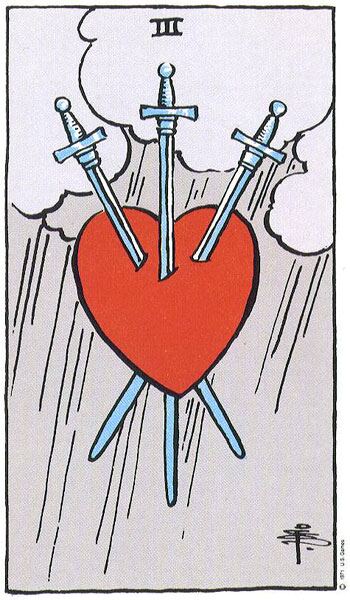
The Three of Swords tarot card meaning centres on painful clarity, grief, separation, and truths that cannot be softened by wishful thinking. It can mark a wound that needs care, not a fixed prediction of betrayal or loss.
I. Card Imagery (Visual and Symbolic)
The Three of Swords in the Rider-Waite system typically presents the following classic image:
- Central figure: A red heart pierced by three swords.
- Sword arrangement: Three swords pierce the heart in a triangular pattern, symbolizing layered wounds.
- Heart symbolism: The heart represents the emotional center, and its piercing symbolizes emotional injury.
- Background environment: Usually beneath a gray, gloomy sky, with rain falling, symbolizing sorrow and tears.
- Rain symbolism: The raindrops represent tears, hinting at inner pain and grief.
- Color symbolism: Red represents emotion and pain, gray represents sorrow and despair, and silver represents sharpness and injury.
This is the classic image of the Rider-Waite system, consistent across most modern tarot decks.
II. Energy & Element and Archetypes
1. Energy & Element (Elemental & Thematic)
- Element: Air — symbolizes thought, reason, communication, and injury.
- Number: The 3rd card of the suit, symbolizing wounding, pain, separation, and sorrow.
- Energy type: Emotional injury, psychological pain, the breaking of relationships, the healing of grief.
2. Archetypes (Archetypal Origins)
- The Wounded archetype: One who has suffered emotional injury and inner pain.
- The Betrayer archetype: May suggest an act of betrayal or one who has been betrayed.
- The Healer archetype: One who needs time and space for emotional healing.
- The Separator archetype: One who is undergoing relational separation or emotional rupture.
Points of uncertainty:
Does the injury of the Three of Swords always come from the outside? Uncertain—sometimes the wound may come from the self or from inner conflict.
What is the specific symbolic meaning of the three swords? Uncertain—they may represent a triple wound, or the depth of the wound.
III. Upright Meaning in Detail
Core Meaning:
"Emotional injury and psychological pain—the deep pain of going through the breakdown of a relationship, betrayal, or separation."
Inner Interpretation:
- Emotional injury: Experiencing profound emotional wounding, with inner pain.
- Relationship breakdown: An important relationship breaks or ends, bringing sorrow.
- Experience of betrayal: Possibly experiencing betrayal or deception, with trust destroyed.
- Pain of separation: Forced separation or parting, bringing emotional emptiness.
- Psychological pain: Mental disturbance and suffering, hard to release.
- Process of grief: In the midst of grief and mourning, needing time to heal.
- Truth revealed: A painful truth is uncovered, and reality must be faced.
Upright in Common Questions:
| Scenario | Interpretation |
|---|---|
| Relationship breakdown | The pain of going through a breakup, divorce, or the end of a relationship. |
| Betrayal by a friend | Betrayed by a friend; trust is broken. |
| Family conflict | Serious conflict in family relationships, causing emotional harm. |
| Career setback | Failure or setback at work brings psychological pain. |
| Health issues | Psychological stress and pain caused by health problems. |
IV. Reversed Meaning in Detail
Core Meaning:
"Pain easing or wounding deepening—either healing begins, or one refuses to face it."
Inner Interpretation:
- Pain easing: Emotional pain begins to lessen, entering the stage of healing.
- Refusal to face: Refusing to acknowledge or face the pain, evading reality.
- Wounds deepening: If one refuses to face it, the pain may deepen or prolong.
- Healing begins: Actively seeking healing, beginning to process emotional wounds.
- Possibility of forgiveness: The possibility of forgiving oneself or others emerges.
- Re-evaluation: Re-evaluating the meaning of the wound, seeking opportunities for growth.
- Time heals: Time begins to take effect, and the pain naturally diminishes.
Reversed in Common Questions:
| Scenario | Interpretation |
|---|---|
| Healing process | Emotional wounds begin to heal, and pain gradually lessens. |
| Evading reality | Refusing to face the pain may bring greater problems. |
| Attempt at forgiveness | Trying to forgive the one who caused harm, seeking inner peace. |
| A new beginning | Learning from the pain and preparing to start life anew. |
| Professional help | Seeking psychological counseling or professional help to process trauma. |
V. Deeper Philosophical and Psychological Significance
1. The Dialectic of Pain and Growth
- The Three of Swords reveals that pain is a necessary condition for growth, but excessive pain may hinder it.
- This resonates deeply with the Buddhist "Four Noble Truths" and the Daoist idea that "fortune and misfortune rely upon each other."
- In modern psychology, this corresponds to the concepts of Post-Traumatic Growth and Emotional Healing.
2. The Layers and Meaning of Wounding
- The upright Three of Swords shows that true injury comes from the destruction of an important relationship.
- When reversed, it indicates either a lessening of the wound or a deepening of it (when one refuses to face it).
- True healing requires facing, accepting, and transforming pain.
Points of uncertainty:
Is the pain of the Three of Swords always necessary? Uncertain—some pain may be unnecessary self-torment.
The duration of healing? Uncertain—healing time varies from person to person, with no fixed standard.
VI. Interaction with Other Cards (Tarot Combination Reference)
| Combination | Meaning |
|---|---|
| Upright Three of Swords + Upright The Tower | Sudden major harm; a relationship is thoroughly broken. |
| Upright Three of Swords + Reversed The Moon | Hidden injuries are revealed and the truth must be faced. |
| Reversed Three of Swords + Upright The Star | After pain, hope appears and a new life begins. |
| Upright Three of Swords + Upright Death | The complete end of a relationship, requiring total release. |
| Reversed Three of Swords + Upright Judgement | Awakening from pain, re-evaluating life. |
VII. Summary Comparison Table
| Dimension | Upright | Reversed |
|---|---|---|
| Core energy | Emotional injury, psychological pain | Pain easing, healing begins |
| Emotional tone | Pain, sorrow, despair | Relief, hope, calm |
| Suggested action | Face the pain, seek support | Continue healing, start anew |
| Interpersonal relationships | Broken relationships, crisis of trust | Possibility of repair, reconnection |
| Relationship with self | Inner pain, self-doubt | Self-acceptance, renewed growth |
| Keywords | Wound, pain, breakdown, sorrow | Healing, forgiveness, growth, hope |
VIII. Uncertainties Explicitly Noted
The necessity of injury:
→ Uncertain. Does all harm lead to growth? Some wounds may carry only negative meaning.The timing of forgiveness:
→ Uncertain. When should one forgive? Premature forgiveness may hinder true healing.The expression of pain:
→ Uncertain. How does one express pain in a healthy way? Both over-expression and repression can be problematic.The standard for healing:
→ Uncertain. How does one judge whether healing is complete? There is no unified standard.
IX. Practical Advice and Action Guide
Action advice when the Three of Swords is upright:
- Acknowledge the pain: First acknowledge that you are going through pain.
- Seek support: Do not bear it alone; seek the support of friends or professionals.
- Allow grief: Allow yourself to feel and express sorrow; do not repress it.
- Temporarily withdraw: If needed, step away temporarily from the environment causing the pain.
- Professional help: Consider seeking psychological counseling or therapy.
Action advice when the Three of Swords is reversed:
- Continue healing: Even as the pain lessens, continue the healing process.
- Re-evaluate: Learn from the wound and re-evaluate life's values.
- Establish boundaries: Learn to set healthy emotional boundaries.
- Rebuild trust slowly: Maintain appropriate caution when trusting others.
- Find meaning: Seek the meaning of growth within the pain.
X. The Three of Swords in Different Cultural Readings
1. Western Psychological Perspective
- Trauma theory: Corresponds to post-traumatic stress disorder (PTSD) and trauma healing.
- Attachment theory: The impact of relationship breakdown on attachment patterns.
- Grief theory: Elisabeth Kübler-Ross's five stages of grief.
2. Eastern Philosophical Perspective
- Buddhist view: Suffering is an opportunity for awakening; through pain one recognizes impermanence.
- Daoist wisdom: "Misfortune is what fortune rests upon"—within pain lies a turning point.
- Confucian thought: Through suffering one cultivates resilience and empathy.
3. Modern Healing Methods
- Mindfulness therapy: Accepting pain through mindfulness, reducing resistance.
- Expressive arts: Expressing unspeakable pain through art.
- Group support: Sharing experiences in support groups to gain understanding.
XI. The Positive Reading of the Three of Swords
Although the Three of Swords primarily represents pain, it also carries positive meanings:
- Emotional depth: Pain allows us to experience the depth and authenticity of emotion.
- Self-awareness: Through pain we come to know ourselves and others more profoundly.
- Relational purification: Pain may purify unhealthy relationship patterns.
- Catalyst for growth: Pain is an important catalyst for personal growth and spiritual maturation.
- Cultivation of empathy: Having endured pain, one can better understand the suffering of others.
Important reminder:
These positive meanings do not negate the reality of the pain, but rather seek meaning on the basis of acknowledging it.
Conclusion
The Three of Swords teaches us that pain is an unavoidable part of life, but how we face it determines our path of growth. When upright, it is a symbol of emotional injury and psychological pain; when reversed, it is a signal that pain is easing and healing has begun.
In any context, the Three of Swords says:
"Pain lets us feel the truth of life; healing lets us experience the power of the spirit. True courage is not the absence of pain, but the preservation of hope within it."
This is the most profound revelation of the Three of Swords: pain deepens us, healing strengthens us, and growth emerges from every brave confrontation.
Waite's 1910 Pictorial Key Entry
Historical source note: The following records A. E. Waite's card-specific divinatory vocabulary from the supplied 1910 edition. It belongs to one early-twentieth-century method, not a universal meaning system or a guarantee. Historical references to illness, marriage, loss, or other high-stakes outcomes are not diagnoses, professional advice, or certain predictions.
- Upright (Waite): Removal, absence, delay, division, rupture, dispersion, and all that the design signifies naturally, being too simple and obvious to call for specific enumeration.
- Reversed (Waite): Mental alienation, error, loss, distraction, disorder, confusion.
Source: A. E. Waite, The Pictorial Key to the Tarot (1910), Part III, § 2.