Two of Pentacles
Two of Pentacles — Upright & Reversed in Detail
I. Card Characteristics (Visual & Symbolic)
The Two of Pentacles carries the meaning of dynamic balance and the circulation of resources. This card expresses the Earth element (matter, resources, reality, the body, security) at the level of the number 2 (balance, choice, adaptation, partnership, rhythm). Its core theme is managing resources amid change, maintaining flexibility and adaptability.
Keywords: Balancing resources, flexible response, multitasking, adapting to change, financial flow, weighing options, sense of rhythm
Card Imagery (Rider-Waite-Smith system):
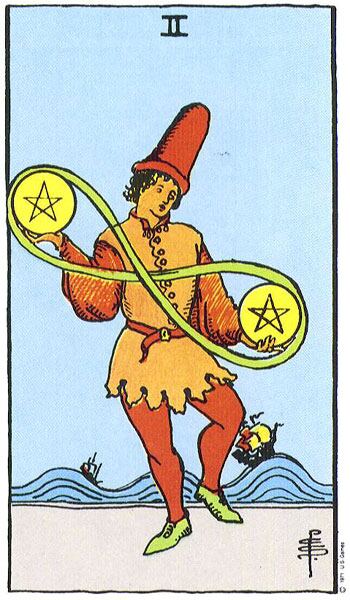
- The juggler / performer: At the center of the image is a young person (usually dressed in colorful, jester- or entertainer-like attire) who is lightly yet attentively using both hands (sometimes with a ribbon) to simultaneously toss and catch two large pentacles. The pentacles trace a ∞ (infinity symbol) loop. This symbolizes maintaining balance in motion, the continuous circulation of resources, and mastery.
- Posture and expression: The body usually sways slightly, one foot raised (or standing on a wave), conveying a dynamic balance and a sense of lightness. The expression is typically focused, confident, even slightly joyful, showing command of—and delight in—the current challenge.
- Waves and ships: The background is usually a turbulent sea with tossing boats. This embodies the water element (in contrast/interaction with the Earth element), symbolizing the fluctuations, changes, uncertainty, and emotional ups and downs of the external environment. The figure appears to stand on the waves or the shore, demonstrating the need to maintain balance amid environmental change.
- Hat and clothing: The juggler often wears a hat (sometimes a boat-shaped hat), and the clothing may bear wave or flow patterns, reinforcing the connection to the changing environment (water) and a fluid character.
- The infinity symbol (∞): Formed naturally by the trajectory of the two pentacles, representing the circulation of energy, the interdependence of things, dynamic balance, and the eternal flow and change.
Energy & Element:
- Earth element (dominant): The foundation of the Pentacles suit, representing material resources, money, work, the body, realistic foundations, and stability.
- Water element (background): The ocean and ships in the background introduce water-element energy, representing emotion, change, fluidity, adaptability, and latent risk or opportunity. This card is a vivid expression of Earth-element (material) energy needing to remain fluid and balanced within a Water-element (changeable) environment.
Origins & Archetypes:
- The "Juggler / Entertainer" archetype: Mastering the art of multitasking, maintaining dynamic balance, and performing amid change. It symbolizes skill, flexibility, and an entertainer's spirit.
- The "Helmsman / Sailor" archetype: Steering through the storms of life, adapting to change, and holding the course (even when the destination may be temporarily unclear).
- The "Balancer" archetype: Finding the point of harmony between conflicting demands, responsibilities, or resources.
- The "Flow" archetype: Understanding and following the natural circulation of energy and resources (like the ∞ symbol), without clinging to rigidity.
Upright Meaning (Core: Flexible management amid change, maintaining dynamic balance):
- Resource management and balance: Effectively managing finances, time, energy, and other resources—especially balancing income and expenditure, multiple projects, and different responsibilities. Money is flowing (in and out), but overall it remains controllable.
- Flexibility and adaptability: Facing environmental changes, challenges, or uncertainty, one can quickly adjust strategy and posture, maintaining flexibility and adaptability. Flowing around obstacles like water.
- Multitasking and rhythm: Handling multiple tasks, projects, or responsibilities simultaneously while sustaining efficiency and rhythm. Knowing how to find the balance point within busyness, alternating labor with rest.
- Weighing options and opportunities: Possibly facing two or more opportunities or choices (especially in the material domain), needing to weigh pros and cons, staying open and flexible, and not rushing a final decision. Letting the options flow and seeing how they develop.
- Financial flow and liquidity: The financial situation may fluctuate (such as unstable income or temporary expenses), but it can be sustained through flexible management. It emphasizes the importance of cash flow and the turnover of funds.
- Adjusting life's rhythm: Life is in a busy or changing phase, requiring one to find a suitable rhythm and avoid being over-tight or too slack.
- Optimism and a sense of mastery: Despite challenges, maintaining a positive attitude and confidence in one's abilities, believing oneself capable of meeting change and maintaining balance.
- "Playing with life": Adopting a light, even playful attitude toward life's challenges, not taking things too seriously.
Upright in Common Questions:
- Career / Work: Handling multiple projects or tasks simultaneously; work content is variable and requires constant adjustment; a freelancer managing unstable income; balancing a main job with a side venture; adapting to corporate restructuring or market shifts; needing flexible scheduling and prioritization; work involving coordination or resource allocation.
- Wealth: Managing cash flow (such as payables and receivables); balancing a budget; income coming in alongside necessary expenses; possibly needing short-term borrowing for turnover; a portfolio needing rebalancing; income sources possibly more than one (requiring coordination).
- Love / Relationships: The relationship requires balancing time, energy, and attention (such as work and romance); possibly in a long-distance relationship (requiring flexible maintenance); the relationship itself is vital yet also needs to cope with change (such as life-stage shifts); not having made a final choice among multiple suitors (taking it lightly).
- Health: The body is healthy, but pay attention to balance: work and rest, diet, exercise volume. Adapting to the body's changes (such as seasonal transitions). Managing stress and avoiding neglecting health signals due to busyness.
- General questions (advice / state): Staying flexible and adapting to change is key! Focus on maintaining present-moment balance and fluidity rather than pursuing absolute stability. Prioritize managing your resources well (time, money, energy). Practice multitasking but don't overload. Weigh your options, but there's no need to rush a decision. Find your rhythm and enjoy this "dance of balance." Trust that your abilities can meet the fluctuations before you.
Reversed Meaning (Core: Imbalance, loss of control, rigidity, or evasion):
- Imbalance and loss of control: Unable to effectively manage resources (money, time, energy), leading to being stretched thin, living beyond one's means, or exhaustion. Feeling overwhelmed by responsibilities or tasks, losing the sense of control.
- Lack of adaptability / rigidity: When facing change, reacting slowly, stubbornly holding one's ground, refusing to adjust—leading to bigger problems or missed opportunities. Unable to respond flexibly to challenges.
- Multitasking collapse / distraction: Trying to handle too many things at once, leading to low efficiency, frequent errors, and surging stress. Severely distracted, unable to focus.
- Financial difficulty / poor decisions: Finances may be in chaos, turnover failing, or debt issues. Hesitation in financial decisions leads to missed opportunities, or erroneous judgments (such as over-borrowing or improper investing) are made.
- Evading responsibility / difficulty choosing: Out of fear of imbalance or inability to cope, evading responsibility or refusing to make necessary choices. Indecision compounds the problem.
- Disrupted rhythm / excessive pressure: Life's rhythm is completely thrown off—either over-busy to the point of breakdown, or procrastinating and evading to the point of stagnation. Immense pressure, losing the sense of lightness.
- "Can't play it anymore": Losing the upright's game-like sense of mastery and optimism; feeling heavy, anxious, overwhelmed.
- External fluctuations intensify: Changes in the external environment (the waves in the card) become more violent or unpredictable, and one's own coping ability is insufficient—adding insult to injury.
Reversed in Common Questions:
- Career / Work: Severely overworked; projects out of control or delayed; eliminated for failing to adapt to work changes; mired in errors amid multitasking; serious work-life imbalance leading to burnout; unemployment or unstable income that is difficult to manage.
- Wealth: Financial crisis (living beyond means, burdened by debt); broken cash flow; severe investment losses; missing important financial opportunities due to hesitation; impulsive spending worsening the predicament; being chased by bills.
- Love / Relationships: The relationship is strained by uneven allocation of time or energy (such as overworking and neglecting a partner); unable to handle changes in the relationship (such as distance or major disagreements); wavering among multiple partners and causing problems; the relationship itself full of instability and hard to sustain.
- Health: Health problems arising from stress, overwork, or irregular living (such as insomnia, weakened immunity, digestive issues). Ignoring health warnings. The body sending signals of imbalance.
- General questions (warning / need for adjustment): Warning! Your balancing system is malfunctioning! Check whether: the burden is too heavy? Resource management is chaotic? You're refusing to adapt to change? You're indecisive? Finances are out of control? Life's rhythm is a mess? You're crushed by stress? Action advice: You must prioritize restoring balance! Simplify! Reduce tasks or responsibilities. Make a clear financial plan and set priorities. Learn to say no. Seek help or delegate. Practice time-management skills. Make necessary choices rather than evading them. Focus on the one or two most critical things. Rest and recovery are essential. Build more stable structures and habits.
Points of Ambiguity & Differing Views:
- The symbolism of the "ships": The tossing boats in the background are usually read as the fluctuation and risk of the external environment. Some hold that the ships may also symbolize "opportunity" (sailing brings opportunity), especially when upright. But the mainstream interpretation emphasizes their representation of external challenges and uncertainty. (Point of ambiguity: the micro-symbolism of the ships.)
- The juggler's sense of delight: Upright, the juggler is often depicted as light and joyful. When reversed, the disappearance of this delight is consensus, but whether it represents "anguish" varies by card (some reversed designs look anxious, others still focused but strained). Interpretation should focus on the overall energy being "out of control" and "heavy" rather than the specific expression. (Differing views: visual presentation across different decks.)
- The specificity of "two choices": The Two of Pentacles is often read as weighing between two (or more) options. It should be emphasized that this "two" more often refers to "two things" or "two aspects of resources" that need to be managed or balanced simultaneously (such as work and life, income and expenditure), rather than a single either/or question. Only when reversed does it indicate difficulty choosing or evading choice. (Clarification of a common misunderstanding.)
- Distinction from the "Justice" card: The Justice card (VIII) concerns rational decision-making, cause and effect, contracts, and absolute balance (a static, rule-based balance). The Two of Pentacles concerns dynamic adjustment, the circulation of resources, and adaptive balance (a real-time balance amid change)—more grounded and pragmatic. (Important distinction.)
Summary:
The Two of Pentacles is a card about "the dance of maintaining material balance amid change." Upright, it depicts a skilled "juggler of life," lightly tossing responsibilities and resources (pentacles) amid the waves (water) of reality (Earth), displaying extraordinary adaptability, management ability, and an optimistic sense of rhythm. It encourages us to embrace change, adjust flexibly, let resources flow healthily, and find the joy of balance within busyness. Reversed, this dance becomes stumbling or even a fall, warning of lost management, maladaptation, overload, or evasive choices. It asks us to confront the imbalance, simplify life, rebuild order, learn pragmatic management skills, and summon the courage to make necessary adjustments.
The key to understanding the Two of Pentacles lies in feeling the interaction between the Earth element (material foundation) and the Water element (change and flow), as well as the dynamic-balance essence of the number 2. When you draw this card, ask yourself: Is my current life or resources in fluid balance, or rigid and out of control? Can I respond flexibly to change? Am I effectively managing my time, money, and energy? What do I need to prioritize simplifying? Am I evading necessary choices? How can I recover (or maintain) a sense of rhythm and mastery in life?
IX. Conclusion
The Two of Pentacles teaches us that true balance is not static perfection but dynamic harmony amid change. It reminds us that life itself is a dance requiring constant adjustment, and that true wisdom lies in learning to remain steady within flow and to find rhythm within change. Whether facing the ups and downs of finances, the multitasking challenges of work, or the balancing needs of relationships, the Two of Pentacles encourages us to respond with a flexible mind and a pragmatic attitude.
Remember: Balance is not a destination but a process; not a state but a capacity.
Waite's 1910 Pictorial Key Entry
Historical source note: The following records A. E. Waite's card-specific divinatory vocabulary from the supplied 1910 edition. It belongs to one early-twentieth-century method, not a universal meaning system or a guarantee. Historical references to illness, marriage, loss, or other high-stakes outcomes are not diagnoses, professional advice, or certain predictions.
- Upright (Waite): On the one hand it is represented as a card of gaiety, recreation and its connexions, which is the subject of the design; but it is read also as news and messages in writing, as obstacles, agitation, trouble, embroilment.
- Reversed (Waite): Enforced gaiety, simulated enjoyment, literal sense, handwriting, composition, letters of exchange.
Source: A. E. Waite, The Pictorial Key to the Tarot (1910), Part III, § 2.