Two of Swords — Upright and Reversed in Detail
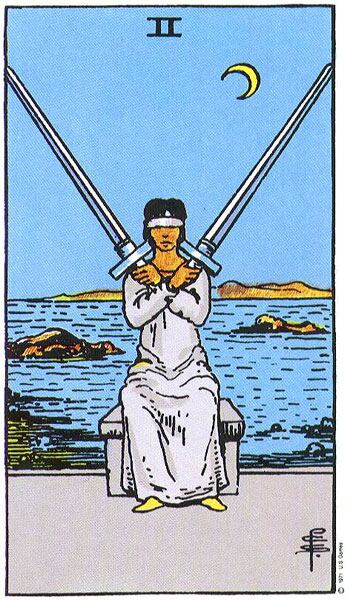
The Two of Swords tarot card meaning centres on hesitation, guarded balance, and a decision waiting for more honest information. It can protect a necessary pause, but it also asks what the blindfold is preventing you from acknowledging.
I. Card Imagery (Visual and Symbolic)
The Two of Swords in the Rider-Waite system typically presents the following classic image:
- Central figure: A woman sits on a stone bench, her eyes blindfolded with a cloth.
- Holding the swords: She holds a sword in each hand, crossed over her chest, forming a defensive posture.
- The blindfold: A white cloth covers her eyes, symbolizing a refusal to see the truth or an evasion of reality.
- Body posture: Rigid body, closed posture, revealing inner defensiveness and resistance.
- Background environment: She usually sits by the sea or water, with the moon hanging high, symbolizing emotional fluctuation and the subconscious.
- Water state: The water's surface is calm but with undercurrents, symbolizing the inner conflict beneath a tranquil surface.
- Color symbolism: Gray represents stalemate, blue represents emotion, white represents evasion, and silver represents moonlight.
This is the classic image of the Rider-Waite system, consistent across most modern tarot decks.
II. Energy & Element and Archetypes
1. Energy & Element (Elemental & Thematic)
- Element: Air — symbolizes thought, reason, decision-making, and communication.
- Number: The 2nd card of the suit, symbolizing choice, balance, opposition, and stalemate.
- Energy type: Mental conflict, decision-making difficulty, information blockage, self-deception.
2. Archetypes (Archetypal Origins)
- The Evader archetype: The one who refuses to face reality and chooses to blindfold themselves.
- The Stalemate-Maker archetype: The one caught in a deadlock in decision-making, unable to move forward.
- The Inner-Conflict archetype: The one whose heart is filled with contradiction, finding it hard to make a choice.
- The Information-Blocker archetype: The one who actively blocks information and refuses to accept the truth.
Points of uncertainty:
Is the blindfold of the Two of Swords an active choice or a forced one? Uncertain—it may be a self-protective mechanism, or it may be an evasion of responsibility.
What is the specific symbolic meaning of the crossed swords? Uncertain—they may form a defensive posture, or they may represent the opposition of ideas.
III. Upright Meaning in Detail
Core Meaning:
"Mental stalemate and decision-making difficulty—hovering between two choices, refusing to see the truth."
Inner Interpretation:
- Decision-making difficulty: Facing two seemingly equal choices, finding it hard to decide.
- Information blockage: Lacking sufficient information or refusing to accept relevant information.
- Mental conflict: Two opposing thoughts struggle fiercely within.
- Evading reality: Choosing to blindfold oneself, unwilling to face difficult truths.
- Stalemate: Caught in a stagnant state, unable to move forward or backward.
- Self-protection: Using a defensive posture to shield oneself from harm.
- Need for calm: It is advisable to pause temporarily and think calmly before making a decision.
Upright in Common Questions:
| Scenario | Interpretation |
|---|---|
| Decision dilemma | Hesitating between two choices; more time to think is needed. |
| Relationship stalemate | Unresolved issues in the relationship that neither side is willing to face. |
| Career choice | Facing difficulty in career choice; more information and analysis are needed. |
| Inner conflict | A clash of inner values or beliefs that calls for self-reflection. |
| Insufficient information | Lacking key information to make an informed decision. |
IV. Reversed Meaning in Detail
Core Meaning:
"The stalemate is broken—either see the truth clearly, or be forced to make a choice."
Inner Interpretation:
- Truth revealed: Forced to face reality, unable to continue evading.
- Forced decision: External pressure compels a choice.
- Information flooding in: New information emerges, altering prior understanding.
- Defense collapses: Self-protective mechanisms fail, and reality must be confronted.
- Conflict erupts: Inner contradictions become public and require immediate resolution.
- Forced action: Time is pressing; a decision must be made at once.
- Bearing consequences: Whatever the choice, the corresponding consequences must be borne.
Reversed in Common Questions:
| Scenario | Interpretation |
|---|---|
| Truth comes to light | A hidden truth is uncovered and can no longer be evaded. |
| Forced decision | External circumstances compel an immediate choice. |
| Relationship crisis | Accumulated problems in the relationship erupt and need immediate resolution. |
| Work pressure | Pressing situations at work demand immediate action. |
| Self-awakening | Suddenly realizing one's evasive behavior and resolving to change. |
V. Deeper Philosophical and Psychological Significance
1. The Dialectic of Evasion and Confrontation
- The Two of Swords reveals that evasion is only a temporary solution; the truth will eventually come to light.
- This resonates deeply with the Buddhist idea of "impermanence" and the Daoist principle of "following the way of nature."
- In modern psychology, this corresponds to the concepts of Cognitive Dissonance and Defense Mechanisms.
2. The Nature of Decision-Making Difficulty
- The upright Two of Swords shows that the real difficulty lies not in the choice itself, but in the courage to face the choice.
- When reversed, either courage is awakened, or external pressure forces confrontation.
- True decision-making requires courage, information, and self-awareness.
Points of uncertainty:
Is the stalemate of the Two of Swords always negative? Uncertain—sometimes a stalemate is a necessary period of reflection.
Is the blindfold always wrong? Uncertain—in some cases, temporary evasion may serve as self-protection.
VI. Interaction with Other Cards (Tarot Combination Reference)
| Combination | Meaning |
|---|---|
| Upright Two of Swords + Upright The Hermit | A need for solitude and reflection, temporarily stepping away from decision pressure. |
| Upright Two of Swords + Reversed Justice | Lacking fair information; a just decision is difficult to make. |
| Reversed Two of Swords + Upright The Sun | The truth comes to light, bringing brightness and clear vision. |
| Upright Two of Swords + Upright The Tower | The stalemate is about to be broken by external force; major change is coming. |
| Reversed Two of Swords + Upright The Chariot | After being forced to decide, active movement begins. |
VII. Summary Comparison Table
| Dimension | Upright | Reversed |
|---|---|---|
| Core energy | Mental stalemate, decision-making difficulty | Stalemate broken, forced decision |
| Emotional tone | Confusion, hesitation, evasion | Tension, pressure, awakening |
| Suggested action | Think calmly, gather information | Face bravely, act immediately |
| Interpersonal relationships | Poor communication, avoidance of issues | Problems erupt, resolution needed |
| Relationship with self | Inner conflict, self-deception | Self-awakening, taking responsibility |
| Keywords | Stalemate, evasion, hesitation, defense | Truth, pressure, action, awakening |
VIII. Uncertainties Explicitly Noted
The necessity of the Two of Swords' stalemate:
→ Uncertain. Sometimes a stalemate is a necessary period of reflection, and overly hasty decisions may bring greater problems.The reasonableness of the blindfold behavior:
→ Uncertain. In certain trauma situations, temporary evasion may serve as psychological self-protection.The legitimacy of external intervention:
→ Uncertain. Should one actively break another person's stalemate, or allow it to develop naturally?Grasping the timing of decision:
→ Uncertain. How to judge when one should wait, and when one must decide immediately?
IX. Practical Advice and Action Guide
Action advice when the Two of Swords is upright:
- Acknowledge the stalemate: First acknowledge that you are in a state of decision-making difficulty.
- Gather information: Actively seek missing information and consult professionals.
- Set a time limit: Give yourself a reasonable period for reflection to avoid indefinite delay.
- Manage emotions: Manage anxiety through meditation, exercise, and similar methods.
- Take small steps: If possible, first undertake a small-scale trial or test.
Action advice when the Two of Swords is reversed:
- Face it bravely: Accept reality, no matter how difficult.
- Act immediately: Delay will only make things worse; begin acting at once.
- Seek support: Do not bear it alone; seek help from friends or professionals.
- Take responsibility: Whatever the outcome, take responsibility for your choice.
- Learn and grow: Treat this experience as an opportunity for growth.
Conclusion
The Two of Swords teaches us that true courage is not the absence of fear, but moving forward in spite of it. When upright, it is a symbol of decision-making difficulty and mental stalemate; when reversed, it is a signal to be forced to face the truth and make a choice.
In any context, the Two of Swords says:
"Evasion can only protect us temporarily, but the truth will eventually emerge; the stalemate may seem safe, but true growth comes from courageous decisions."
This is the most profound revelation of the Two of Swords: facing requires courage, evading exacts a price, and growth emerges from every courageous choice.
Waite's 1910 Pictorial Key Entry
Historical source note: The following records A. E. Waite's card-specific divinatory vocabulary from the supplied 1910 edition. It belongs to one early-twentieth-century method, not a universal meaning system or a guarantee. Historical references to illness, marriage, loss, or other high-stakes outcomes are not diagnoses, professional advice, or certain predictions.
- Upright (Waite): Conformity and the equipoise which it suggests, courage, friendship, concord in a state of arms; another reading gives tenderness, affection, intimacy. The suggestion of harmony and other favourable readings must be considered in a qualified manner, as Swords generally are not symbolical of beneficent forces in human affairs.
- Reversed (Waite): Imposture, falsehood, duplicity, disloyalty.
Source: A. E. Waite, The Pictorial Key to the Tarot (1910), Part III, § 2.