Two of Wands
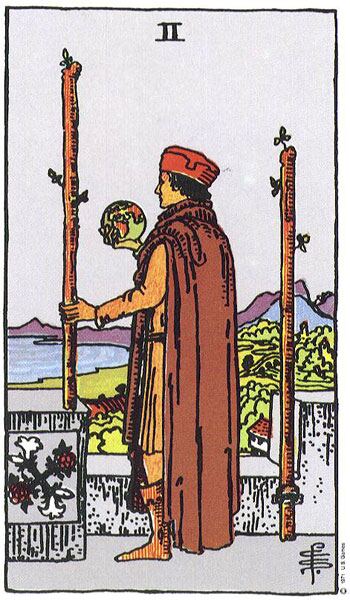
The Two of Wands tarot card meaning centres on planning, choice, and the tension between a secure base and a larger horizon. It can invite ambition, but asks for a concrete route rather than a vision without a next step.
I. Card Features (Visual & Symbolic)
In the Rider-Waite tarot system, the Two of Wands typically presents the following classic image:
- Core Image: A man stands on the balcony of a castle, holding a globe.
- Wand Arrangement: Two wands are fixed to the balcony railing—one in his hand and one on the railing.
- Gazing Afar: The figure gazes at distant mountains and sea, symbolizing planning for the future and exploration.
- Globe Symbolism: Holding the globe symbolizes global vision and lofty ambition.
- Castle Setting: Standing within the safety of the castle, yet with eyes turned toward the unknown outer world.
- Mountains and Sea: In the distance lie rolling mountains and a vast sea, symbolizing challenge and opportunity.
- Color Symbolism: Red represents action, yellow wisdom, blue foresight, and green growth.
This is the classic image of the Rider-Waite system and remains consistent across most modern tarot decks.
II. Energy, Element & Archetypes
1. Energy & Element
- Element: Fire — symbolizing action, passion, creativity, and willpower.
- Number: The 2nd card, symbolizing choice, balance, planning, and foresight.
- Energy Type: Strategic planning, lofty ambition, decision readiness, future orientation.
2. Archetypes (Archetypal Origins)
- The Strategist: One skilled at planning for the future, possessing vision.
- The Explorer: One who yearns to explore the unknown and pursue greater achievement.
- The Decision Maker: One who weighs safety against risk and prepares to make a major decision.
- The Visionary: One who can see future possibilities and plan for them.
Open Questions:
Is the figure in the Two of Wands always male? Disputed—modern readings may use any gender.
What exactly does the globe symbolize? Disputed—it may represent global vision, or a desire to master the world.
III. Detailed Upright Meaning
Core Meaning:
"Strategic planning and lofty ambition—weighing safety against risk, preparing to step into a larger world."
Inner Interpretation:
- Strategic Planning: Currently formulating long-term plans, considering various possibilities.
- Lofty Ambition: Possessing grand goals and vision, discontent with the status quo.
- Decision Readiness: Weighing safety against risk, preparing to make a significant decision.
- Global Vision: Possessing broad perspective and foresight, able to see the larger picture.
- Resource Assessment: Currently evaluating existing resources and capabilities, preparing for the next move.
- Patient Waiting: Though eager to act, wisely waiting for the optimal moment.
- Leadership Potential: Displaying leadership ability and strategic thinking.
Common Question Scenarios (Upright):
| Scenario | Interpretation |
|---|---|
| Career Development | Planning career advancement or entrepreneurship, considering greater opportunities for growth. |
| Project Planning | Formulating project strategy, considering long-term development and resource allocation. |
| Life Decisions | Facing major life choices, weighing safety against risk. |
| Study Planning | Mapping out a learning path, considering future career directions. |
| Investment Decisions | Evaluating investment opportunities, formulating long-term investment strategy. |
IV. Detailed Reversed Meaning
Core Meaning:
"Planning obstructed or vision narrowed—either overly cautious, or recklessly adventuring."
Inner Interpretation:
- Planning Obstructed: Strategic plans meet obstacles and cannot be implemented as intended.
- Narrow Vision: Lacking foresight, seeing only immediate gains or difficulties.
- Decision Difficulty: Over-deliberating between safety and risk, unable to decide.
- Resource Misjudgment: Misjudging one's own capacity or external conditions.
- Poor Timing: Choosing the wrong moment to act, too early or too late.
- Overambition: Unrealistic goals, lacking feasibility analysis.
- Leadership Failure: Errors in strategic decision-making, leading to wasted resources or lost opportunities.
Common Question Scenarios (Reversed):
| Scenario | Interpretation |
|---|---|
| Career Stagnation | Career planning obstructed, lacking a clear direction for development. |
| Project Failure | Project plans unrealistic, meeting significant obstacles. |
| Decision Errors | Making wrong strategic decisions, leading to loss. |
| Limited Vision | Lacking foresight, missing important opportunities for growth. |
| Wasted Resources | Misallocating resources, leading to inefficiency. |
V. Deeper Philosophy & Psychological Significance
1. The Dialectic of Planning and Action
- The Two of Wands emphasizes that planning is the prerequisite for action, but excessive planning may lead to paralysis.
- This resonates deeply with the Confucian idea that "success depends on previous preparation, and without such previous preparation there is sure to be failure," and the military strategist's principle of "move only after careful deliberation."
- In modern management, this corresponds to Strategic Planning and Opportunity Cost.
2. The Balance of Safety and Risk
- Upright, the Two of Wands shows that wise risk-taking requires thorough preparation and planning.
- Reversed, it indicates either excessive conservatism (afraid to take risks) or reckless adventuring (lacking planning).
- True success comes from moderate risk-taking built upon a secure foundation.
Open Questions:
Is planning in the Two of Wands always necessary? Disputed—sometimes intuitive action can bring unexpected success.
Where is the balance point between safety and risk? Disputed—this varies by individual, depending on risk tolerance.
VI. Interaction with Other Cards (Tarot Combination Reference)
| Combination | Meaning |
|---|---|
| Two of Wands (Upright) + The Emperor (Upright) | Powerful leadership and strategic planning ability. |
| Two of Wands (Upright) + The Star (Upright) | Hopeful future planning, clear vision. |
| Two of Wands (Reversed) + The Tower (Upright) | Planning failure leading to major upheaval, requiring a fresh start. |
| Two of Wands (Upright) + The Chariot (Reversed) | Having a plan, but lacking the momentum to act. |
| Two of Wands (Reversed) + The Fool (Upright) | Abandoning excessive planning, choosing to follow intuition. |
VII. Summary Comparison Table
| Dimension | Upright | Reversed |
|---|---|---|
| Core Energy | Strategic planning, lofty ambition | Obstructed planning, narrow vision |
| Emotional Tone | Expectation, confidence, caution | Anxiety, confusion, disappointment |
| Recommended Action | Continue planning, await timing | Reassess, adjust strategy |
| Career Development | Clear direction, steady progress | Confused direction, needs adjustment |
| Relationships | Leadership role, strategic cooperation | Poor communication, difficult cooperation |
| Keywords | Planning, foresight, weighing, readiness | Obstructed, narrow, misjudgment, error |
VIII. Clearly Stated Open Questions (Disputed)
The Balance of Planning and Intuition:
→ Disputed. Over-reliance on planning may suppress intuition and creativity.Grasping the Safety Margin:
→ Disputed. How does one determine how much risk is "moderate"?Standards for Judging Timing:
→ Disputed. How does one judge when to wait and when one must act?Accuracy of Resource Assessment:
→ Disputed. Self-assessment is often biased; how does one obtain an objective assessment?
IX. Practical Advice & Action Guide
Action Advice when the Two of Wands is Upright:
- Refine the Plan: Continue to refine the strategic plan, considering various possibilities.
- Gather Information: Actively collect relevant information to reduce uncertainty.
- Assess Risk: Objectively evaluate risk and reward, formulating response strategies.
- Cultivate Patience: Wait for the best moment, avoiding premature action.
- Seek Counsel: Consult professionals to gain perspectives from different angles.
Action Advice when the Two of Wands is Reversed:
- Reassess: Pause the current plan and re-evaluate goals and resources.
- Scale Down: If the goal is too large, consider implementing it in stages.
- Seek Help: Do not bear it alone; seek professional guidance or partnership.
- Adjust Strategy: Adapt strategy to actual circumstances, maintaining flexibility.
- Learn from Experience: Learn from failure, accumulating experience and wisdom.
X. Application of the Two of Wands in Different Fields
1. Career Development
- Upright: Planning a career advancement path, considering job changes or entrepreneurial opportunities.
- Reversed: Career planning in confusion; needs repositioning of direction.
2. Business & Investment
- Upright: Formulating long-term investment strategy, evaluating market opportunities.
- Reversed: Investment decisions in error; needs reassessment of risk.
3. Personal Growth
- Upright: Planning a personal development path, setting long-term goals.
- Reversed: Goals unrealistic; needs adjustment of expectations.
4. Relationship Development
- Upright: Planning the future of the relationship, considering long-term commitment.
- Reversed: Relationship planning meeting obstacles; needs renewed communication.
Conclusion
The Two of Wands teaches us that true success comes from wise planning and moderate risk-taking. Upright, it is a symbol of strategic planning and lofty ambition; reversed, it is a signal reminding us to reassess our plans and adjust our strategy.
In any situation, the Two of Wands says:
"Planning lets us see the direction; risk-taking lets us break through limitations; true wisdom lies in knowing when to plan cautiously and when to act bravely."
This is the most profound revelation of the Two of Wands: foresight lets us see what is possible, planning lets us realize what is possible, and courage lets us surpass what is possible.
Waite's 1910 Pictorial Key Entry
Historical source note: The following records A. E. Waite's card-specific divinatory vocabulary from the supplied 1910 edition. It belongs to one early-twentieth-century method, not a universal meaning system or a guarantee. Historical references to illness, marriage, loss, or other high-stakes outcomes are not diagnoses, professional advice, or certain predictions.
- Upright (Waite): Between the alternative readings there is no marriage possible; on the one hand, riches, fortune, magnificence; on the other, physical suffering, disease, chagrin, sadness, mortification. The design gives one suggestion; here is a lord overlooking his dominion and alternately contemplating a globe; it looks like the malady, the mortification, the sadness of Alexander amidst the grandeur of this world's wealth.
- Reversed (Waite): Surprise, wonder, enchantment, emotion, trouble, fear.
Source: A. E. Waite, The Pictorial Key to the Tarot (1910), Part III, § 2.